
The fastest way to split expenses with friends is to log each purchase in a group expense calculator or app the moment it happens, choosing equal, percentage, share, or exact-amount splits as you go. The tool nets everything into one clear balance per person and tells you the minimum number of payments needed to settle up. For a weekend trip, a free calculator does the job. For roommates or recurring costs, an app like Vala keeps the ledger and your budget in one place.
TL;DR:
- Equal splits are suitable only when all participants benefit equally and contribute similarly, but percentage or share-based splits may be fairer for differing contributions or usage.
- Using a settlement algorithm that nets and matches the biggest debtors against the biggest creditors reduces the number of payments from multiple transactions to just a few.
- For recurring costs, linking shared expenses directly to your budget with automation saves more time than manual calculations, especially when expenses change frequently.
- Recording all repayments, advances, and participation changes in real-time ensures transparency and prevents disputes in ongoing group expenses.
- Choose a flexible app or calculator supporting multiple split methods and export options based on whether the group’s expenses are one-time events or long-term shared costs.
Table of Contents
- How Do You Split Group Expenses Fairly?
- A Worked Example: Who Owes Whom?
- Which App or Calculator Should You Use?
- How Do You Actually Pay Each Other Back?
- What Rules Prevent Splitting Arguments?
- Why Trust This Approach to Group Splitting?
- What Happens When Friends Join or Leave Midway?
- How Do You Manage Recurring Shared Costs Long Term?
- How Should Friends Handle Loans and Advance Payments?
- When Should You DIY vs Use an App?
- Split Smarter, Budget Better With Vala
- Calculators and Guides Worth Bookmarking
- Sources
- FAQ
How Do You Split Group Expenses Fairly?
Fair doesn’t always mean equal. The right method depends on who benefited from the purchase and how evenly people are contributing.
- Equal split: Divide the total by the number of people. Simple, fast, and fine for meals or activities everyone shared the same way.
- Percentage split: Assign each person a fixed share of the total, useful when incomes or usage differ consistently, like a shared apartment where one room is bigger.
- Shares or weights: Give people relative “weights” (a couple counts as two shares, a solo traveler as one) so the math adjusts automatically without manual recalculating.
- Exact-item split: Assign specific line items to specific people, best when a receipt has mixed purchases and someone didn’t order the $40 bottle of wine.
Most group expense calculators support all four methods inside the same ledger, so you’re not locked into one rule for the whole trip. A dinner might get split equally while the hotel gets split by percentage. Pick the method that matches the expense, not the other way around.
A Worked Example: Who Owes Whom?
Picture four friends on a weekend trip: Maya, Josh, Priya, and Dan.
- Maya pays $400 for the hotel, split equally four ways ($100 each).
- Josh pays $120 for dinner, split equally four ways ($30 each).
- Priya pays $60 for a taxi, split three ways among everyone but Dan, who skipped that ride ($20 each).
Netting the numbers shows Maya is owed $300, Josh is owed $90, Priya is owed $40, and Dan owes $130 while also being owed nothing. A greedy settlement algorithm matches the biggest debtor against the biggest creditor first, which turns what looks like six separate transfers into just three: Dan pays Maya, Josh, and Priya directly. That’s the core trick behind every calculator’s “simplified settlement” feature.
Stat check: the record, net, then settle workflow is the sequence nearly every calculator and guide recommends, because verifying that net balances sum to zero catches entry errors before anyone pays the wrong amount.
Which App or Calculator Should You Use?
The right tool depends on how long the group will exist and how much you already track your money.
- No-signup web calculators work best for one-off events: a birthday dinner, a single road trip, a bachelor party. You enter names, expenses, and split types, then share a link. No account, no app download, no data left behind.
- Lightweight splitting apps fit recurring friend groups, like a monthly game night or a ski trip crew that reunites every winter. You keep history without re-entering everyone’s name each time.
- Full finance apps make sense for roommates and recurring bills, where shared costs need to connect to your actual budget instead of living in a separate silo.
Before you commit to any tool, check for a shareable link, CSV or PDF export, support for all four split types, the ability to record payments (not just calculate them), and clear privacy settings around who can see the ledger. Export and backup options matter more than people expect. A trip ledger you can’t download is a ledger you’ll lose access to the moment you stop paying for an app.
Pro Tip: If your group splits costs more than once a month, budget-linked tracking saves more time than a fresh calculator every time. Vala’s group split automation ties shared expenses to your actual spending picture instead of a disconnected spreadsheet.
How Do You Actually Pay Each Other Back?
Calculating balances is only half the job. Settling them cleanly is what prevents the “did you ever pay me back?” text three weeks later.
- Record every repayment, full or partial, directly in the ledger so balances update in real time instead of living in your memory.
- Choose a workflow that fits the group: one person collects everything and redistributes, or each debtor pays their matched creditor directly using the simplified settlement plan.
- Export a settlement summary as a CSV or PDF once everyone’s paid, and keep it alongside receipts in case a dispute comes up later.
- If a refund lands (a canceled reservation, a returned item), enter it as a negative expense rather than trying to do the math by hand.
Vala’s approach to settling shared costs treats every repayment as its own event, so the running balance always reflects reality, not what you think you remember.
What Rules Prevent Splitting Arguments?
Most disputes come from ambiguity, not dishonesty. Nobody’s mad about owing $23. They’re mad about not knowing why.
- Agree on the ground rules before the trip: does tip count, does the service fee get split, who’s excluded from the taxi.
- Enter expenses the same day, attach a photo of the receipt, and skip the “I’ll remember the total” trap entirely.
- Use specific names and categories in the ledger, and walk through it together before anyone sends money.
- Write down any unequal-split agreement directly in the app or spreadsheet, not in a group chat that gets buried in twenty messages.
Pro Tip: A transparent, shared ledger does more to prevent friction than any personality trait. Groups argue less when everyone can see the same numbers at the same time.
Why Trust This Approach to Group Splitting?
SaverStride covers shared-cost tools and everyday budgeting decisions, focusing on what actually reduces friction between friends and roommates rather than theoretical fairness debates. The guidance here reflects how calculators and apps in this category are actually built and used.
Vala fits naturally into that picture for readers managing ongoing shared costs. It handles group split automation, exports ledgers when you need a paper trail, and connects to your bank with privacy-first integration rather than asking you to re-enter transactions by hand. When shared expenses and your personal budget live in separate places, small leaks slip through. Combining them closes that gap.
What Happens When Friends Join or Leave Midway?
Uneven participation is the single biggest reason DIY spreadsheets fall apart. Someone flies in a day late. Someone leaves the group dinner early to catch a flight. A friend covers only two of five nights at the Airbnb.
The fix isn’t a new formula. It’s assigning participants per expense instead of per trip. A calculator that lets you toggle who’s “in” on each line item handles this automatically: the hotel might include all five people, but the late arrival’s flight-day dinner only includes four. Weighted shares work well here too. If someone stays for three nights out of a five-night rental, give them a weight of 3 against the group’s total of, say, 20 person-nights, and the software prorates the cost without anyone doing mental math at the kitchen table.
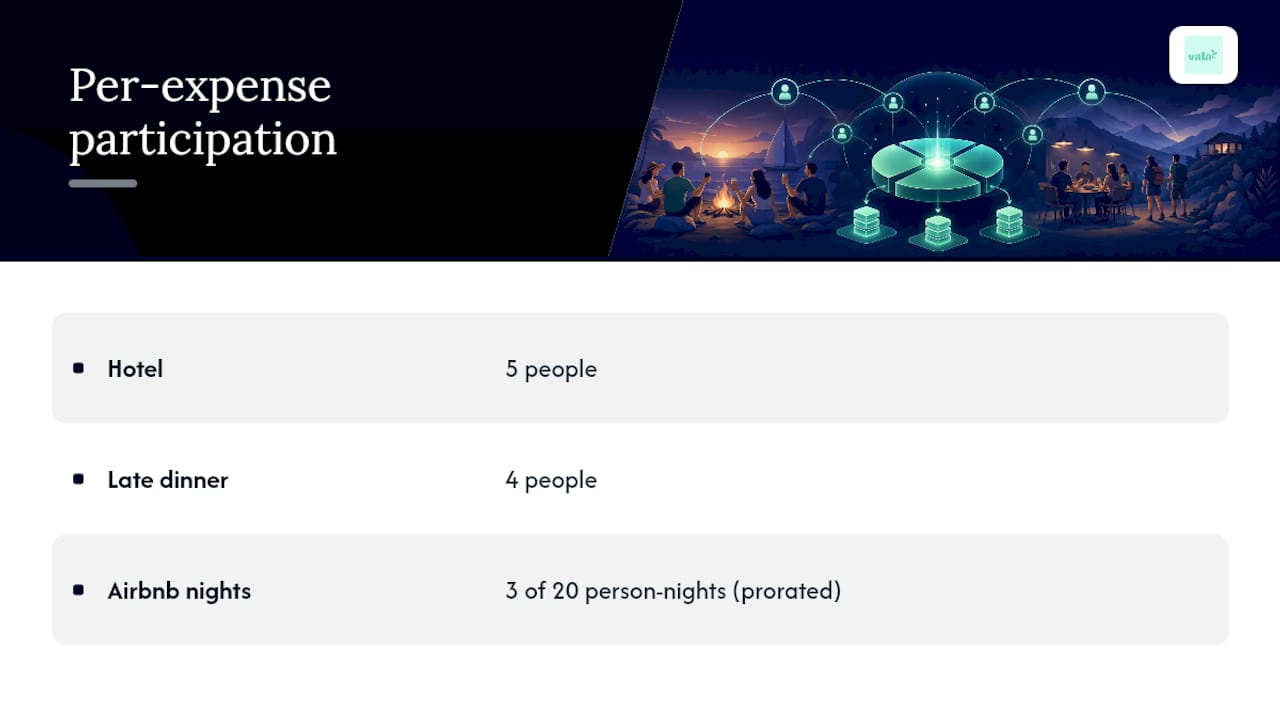
The mistake most groups make is trying to “true up” at the very end by guessing who owes extra for what. That’s where memory fails and arguments start. Log participation changes as they happen, right when someone confirms they’re skipping the group activity or joining a day late. A ledger updated in real time absorbs a moving guest list far better than one person’s spreadsheet reconstructed after the fact from a hazy memory of who ate what.
If your group’s composition shifts often, and it does whenever eight friends coordinate a trip, look for a tool that supports per-expense participant lists rather than one fixed group total for everything.
How Do You Manage Recurring Shared Costs Long Term?
Rent, utilities, and streaming subscriptions are a different animal than a weekend trip. The expenses repeat, the group is usually smaller and more stable, and small errors compound over months instead of disappearing after one settlement.
The biggest shift for recurring costs is moving from single-event math to a running monthly balance. Instead of settling after every grocery run or utility bill, most roommate households batch everything into one monthly reconciliation. Set a fixed split (equal, or by room size, or by income using a fair-share formula) once, and let it apply automatically to every recurring bill rather than renegotiating each month.
Automatic bill detection matters more here than for a one-time trip. A subscription that quietly renews, or a utility bill that jumps $40 in July, needs to surface itself instead of hiding in a shared inbox nobody checks. That’s the gap between a calculator and a genuine budgeting tool: calculators are built for discrete events, while recurring shared costs need something watching your accounts continuously for changes.
Set a recurring reminder, whether it’s the first of the month or right after rent clears, to review the ledger together. Waiting three months to reconcile is how a $15 discrepancy turns into a $200 argument nobody can untangle.
How Should Friends Handle Loans and Advance Payments?
Not every shared cost splits evenly at the moment of payment. Someone books the Airbnb on their card months in advance and collects shares later. A friend covers a ticket for someone who’s short on cash that week, expecting repayment on payday.
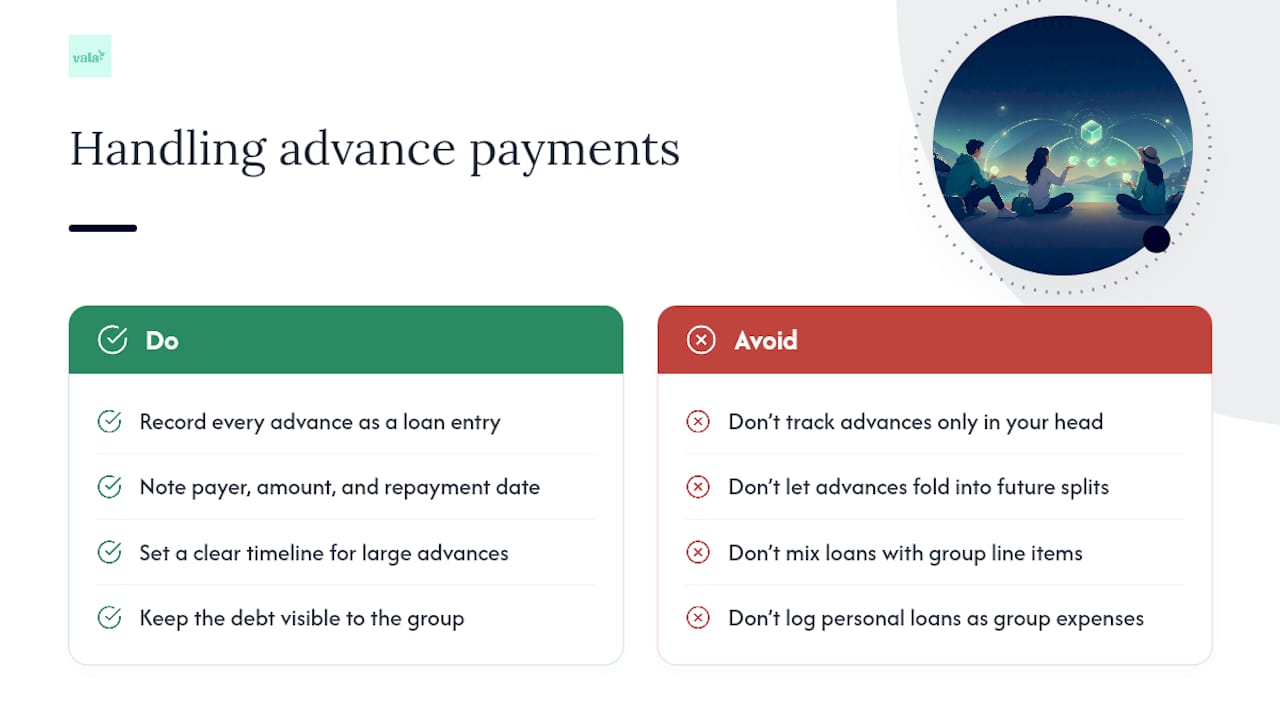
Treat every advance payment as a loan entry in the same ledger you use for splits, not as a separate favor you’re tracking in your head. Record who fronted the money, the amount, and the expected repayment date right next to the expense it covers. This does two things: it keeps the debt visible to everyone (reducing the awkwardness of asking for money back), and it prevents the advance from getting silently folded into an unrelated future split.
For larger advances, like a security deposit or a multi-hundred-dollar event deposit, some groups add a small buffer or timeline to the agreement: repayment within two weeks of the event, for example. That’s not about distrust. It’s about giving the borrowing friend a clear, low-pressure deadline instead of an open-ended “whenever.”
Avoid mixing loans with splits in the same line item. If Priya lends Dan $50 for his share of the hotel, that’s a personal loan between two people, not a group expense. Log it separately so the group ledger stays clean and Dan’s individual repayment to Priya doesn’t distort everyone else’s balance.
When Should You DIY vs Use an App?
A shared spreadsheet works fine for two or three friends splitting one dinner. Past that, manual tracking gets error-prone fast, especially with recurring costs. Use a free web calculator for one-off events, a lightweight app for groups that reunite often, and an integrated tool like Vala once budgeting and recurring bills enter the picture.
— SaverStride
Split Smarter, Budget Better With Vala
Vala gives you one place to handle both sides of shared money: splitting costs with friends and knowing where your own money actually goes. Group split automation calculates who owes whom the same way the calculators in this guide do, but it stays connected to your real budget instead of resetting after every trip.

Because Vala links to your accounts with privacy-first bank integration, recurring shared bills like rent or utilities get flagged automatically instead of requiring manual entry every month. If you’re curious whether hidden subscriptions or forgotten recurring charges are quietly draining your shared or personal budget, run a Money Leak Check first. It’s a fast way to see what’s actually happening with your money before you decide which tracking approach fits your group. From there, the paid subscription plan unlocks the full budgeting and split-tracking toolkit; current prices are on the pricing page.
Calculators and Guides Worth Bookmarking
For quick, one-off splits, the Group Expense Splitter covers all four split methods with instant net balances. The no-signup bill splitter works entirely in your browser and generates a shareable settlement link. For a deeper walk-through of the record, net, and settle workflow, the group expense management guide breaks down each step. Roommates managing housemate costs specifically may also find MatePoints useful for household-specific splitting.
Sources
- Group Expense Splitter
- Free Expense Splitter & Bill Splitting Calculator — Split Bills with Friends, Group Travel, Roommates | No App, No Sign-Up
- Group Expense Management Guide – Split Expenses Fairly & Track Who Owes Whom
- Financial Times coverage of shared-expense tools
FAQ
What app can I use to split trip expenses with friends?
Any calculator or app that supports equal, percentage, share, and exact-amount splits will handle a trip, including free no-signup web tools for one-off getaways. For trips with recurring friend groups or ties to your broader budget, an app like Vala adds group split automation alongside expense tracking.
What is an example of split expenses?
A classic example is a group dinner where the total bill gets divided by the number of diners, or a trip where the hotel is split equally but a taxi is split only among the people who rode in it. The worked example above shows how a hotel, dinner, and taxi across four friends net down to just three final payments.
Should you split the bill with friends?
Splitting the bill is reasonable when everyone ordered similarly or shared a joint purchase like a hotel room. When contributions are uneven, an exact-item or percentage split tends to feel fairer than dividing everything equally.
What is an app that allows me to split payments with friends?
Vala allows friends to split shared expenses, automate the math, and connect the results to a broader budget view rather than leaving the ledger isolated from your actual finances. Standalone calculators also work well for single events with no ongoing budget needs.
How do you split expenses fairly when contributions are unequal?
Use a percentage or shares-based split instead of an equal division, weighting each person based on income, usage, or agreed contribution. Document the agreed weights in the ledger itself so nobody has to recall the reasoning weeks later.