
The most reliable way to track shared credit card expenses is to keep one canonical transaction ledger, label each charge by owner and split, reconcile it to your statement every billing cycle, and settle up before the due date. Joint account holders are each on the hook for the full balance, while an authorized user usually isn’t, so the stakes differ depending on your setup. The rest comes down to a workflow, a few tools, and a five-minute monthly habit.
TL;DR:
- Keeping one canonical transaction ledger with clear labels and split ownership prevents double counting and helps track liability accurately.
- Reconciliation should align with billing cycle dates, not calendar month, and all fees, interest, and refunds must be included for accurate monthly balances.
- Automated tools with transaction import, auto splits, and reminders simplify maintenance for households with more than 20 transactions or multiple subscriptions.
- Explicit household rules and access controls about who can see or modify shared data reduce misunderstandings and protect account security.
- Joint account holders are responsible for the full balance, while authorized users generally are not, making detailed records essential for legal protection.
Table of Contents
- What’s the Best Way to Track Shared Card Spending?
- How Do You Record and Split Every Shared Transaction?
- Which Tools and Templates Actually Work for This?
- Who’s Actually Liable: Joint Account vs. Authorized User?
- Why Does Reconciling by Billing Cycle Actually Matter?
- What Are the Most Common Tracking Mistakes?
- How Can Automation Make This Easier to Maintain?
- Why Systems Beat Good Intentions Here
- Where Vala Fits Into This Workflow
- Sources
- FAQ
What’s the Best Way to Track Shared Card Spending?
A single canonical ledger beats every alternative because it kills the number one failure mode in shared expenses: double counting. That happens when one partner logs a charge as spending and the other logs the reimbursement as a separate line item, so the same dollar gets counted twice in two different places. The fix isn’t more tracking. It’s one record per transaction, split by ownership, with reimbursements logged only as settlement entries against that record.
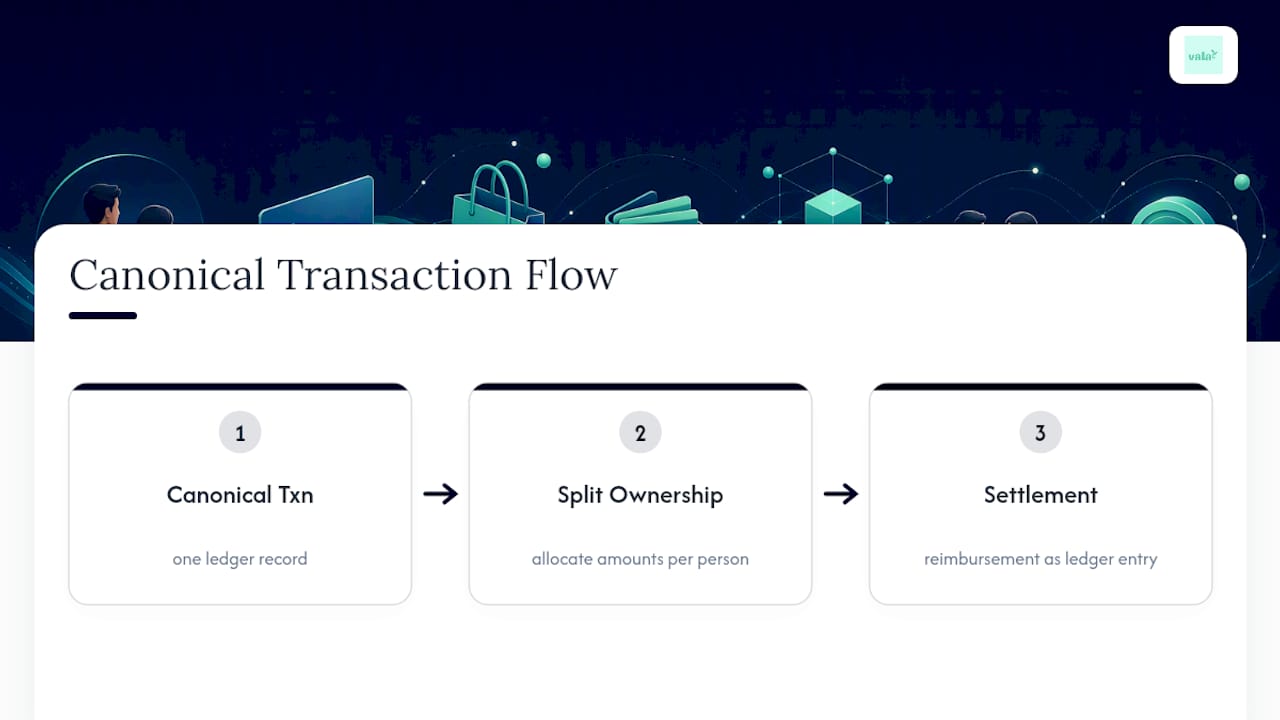
This matters more than most couples realize because a joint credit card isn’t just a shared bill. It’s a shared liability. The steps below turn that liability into something you can see clearly, every month, without arguments over who spent what.
How Do You Record and Split Every Shared Transaction?
Think of this as a six-step loop you run continuously, not a one time setup. Each step protects against a specific way tracking breaks down.
- Capture the transaction once. Import it from your bank feed or enter it manually the same day it happens. This becomes the single canonical record. No second entry, no separate note in a group chat, no duplicate line in another app.
- Label the type. Tag it as shared, personal, reimbursement, fee, interest, payment, or credit. A coffee run tagged “personal” behaves differently in your monthly math than one tagged “shared,” and mixing these up is where most ledgers quietly drift off from reality.
- Split ownership inside the transaction. Decide the percentage or fixed share each partner owes and record it directly on that line, not in a separate spreadsheet tab. A $180 grocery run might be a straight 50/50 split, while a $600 furniture purchase might be recorded as one partner’s share with the other reimbursing a fixed amount.
- Attach a receipt and a short note. Note why the purchase happened and who approved it. This sounds like overkill for a $12 lunch, but it saves real time three weeks later when someone asks “wait, what was this charge for?”
- Reconcile against the statement. Compare your running ledger total to what your card issuer actually posted, using the billing cycle closing date as the boundary, not the calendar month.
- Log settlement separately. When one partner pays the other back, or when an app auto splits a reimbursement, record that transfer as a settlement entry only. It closes out a balance. It is never a new expense.
Pro Tip: Set a recurring rule for anything that repeats, like a streaming subscription or a gym membership. If you split it 50/50 every single month, don’t re-decide the split each time. Lock it in once so the only thing left to review is whether the charge itself still makes sense.
Chase’s own guidance on shared credit card use points to the same conclusion from the issuer’s side: clear labels, saved receipts, and a regular review cycle prevent the misunderstandings that erode trust between partners sharing a card. A simple household purchase tracking approach works the same way whether you’re splitting groceries or a shared streaming bill, because the mechanics don’t change with the size of the purchase.
Which Tools and Templates Actually Work for This?
A spreadsheet is genuinely enough if you’re a two-person household with fewer than roughly 15 to 20 shared transactions a month and neither of you minds a little manual entry. Once you’re juggling more transactions, multiple recurring subscriptions, or a third person on the card, a dedicated app with automated splitting starts paying for itself in time saved.
Whichever format you choose, build your ledger around these fields:
- Date the transaction posted or was made
- Merchant name, exactly as it appears on the statement
- Amount in dollars and cents
- Category (groceries, utilities, dining, subscriptions, and so on)
- Owner(s) whose share this charge belongs to
- Split as a percentage or fixed dollar amount per person
- Reimbursement status (owed, paid, waived)
- Receipt link or photo reference
- Billing cycle tag noting which statement period the charge falls under
If you’re deciding between a plain spreadsheet and something automated, look for these features before you commit: automatic transaction import from your bank, auto categorization that learns your merchants over time, a shared or “household” label you can apply in one tap, and reminders tied to your actual billing cycle rather than a generic monthly nudge. A digital expense splitting app that handles all four of these removes most of the manual labor from steps one through three of the workflow above.
One thing worth deciding upfront: who can see what. If you’re using a shared spreadsheet, control edit access so old entries can’t be quietly altered. If you’re using an app, check what data it pulls from your bank connection and whether that access is read only. Shared financial visibility should never come at the cost of one partner losing control over their own account security.
Who’s Actually Liable: Joint Account vs. Authorized User?
This distinction changes what’s actually at stake if the relationship ends or a payment gets missed, and too many couples skip past it because “we trust each other” feels like enough. It isn’t, legally.
Under CFPB guidance, joint account holders are each responsible for the entire balance, not just their half, even if the other person made every single charge. An authorized user, by contrast, generally isn’t legally obligated to repay the debt at all, even though their name appears on the card. That asymmetry is exactly why a canonical ledger matters. It’s not just a budgeting nicety. It’s the only record that protects you if things go sideways.
There’s no universal “2/3/4 rule” for shared credit cards. Some blogs float that mnemonic, but issuer guidance treats it as informal shorthand at best, not a real financial rule. Skip it and write your own explicit terms instead:
- What purchases are automatically approved as shared, versus what requires a heads up first
- A monthly cap on shared spending, if you want one
- A per purchase dollar threshold above which you check in before buying
- A deadline for uploading receipts (same day works well)
- A deadline for reimbursing each other (end of billing cycle is a clean default)
Write these rules down somewhere you’ll both actually see again, ideally right next to your ledger, and revisit them if a relationship status or living situation changes. If someone moves out or the relationship ends, notify your card issuer and remove authorized user access immediately. That single Federal Reserve household survey point is worth sitting with: many cardholders carry a balance rather than pay in full each month, and a joint card with unclear responsibility makes that risk worse for both people on the account, not just one.
Why Does Reconciling by Billing Cycle Actually Matter?
Your statement doesn’t follow the calendar month, and treating it as if it does is one of the fastest ways to make your ledger disagree with reality. A charge made on the 29th of the month might post after your statement closes on the 27th, which means it belongs to next month’s cycle, not this one. Reconciling by calendar month instead of billing cycle is a mismatch waiting to happen.
Here’s the practical sequence to run every cycle:
- Wait for the statement to close, then pull the full list of transactions, payments, credits, fees, and interest charges it shows. Mycreditunion covers exactly these categories, and all of them need to appear in your reconciliation, not just the purchases.
- Match each ledger entry to a statement line. Anything pending in your ledger that hasn’t posted yet stays flagged as pending, not paid.
- Update status flags as you go: pending, posted, disputed, refunded, paid. A charge that gets refunded two weeks later needs its own status change, not a deleted line.
- Handle edge cases explicitly. Late posted charges get pushed to the next cycle. Foreign transaction fees, tips added after a restaurant charge, and delivery fees all need a place in your categories, not a shrug.
- Settle before the due date, not after. Whatever one partner owes the other should be transferred and logged as a settlement entry before the statement’s minimum payment is due, so nobody’s guessing what the actual balance situation is when the bill hits.
What Are the Most Common Tracking Mistakes?
Double counting tops the list, and it happens almost every time because two people are recording the same reality from two different angles instead of sharing one source of truth. The fix is structural, not a matter of trying harder: one canonical entry per transaction, split for ownership, with reimbursements logged only as settlement, never as a second expense.
A few other patterns show up constantly:
- Undefined tax, tip, and delivery fee handling creates small mismatches that compound over months. Pick a rule for each and write it next to the transaction type, not in your memory.
- Ignoring interest and fees in the reconciliation skips real money that affects the balance. Include them every cycle, and agree in advance who covers any interest if a balance carries.
- Skipping the monthly review is how small errors turn into arguments three months later. A five minute check in, verifying merchant, category, owner, and receipt against the statement, catches almost everything before it snowballs.
Pro Tip: Turn on transaction alerts through your card issuer’s app. A same day alert for any purchase over your agreed threshold takes the guessing out of “did you see that charge?”
How Can Automation Make This Easier to Maintain?
The workflow above works whether you run it by hand or let software handle the repetitive parts. What automation actually changes is consistency: it does step one through five every single day instead of once a month when someone remembers.
Realistic automations to look for include:
- Transaction import that pulls every card charge into your ledger automatically, so nothing gets missed or entered twice
- Auto split rules for recurring shared charges, like a streaming subscription split 50/50 every month without you touching it
- Anomaly surfacing that flags an unusual charge, a subscription price increase, or a merchant you don’t recognize
- Settlement reminders scheduled around your actual billing cycle closing date, not a generic monthly nudge
A basic setup takes a few minutes: turn on transaction import, create a shared “household” category, enable a monthly reconciliation reminder, and set auto split rules for anything recurring. From there, the real time group spending tracking approach does most of the daily work, leaving you with a short review instead of a monthly scramble. Vala’s own expense tracking guide walks through the same fundamentals in more general terms if you want the full picture before automating anything.
Why Systems Beat Good Intentions Here
Good intentions don’t survive a busy month. Systems do. The couples who track shared credit card spending well aren’t the ones who care more. They’re the ones who wrote down a rule once and stopped relitigating it every time a charge shows up.
Start small: one ledger, one split rule for the big recurring items, one monthly five minute review tied to your statement closing date. Add complexity only when the simple version actually breaks. Most couples never need more than that.
— SaverStride
Where Vala Fits Into This Workflow
Every step in this workflow, from capturing a transaction to flagging an anomaly, is exactly what Vala is built to automate. Vala pulls in your card transactions automatically, applies shared labels and splits so you’re not manually tagging every grocery run, and surfaces recurring charges and odd spending patterns before they turn into a monthly argument about who owes what.

If you want to see where your shared spending is actually leaking money before you build out a full tracking habit, start with the Money Leak Check. It’s a free way to see recurring subscriptions and anomalies without setting up anything first. For couples ready to run the full workflow on autopilot, monthly reminders, auto splits, reconciliation alerts and all, SaverPro is available via subscription; current prices are on the pricing page. Either way, the app is one option among the tools this article covers; a spreadsheet works too, but if you’d rather the reminders and splits happen without you, that’s exactly what SaverPro is built to handle. Head to Valapoint to get started.
Sources
- Am I responsible for charges on a joint credit card account if I didn’t make them? | CFPB
- A Guide to Shared Expenses with a Credit Card | Chase
- Mycreditunion
- Economic well‑being of U.S. households in 2025: Credit (Federal Reserve)
FAQ
How Do I Track Shared Expenses With a Partner?
Keep one canonical transaction record for every shared charge, tag who owns what share of it, and reconcile that ledger against your card statement each billing cycle. Chase’s guidance on shared credit card use recommends adding clear labels and receipts to that same record so nothing gets double counted.
How Many Americans Carry Credit Card Debt Month to Month?
The Federal Reserve’s household survey found that a meaningful share of cardholders carry a balance rather than paying in full each cycle. Carrying a balance can also mask whether a household is actually spending within its means, which is part of why tracking both spending and payoff status matters.
What’s the Best Way to Keep Track of Credit Card Expenses?
Log every charge once, label it by category and owner, and compare your running total to the statement at the end of each billing cycle rather than at the end of the calendar month. A short five minute monthly review, checking merchant, category, and receipt against the statement, catches most errors before they compound.
Is There a Real “2/3/4 Rule” for Credit Cards?
No, there’s no universal 2/3/4 rule recognized by card issuers. It circulates as an informal mnemonic, but explicit household terms, a spending cap, a per purchase threshold, and clear reimbursement deadlines, work far better than relying on a catchy shortcut.
What’s the Difference Between a Joint Account and an Authorized User?
A joint account holder is legally responsible for the entire card balance, not just their share, according to CFPB guidance. An authorized user can use the card but generally isn’t legally obligated to repay the debt, even though their name is on the account.