
Open banking is a system that lets you share your bank data securely with apps and services you choose, using encrypted digital connections instead of handing over your password. It gives you one clear view of your money across every account, powers smarter budgeting tools, and speeds up payments. It runs on tokenized access and regulated standards, so the benefit is real, but you still need to follow basic safety habits when granting access.
TL;DR:
- Only trusted apps that display your bank’s login page and request limited access should be used to ensure compliance with open banking standards.
- Security relies on tokenized connections, which prevent your actual password from being shared or stored by third-party apps.
- Real-time data aggregation enables comprehensive financial views, automatic budget tracking, and faster loan approvals, enhancing everyday money management.
- Risks include phishing, excessive permissions, and data breaches, making it essential to revoke unused tokens and verify app legitimacy regularly.
- Regulations like the CFPB rule and industry standards such as FDX and FAPI work to improve accountability, but user vigilance remains crucial.
Table of Contents
- How Does Open Banking Work?
- What Are the Benefits of Open Banking for Everyday Money Management?
- Is Open Banking Safe? Risks and Protections You Should Know
- What Rules and Standards Govern Open Banking?
- How to Use Open Banking Safely: A Practical Checklist
- A Real Example: How Tokenized Bank Links Work in Practice
- Open Banking vs. Traditional Banking and Open Finance
- A Cautiously Optimistic Take on Open Banking
- See What Open Banking Looks Like Done Right
- Sources
- FAQ
How Does Open Banking Work?
Open banking works through a secure handoff between your bank, a third-party app, and sometimes a middleman called an aggregator. Understanding that handoff is the difference between feeling nervous about linking your accounts and feeling confident about it.
The old way of connecting financial apps to your bank was called screen scraping. An app would ask for your actual username and password, then log in as you and copy data off the screen. It worked, but it was clumsy and risky: the app was holding your real credentials, and if that app got compromised, so did your bank login.
Application Programming Interfaces (APIs) replaced that model. An API is a secure, standardized channel that lets your bank’s system and an app’s system talk to each other directly, without your password ever leaving your bank. Plaid explains open banking as exactly this: standardized APIs that let you share your banking and transaction data with providers you trust, powering everything from budgeting apps to instant funding tools.
Here’s the part that actually protects you: tokenization. Instead of your password, the app receives a digital token, a temporary, limited pass tied to specific permissions and a specific time window. You’re not giving an app the keys to your house. You’re giving it a guest badge that only opens certain doors and expires on its own.
A typical connection looks like this:
- You choose an app and tap “connect your bank.”
- You’re redirected to your bank’s own login page, not the app’s, and you authenticate there.
- You approve exactly what data the app can see (balances, transactions, account details).
- The app receives a token and starts pulling only that approved data.
- You can revoke that token anytime from your bank or the app’s settings, cutting off access instantly.
Aggregators sit behind many of these connections. Rather than every app building a direct line to every bank, aggregators maintain those connections and hand data to apps through one clean interface, which is part of why so many apps can support thousands of banks at once.
Pro Tip: Before connecting any account, check whether the app displays your bank’s own login screen during setup. If it asks you to type your password directly into the app instead, that’s a sign it’s not using a proper open banking connection, and you should stop.
What Are the Benefits of Open Banking for Everyday Money Management?
Open banking’s real value shows up in ordinary moments, not in the technology itself. Here’s where it actually changes how you handle money:
- One real-time view of everything you own. Instead of logging into four different bank apps, open banking pulls your checking, savings, and credit card data into a single dashboard that updates as transactions post.
- Automated budgeting and leak detection. Because your transaction history flows in automatically, apps can categorize spending, flag recurring subscriptions you forgot about, and surface small charges that quietly drain your account. Money leaks like a forgotten streaming trial or a duplicate subscription are far easier to catch when software is watching every transaction instead of you scanning statements once a month.
- Faster, fairer lending decisions. Lenders traditionally leaned on credit scores alone. With permissioned access to real transaction history, they can see actual cash flow and payment patterns, which Investopedia notes can support more precise lending decisions and speed up approvals for people with thin credit files.
- Smoother payments and checkouts. Open banking enables pay-by-bank options that skip card numbers entirely, moving money directly from your account to a merchant, often with less friction than typing in a 16-digit card number.
None of this requires you to become a finance expert. The apps do the categorizing, the flagging, and the calculating. You just get to see the results and make decisions with a clearer picture than a stack of monthly statements ever gave you.
Is Open Banking Safe? Risks and Protections You Should Know
The honest answer is that open banking is generally safer than the alternatives it replaced, but it is not risk-free. Knowing the trade-offs is what lets you use it with confidence instead of blind trust.
The real risks aren’t usually in the technology itself. They’re in how people interact with it:
- Phishing attempts where scammers impersonate your bank or a finance app to trick you into typing real credentials somewhere unsafe.
- Malicious or poorly built apps that request far more data access than they actually need for their stated purpose.
- Excessive permissioning, where you approve broad, long-term access instead of the narrow scope a service actually requires.
- Data breaches at any point in the chain, from the bank to the aggregator to the app itself.
Standardized security protocols exist precisely to shrink these risks. Bank-level encryption protects data in transit, and OAuth-based token access means apps never see or store your actual password. Many providers now build toward Financial-grade API (FAPI), a security specification designed specifically for high-stakes financial data exchanges, going further than standard web security to limit what a compromised app could ever expose.
Regulation adds another layer. Mastercard’s guide to open banking points out that regulated providers and industry standards are central to how account data stays protected, and in many markets, banks carry liability for transactions you didn’t authorize, provided you reported them promptly.
Statistic Callout: The Consumer Financial Protection Bureau has specifically targeted open banking rulemaking as a way to protect consumer data rights while still encouraging competition, a signal that regulators see both the upside and the exposure clearly enough to write rules around it.
The risk that remains is largely behavioral. Watch for apps demanding your actual bank password, unclear explanations of what data they collect, or permission requests that go far beyond what the app’s function requires.
What Rules and Standards Govern Open Banking?
Open banking isn’t a free-for-all. It sits inside a growing framework of regulation and technical standards that shape how much you can trust any given provider.
In the United States, the CFPB finalized a personal financial data rights rule aimed at giving you a legal right to your own financial data and more control over who can access it. That’s a meaningfully different approach from Europe’s PSD2 (Payment Services Directive 2), which mandated open banking access years earlier and created a more uniform, regulator-driven rollout across EU markets. The U.S. path has leaned more on industry coordination alongside regulation.
That coordination shows up in a few key places:
- Financial Data Exchange (FDX) is the industry group pushing a common technical standard, replacing a patchwork of one-off integrations with something interoperable across banks and apps.
- FAPI (Financial-grade API) defines the security bar for how those connections should be built.
- Provider registration and vetting processes give you a way to check whether an app or aggregator is operating within recognized industry norms, rather than just taking its word for it.
None of this guarantees a flawless provider, but it does mean the ecosystem has real accountability points; you’re not trusting a single company’s promises in a vacuum.
How to Use Open Banking Safely: A Practical Checklist
You don’t need technical knowledge to protect yourself here. You need a short list of habits.
- Check the provider before you connect. Look for a clear privacy policy, confirm the company is registered where applicable, and skim independent reviews, not just the app store rating.
- Grant the minimum access needed. If an app only needs to see your checking account, don’t approve access to savings and credit cards too.
- Set reasonable time windows and revoke access you no longer use. Old, forgotten connections are unnecessary exposure sitting idle.
- Watch for red flags. Any request for your actual bank password, vague explanations of data use, or surprise charges after signup should stop you immediately.
- Keep your devices clean. Updated software and strong device passcodes protect the token-based sessions that open banking relies on.
- Report anything unusual to your bank right away. Prompt reporting is often what determines whether you’re protected from an unauthorized transaction.
Pro Tip: Once a season, open your bank’s connected-apps settings and revoke anything you no longer recognize or use. Most people connect five or six services over a year and forget about half of them.
A Real Example: How Tokenized Bank Links Work in Practice
Vala uses tokenized bank connections, meaning your password never touches the app itself. That’s the same principle behind its real-time financial planning tools and its Money Leak Check feature, which reads transaction data to flag waste without ever storing your login. Before trusting any app with this kind of access, check three things: its privacy policy, its consent controls, and how long it retains your data after you disconnect.
Open Banking vs. Traditional Banking and Open Finance
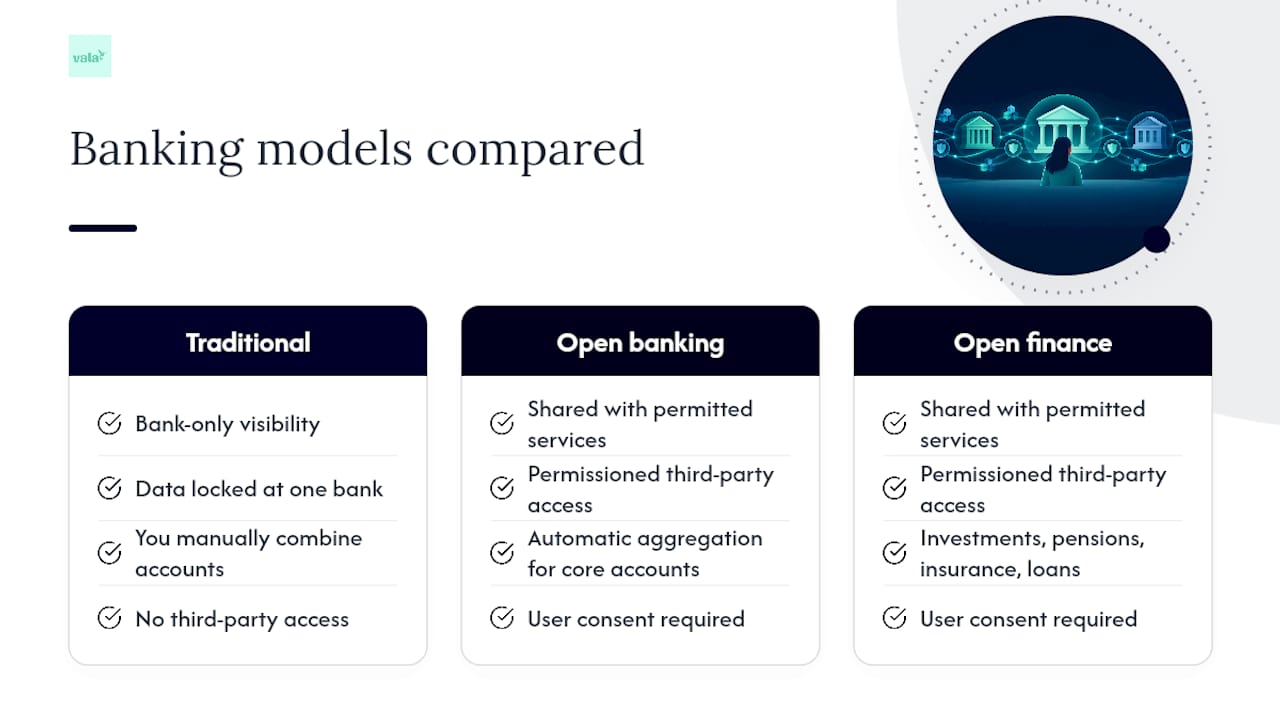
Traditional banking keeps your data locked inside one institution’s walls. Your bank sees your accounts, and that’s largely where the visibility ends unless you manually export statements or log into each account separately. Open banking breaks down those walls, letting you grant permissioned access to that same data so other services can use it on your behalf, with your consent required at every step.
Open finance is the next layer out. Where open banking typically covers checking, savings, and payment accounts, open finance extends the same permissioned-sharing idea to a wider range of financial products: investments, pensions, insurance, and loans. Think of open banking as the foundation and open finance as the expansion built on top of it, covering more of your full financial picture rather than just your day-to-day cash accounts.
The practical difference for you comes down to scope. With traditional banking, you’re the one manually stitching together a full picture of your finances. With open banking, that stitching happens automatically for your core accounts. With open finance, it stretches to cover investments and other products too, though that layer is less mature and less universally regulated right now, which is part of why Wikipedia’s overview of open banking notes that adoption and regulation still vary significantly by country and by product type.
A Cautiously Optimistic Take on Open Banking
Open banking’s upside is real, but so is the responsibility it hands you. Demand transparency from every app you connect. As FAPI and FDX-style standards mature, safer, clearer consent experiences should follow.
— SaverStride
See What Open Banking Looks Like Done Right
This app gives you the open banking benefits this article just walked through, aggregation, automated leak detection, and real-time visibility, without ever asking for your bank password. Every connection runs on tokenized links, so your credentials stay with your bank, not with an app.
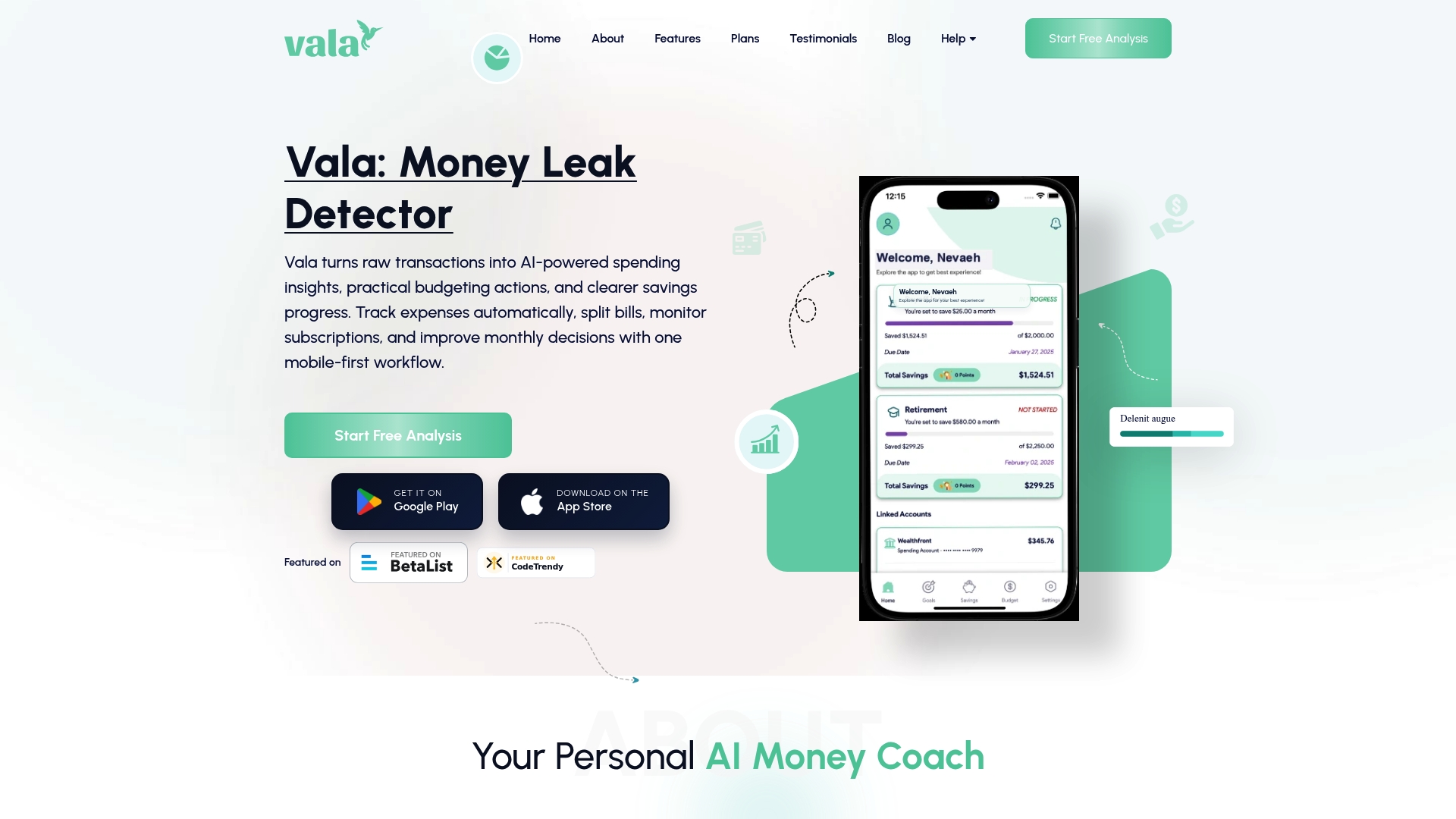
One feature scans linked accounts for forgotten subscriptions, creeping fees, and duplicate charges automatically. If you want ongoing protection instead of a one-time scan, SaverPro unlocks deeper budgeting tools and AI-driven insights for $2.99 per month. That’s a lower bar than most people expect to pay for automated money-leak detection and real-time tracking that would otherwise mean manually reviewing statements every month.
If you’re ready to see your own accounts through this lens, start with a Money Leak Check and see what open banking access actually reveals about your spending.
This article is general information, not a substitute for advice from a qualified financial advisor. Consult a qualified financial professional about your own circumstances before acting on anything here.
Sources
- CFPB: announcement and coverage of open banking / data-rights proposals
- Plaid: What is open banking? A guide to the future of finance
- Investopedia: Understanding open banking, benefits, functionality, and risks
- Mastercard: What is open banking? Your essential guide
- Wikipedia: Open banking
FAQ
What Is Open Banking in Simple Terms?
Open banking is a way to securely share your bank data with apps you choose, using encrypted digital connections instead of your password. The CFPB frames it as a consumer-permissioned system built to increase competition and give you more control over your own financial data.
What Are the Downsides of Open Banking?
The main downsides are phishing risks, apps requesting more access than they need, and the possibility of a data breach somewhere in the chain between your bank, an aggregator, and the app you’re using. Investopedia notes that these privacy and security trade-offs are real, even as standardized APIs and tokenized access work to limit the exposure.
What Is an Example of an Open Banking App?
Budgeting and expense-tracking apps that connect to your bank accounts to automatically categorize spending or flag subscriptions are common examples. Vala is one such example, using tokenized bank links for its Money Leak Check feature so your login credentials never pass through the app.
What Is the Difference Between Open Banking and Traditional Banking?
Traditional banking keeps your financial data locked inside a single institution, visible only to you and that bank. Open banking lets you grant permissioned, revocable access to that same data so other apps and services can use it, with standardized APIs replacing the need to hand over your actual password.
Is Open Banking Regulated in the United States?
Yes. The CFPB has finalized a personal financial data rights rule intended to give consumers stronger legal control over their financial data, alongside industry standards like FDX and FAPI that govern how data connections are built and secured.