
The 52 week savings challenge asks you to save $1 in week one, $2 in week two, and add $1 every week until you set aside $52 in week 52. Follow it all the way and you finish the year with $1,378. The idea is simple, the first weeks are almost painless, and the chart below shows exactly where it gets harder so you can plan for it.
This guide covers the standard schedule, a week-by-week chart, the reverse version, a plan for $5,000, what to do when you miss a week, and where to keep the money.
TL;DR
- The standard challenge saves $1 in week 1 up to $52 in week 52, for a total of $1,378.
- Flipping the order (start at $52, end at $1) gives the same total and front-loads the hard part.
- A flat $26.50 transfer every week also reaches $1,378 and is the easiest version to automate.
- The standard schedule will not reach $5,000. That takes about $96.15 a week, or a custom plan.
- Missing a week is fine. Catch up, skip it, or finish a little lower. Finishing matters more than being perfect.
Table of Contents
- How the 52 week money challenge works
- 52 week challenge chart
- Three ways to run the challenge
- How to save $5,000 in 52 weeks
- What if you miss a week or your income changes?
- Where to keep the money
- 365 day savings challenge and the $27.39 rule
- Our perspective: why challenges stall, and what helps
- Find the money before you start
- Tips to finish all 52 weeks
- FAQ
- Sources
How the 52 week money challenge works
You pick a start date, then deposit the number of dollars that matches the week. Week 1 is $1. Week 10 is $10. Week 52 is $52. Add up every deposit from 1 to 52 and you get $1,378.
The appeal is psychological. Early weeks cost less than a coffee, so starting feels easy. By the time the deposits get bigger, you already have a habit and a visible balance. NerdWallet’s walkthrough describes the same schedule, and most of the guides ranking for this topic use it.
The catch is the back half. Weeks 40 to 52 alone add up to $598, which is more than 43% of the whole total. If your budget is tight in December, when holiday spending peaks, that is the stretch to plan for in advance.
52 week challenge chart
You don’t need a fancy printable. A simple table works, and you can copy it into a notes app or spreadsheet. The running total column is the one to watch.
| Week | Deposit | Running total |
|---|---|---|
| 1 | $1 | $1 |
| 5 | $5 | $15 |
| 10 | $10 | $55 |
| 13 | $13 | $91 |
| 20 | $20 | $210 |
| 26 | $26 | $351 |
| 30 | $30 | $465 |
| 39 | $39 | $780 |
| 45 | $45 | $1,035 |
| 52 | $52 | $1,378 |
A few things stand out:
- You reach $351 by the halfway point, only about a quarter of the total.
- The last four weeks (49 to 52) add $202.
- The week-26 deposit is $26, close to the flat $26.50 average, so mid-year is the point where the standard plan starts costing more than an even split would.
How to track it
Log what you actually deposit each week, not what the chart says you should. Mark the week done and keep an eye on the running total. A visual tracker where you check off each deposit makes the progress easy to see, and a spreadsheet with a running-total column does the same job. Both work. Pick the one you will open every Monday.
Three ways to run the challenge
The same $1,378 can arrive in different shapes. Choose the one you are most likely to finish.
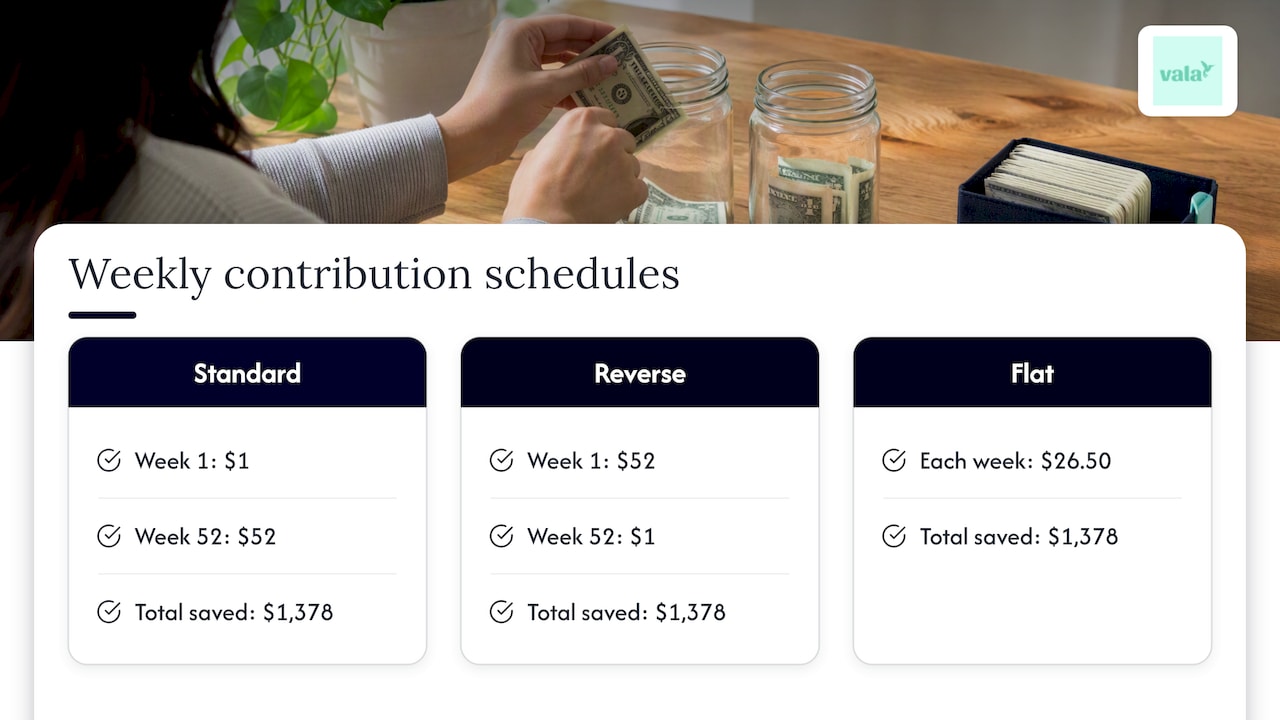
Standard: $1 up to $52
Easy start, hard finish. Best if your income is steady and you want a quick win to build the habit.
Reverse: $52 down to $1
You start with $52 and drop $1 each week. The total is the same, and NerdWallet notes that the larger early deposits may earn a bit more interest because they sit in the account longer. The bigger benefit is practical: the heavy lifting happens when your motivation is highest, and the holidays get lighter. Neither version is better, and one tracker guide puts it simply: choose the one you are more likely to finish.
Flat: $26.50 every week
If you would rather not think about it, you can automate a $26.50 weekly transfer and land on the same $1,378. This is the version we point most people to, because there is nothing to remember. If you are lining up several recurring payments and transfers at once, a method for organizing your recurring accounts helps keep everything on a calendar.
Here is how they compare:
| Version | Week 1 | Week 52 | Total | Best for |
|---|---|---|---|---|
| Standard | $1 | $52 | $1,378 | First-time savers who want an easy start |
| Reverse | $52 | $1 | $1,378 | People worried about holiday costs |
| Flat | $26.50 | $26.50 | $1,378 | Anyone who wants it automatic |
How to save $5,000 in 52 weeks
The standard challenge tops out at $1,378, so it does not reach a $5,000 goal unless you raise or customize the deposits. You have two options.
Option 1: a flat weekly amount. Divide $5,000 by 52 and you get about $96.15 a week. That is $96.15 times 52 weeks, which lands at $4,999.80, so rounding up to $97 gets you comfortably past the goal. If you already have some money set aside, an initial deposit lowers what you need from future paychecks, and a savings goal calculator lets you test different timelines and deposits.
Option 2: a customized ramp. Clark.com published a $5,000 plan that starts at $20 in week 1, then $35, then $45, and keeps growing. It is heavier in the middle of the year and gets easier in the second half. That works if you expect a raise or a bonus later and want to bank money before then.
No matter which route you pick, check the number against your real income first. If $97 a week would leave you short on rent, a smaller goal you hit beats a bigger one you abandon in March. Bankrate’s guidance is to break a large annual target into regular contributions and to accept that the right amount depends on your income and circumstances.

What if you miss a week or your income changes?
This is where most challenges quietly die, so plan for it.
- Missed one week? Tick it off when you catch up, or skip it and accept a slightly lower total. As one chart guide says, the chart is a guide, not a contract.
- Paid irregularly? The Consumer Financial Protection Bureau says that for seasonal or fluctuating income it may be necessary to temporarily lower automatic savings in months when income comes in under plan. Do that deliberately, then restart.
- Hit a big bill? Pause the challenge, cover the bill, and resume at your current week. Don’t try to repay every missed dollar in one go.
The same CFPB toolkit notes that the most successful savers set up a system, such as direct deposit, so that saving happens automatically. If your pay lands every other Friday, you can also split each deposit across your paychecks. Our guide to the paycheck budget method shows how to do that for weekly and biweekly pay.
Where to keep the money
The challenge works best when the cash is somewhere you can’t casually spend it. Fidelity lists a checking or savings account, a high-yield savings account, a cash management account, or an investment account as options, and notes that high-yield savings accounts are generally available with FDIC insurance. FDIC insurance covers deposits up to $250,000 per depositor, per insured bank, so a $1,378 balance is well within the limit.
A separate account with its own name (“Emergency fund” or “Trip”) makes it harder to dip into. If you are still deciding what the money is for, our piece on sinking funds versus savings explains how to split goals between short-term bills and a longer cushion.
365 day savings challenge and the $27.39 rule
The 365 day version moves the same idea to daily deposits. There are two common shapes:
- Flat $1 a day. You set aside $1 every day and finish with $365. It is gentle, but small.
- Climbing $1 to $365. Day 1 is $1, day 2 is $2, and so on up to $365. Adding 1 through 365 gives $66,795, which is out of reach for most people, so treat this as a novelty rather than a plan.
A more realistic daily goal is what CBS News calls the $27.39 rule: save $27.39 a day for 365 days and you reach $9,997.35, just under $10,000. Round up to $27.40 and you get $10,001. It is a fixed daily amount rather than the $1-to-$52 ramp.
For most budgets, the weekly challenge is easier to maintain. Fewer transactions means fewer chances to forget, and a weekly transfer lines up with how many people get paid.
Our perspective: why challenges stall, and what helps
We like the 52 week challenge because it turns a vague goal (“save more”) into a number you can act on this week. But we see the same pattern when people try it: the plan is not the problem, the money leaking out in the background is.
If $18 a month goes to a subscription you forgot about, $9 to a trial that rolled into a paid plan, and a utility bill jumped last quarter without you noticing, that is real money. Over a year, those small recurring charges can easily cover the larger deposits in the second half of the challenge. So before you start, we suggest reviewing what is already leaving your account. Free up the room first, then set the weekly amount.
We also think automation beats willpower. A transfer that moves on payday does not rely on remembering, and bill reminders help you avoid late fees that would pull money back out. Pair the challenge with paying yourself first and the savings stop competing with everything else for what is left at the end of the month.
Finally, shared goals work better with friends. If you are splitting trips, dinners or events, keeping those costs separate from your challenge money means the savings do not quietly cover someone else’s share.
— SaverStride
Find the money before you start
The biggest barrier to a 52 week challenge is finding the $40 to $50 a week it asks for in the last months. Vala’s Money Leak Check scans your linked accounts through secure Plaid bank integration, flags subscriptions, recurring charges and bill spikes, and shows you what you could redirect to savings. You can begin with the free money leak calculator, or start your free analysis to see your own numbers.

Paid plans start with SaverLite at $2.99 per month, which adds ongoing tools like savings goal management and bill reminders. You can see the full set of features on our finance app page.
Tips to finish all 52 weeks
- Start when it suits you. January is popular, but any Monday works. Starting in the fall puts the biggest deposits around summer instead of the holidays.
- Automate what you can. Set up a recurring transfer for the flat version, or schedule each week’s amount in advance. Our guide on automating personal savings goals walks through the setup.
- Name the goal. A trip, a car repair fund, or a three-month cushion is easier to protect than “savings.”
- Plan the spending week too. A weekly spending plan shows you how much is left after bills, so you can see whether this week’s deposit fits.
- Build in a buffer. Deposit a few extra dollars in the easy weeks to cushion the heavy ones.
- Celebrate milestones. Hitting $351 at week 26 or $1,035 at week 45 is worth noticing. Treat it as progress, not a license to spend it.
FAQ
How much money can you save with the 52 week challenge?
The standard schedule gives you $1,378 after 52 weeks. You deposit $1 in week one and increase by $1 each week to $52 in the final week. If you want a different total, you can scale the amounts up or down.
How do you save $5,000 in 52 weeks?
You need about $96.15 a week, which is a flat plan rather than the $1-to-$52 ramp. You can also use a customized schedule that starts higher and grows. Check that the weekly amount fits your income before committing.
What is the $27.39 rule?
It is a daily savings goal: put away $27.39 every day for 365 days and you finish just short of $10,000, at $9,997.35. Saving $27.40 daily gets you $10,001. It is a different approach from the 52 week challenge, with a larger goal and a daily rhythm.
What if I miss a week?
Catch up when you can, or skip it and finish with a slightly lower total. The goal is a savings habit, not a perfect record. If the missed weeks keep piling up, lower the amounts or switch to the flat plan.
Is the reverse 52 week challenge better?
Not necessarily. It has the same $1,378 total, but you save the bigger amounts first, which can help if you expect expensive holidays. The better version is the one you are more likely to finish.
Sources
- 52-week money challenge guide | Fidelity
- How to Do the 52-Week Money Challenge | NerdWallet
- Savings Goal Calculator | Bankrate
- How To Save $10,000 In A Year | Bankrate
- How To Save $5,000 With the 52-Week Money Challenge | Clark.com
- Save $5,000 in a Year Calculator
- 52-Week Savings Challenge: Free Tracker and Printable Chart
- 52 Week Money Challenge Chart Printable
- A financial empowerment toolkit for community volunteers | CFPB
- What is the $27.39 rule for savers? | CBS News