
A holiday gift budget is one number you can afford, split across the people on your list, with room for wrapping, shipping and surprises. There is no single right amount. The way to find yours is to start with what you have left after essentials, subtract known holiday costs, and divide the rest. This guide walks you through that, step by step, with a worked example and a simple plan for gift exchanges.
TL;DR
- Start from what you can afford after rent, utilities, groceries and debt payments, not from what you think you should spend.
- A common starting point is 1% to 1.5% of annual income, but your own finances decide the real number.
- Subtract travel, decorations and entertaining first, then divide what is left among recipients, with a firm amount per gift.
- For friends and coworkers, agree on a group cap and use Secret Santa so everyone buys just one gift.
- If the numbers don’t fit, shrink the list or change the type of gift. Don’t borrow to cover it.
Table of Contents
- Start with what you can afford, not with the list
- How much should you spend on Christmas gifts?
- Add the costs that aren’t gifts
- Split the budget among recipients
- Set a fair budget for a gift exchange
- Save and stick to the limit while you shop
- Free up room in your budget before the season
- If your planned spending is more than you can afford
- Our perspective
- Plan your holiday spending with Vala
- FAQ
- Sources
Start with what you can afford, not with the list
Most people build a gift list first and add up the cost afterward. That order is how a budget gets blown. Flip it.
The Better Business Bureau suggests you review your income and subtract essentials such as rent, utilities, groceries and debt payments. Then set a clear limit for gifts, travel, parties and other holiday costs. Truist’s guide adds a practical check: look at your checking and savings balances, cash flow and emergency savings along with necessities like rent, utilities and car payments before you decide.
Fidelity puts the rule plainly: your maximum should be money you already have or can save up promptly, not money that would need debt you can’t afford.
Here is a quick way to find that number:
- Write down your monthly take-home pay.
- Subtract essentials: housing, utilities, groceries, transportation, insurance and minimum debt payments.
- Look at what is left across the weeks before the holidays, and decide how much of it can go to the season without touching your emergency savings.
- Write that number down. That is your total holiday budget.
If you want a clean view of your monthly numbers first, our monthly budget planner guide shows how to set it up in a few minutes.
How much should you spend on Christmas gifts?
There is no universal amount, and anyone who gives you one is guessing. Still, benchmarks help you check whether your number feels reasonable.
A share of income. Kiplinger’s November 2025 guide suggests 1% to 1.5% of annual income as a starting point, and notes that people with competing goals or a tight season may spend less. Financial planner Jon Lapp, speaking to CNBC, says 1% to 2% of annual income can be reasonable for many households, but the safe amount depends on your individual finances.
What shoppers nationally plan. Kiplinger also reports National Retail Federation projections of $890.45 per person for holiday items and $627.93 for gifts for family, friends and coworkers. Treat that as context, not a target. Plenty of households spend well under it, and that is fine.
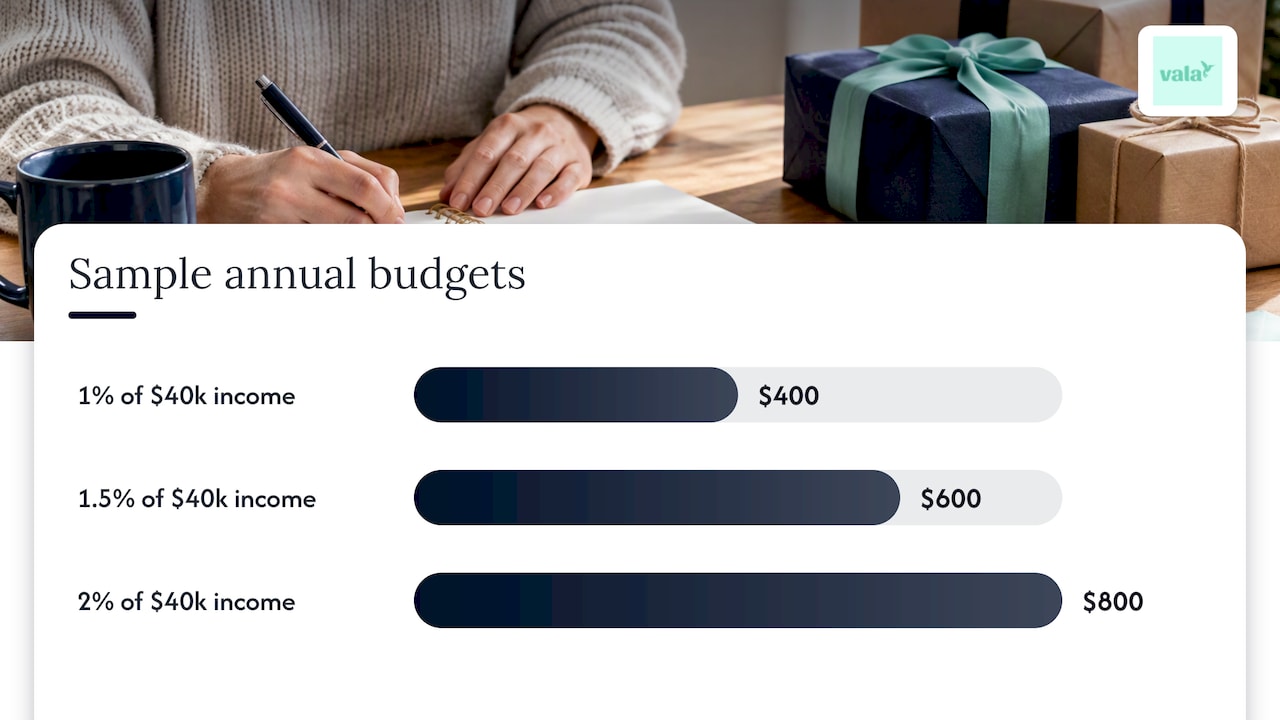
Here is what those percentages look like in dollars. This is simple arithmetic on a sample income, not a recommendation:
| Annual income | 1% | 1.5% | 2% |
|---|---|---|---|
| $40,000 | $400 | $600 | $800 |
| $60,000 | $600 | $900 | $1,200 |
| $80,000 | $800 | $1,200 | $1,600 |
If a figure in that table feels heavy for your month, go lower. A percentage of income says nothing about your rent, your student loans or your savings goals. Your own cash flow wins every time.
Add the costs that aren’t gifts
Gifts are only part of the season. If you leave the rest out, the gift budget quietly absorbs it, and then you overspend.
Kiplinger lists these costs to plan for:
- Travel: flights, gas, lodging and pet boarding
- Entertaining: food, drinks and party supplies
- Decorations
- Wrapping paper and postage
- Tips
- Spontaneous purchases
The BBB also recommends planning for transportation, hotels, meals and unexpected expenses. Fidelity suggests you include wrapping and shipping in each person’s allocation so those small costs don’t float outside the plan.
A simple habit: make two lines in your plan. One is “holiday costs,” the other is “gifts.” Fill in holiday costs first, because they are usually known and fixed.
Split the budget among recipients
Once you know the gift total, divide it. Kiplinger’s method is to take your total holiday amount, subtract known costs like travel and decorations, and allocate what remains among recipients.
Some rules that make this easier:
- List everyone, with the number of gifts. Fidelity recommends listing every recipient and gift, then ranking people by priority. Higher-priority people get funded first.
- Amounts don’t have to be equal. Truist notes that a coworker may receive less than a family member. Assign a firm amount to each gift before you shop.
- Write a price range and an idea. The BBB recommends a recipient-by-recipient list with a price range and early ideas, and tracking purchases in an app, spreadsheet or notebook.
A worked example
Say your total holiday budget is $600, and you know you’ll spend $150 on travel and decorations. That leaves $450 for gifts. One way to divide it:
| Line | Amount |
|---|---|
| Partner | $100 |
| Two parents, $60 each | $120 |
| Two siblings, $40 each | $80 |
| Friend exchange and office exchange, $25 each | $50 |
| Wrapping and shipping | $40 |
| Buffer for surprises | $60 |
| Total gifts | $450 |
The buffer matters. It is the line that absorbs the last-minute gift for a neighbor, so the rest of your plan stays intact.
This is only an example. Change the lines to match your list, and the totals to match your own number.
Set a fair budget for a gift exchange
Exchanges with friends or coworkers are where a lot of unplanned spending hides, especially when everyone buys for everyone. The fix is a shared cap and a format where each person buys only one gift.
Kiplinger suggests agreeing on a group cap, such as $25 or $50 per person, and using Secret Santa. Fidelity recommends Secret Santa or White Elephant so each participant buys for one recipient instead of the whole group. Truist recommends discussing limits openly with family or friends, and gives a $25 limit as an example of a proposed cap.
To set the cap without awkwardness:
- Ask in the group chat early. A low cap proposed in October feels normal. The same cap in mid-December feels pointed.
- Offer two options. For example, “$25 or $40?” lets people pick the lower one without saying why.
- Count the cap as the total. Tax, wrapping and shipping come out of the same number. Say so up front.
- Pick the format together. Secret Santa for a fixed budget, White Elephant for a more playful swap.
If your group also splits dinners, trips or a shared present, tracking who paid what gets messy fast. Our guide to a budget tracking app for couples and shared expenses covers how to keep group costs clear so nobody is left covering the difference.
Save and stick to the limit while you shop
A plan only helps if it holds at the checkout. These habits come straight from the guidance above:
- Shop from the list only. Fidelity advises sticking to your list of recipients and amounts, comparing prices and tracking them over time, using coupons, and mailing gifts early to avoid express shipping.
- Treat the budget as a hard stop. Brian Ford, Truist’s head of financial wellness, frames it this way: once the planned money is gone, shopping stops.
- Track each purchase the day you make it. A running total is easier to respect than a feeling about how much you’ve spent.
- Keep a separate pot. If you set aside money in a dedicated savings account ahead of time, the gift budget has a visible edge.
If you shop for new parents, price comparison matters even more, because baby gifts add up quickly. A walkthrough on building a baby registry on a budget can help you see what is actually needed before you buy something extra.
For next year, the easiest way to avoid a December scramble is to save a small amount each month. Our penny saver habits guide shows small daily moves that add up, and a holiday fund of even a modest monthly amount takes the pressure off.
Free up room in your budget before the season
The quickest way to find gift money is often not cutting gifts. It is finding spending you didn’t mean to make. Subscriptions you forgot, recurring charges that crept up and bills that spiked all quietly eat into the money you could use now.
The Truist and BBB guidance both start with checking what you really have. Checking your recurring charges is part of that. A review of the last two or three months often turns up a streaming plan nobody uses, a trial that converted to a paid plan or a fee that rose. Canceling or pausing those can create extra wiggle room before you buy a single present.
You can do this by hand with your bank statements. If you’d like help, our Money Leak Check looks for recurring charges and bill spikes so you can see what is available for your holiday plan.
If your planned spending is more than you can afford
If the numbers don’t add up, you have options that don’t involve guilt or debt.
The BBB says to reduce spending, focus on low-cost or free ways to celebrate, and consider scaling back gift-giving or choosing handmade gifts, acts of service or a family exchange. It also advises that anyone with outstanding debt, especially high-interest debt, prioritize repayment rather than add financial stress.
Consumer-finance expert Erika Rasure told CNBC that gift spending should be intentional and shouldn’t put you in an uncomfortable or dangerous financial situation, such as credit-card debt with no plan to pay it off.
Practical ways to bring the total down:
- Shorten the list. Truist suggests you can skip an exchange, give a joint gift to couples or families, or send a handwritten card when the per-person amount is too high.
- Lower the top allocations. Fidelity notes that if the budget runs out before lower-priority people are funded, you can reduce higher allocations, skip some purchases, or try homemade, swapped or regifted items.
- Change the kind of gift. Rutgers Cooperative Extension recommends non-gift agreements, experiences, homemade gifts and redeemed credit-card rewards in place of out-of-pocket spending on physical gifts.
- Use one gift per person in a group. Rutgers also points to Secret Santa or a similar exchange so each person buys a single gift.
If you are already carrying card balances, talk with a nonprofit credit counselor before the season starts. They can look at your actual numbers and help you decide how much, if anything, to put toward gifts.
Our perspective
Most holiday budgets fail for a simple reason: the number was never connected to the rest of your money. People pick a figure, and then bills, subscriptions and everyday spending quietly fight it.
We built Vala around that gap. Instead of only recording what you spent, it looks for money leaks, such as subscriptions, recurring charges and unexpected bill spikes, so you can see what is really available. When you know that number, a gift budget stops being a guess.
We also think holiday planning should look ahead. Future cash flow simulations and automated bill reminders help you see how a gift budget fits next to rent, utilities and upcoming payments, before you commit to it. And when friends split dinners, trips or a group present, shared expense tools keep it clear who owes what.
Our advice: set the total first, give every gift a firm amount, keep a small buffer, and check your recurring charges before you shop. Small, steady steps build confidence, and confidence makes the season easier.
SaverStride
Plan your holiday spending with Vala
If you want your holiday gift budget to sit inside a clear picture of your money, Vala can help. Connect your accounts securely through Plaid, review recurring charges, and see what you can safely set aside for gifts. Our Money Leak Check is a good first step, and you can start with the Money Leak Check in a few minutes.

The SaverLite plan is $2.99 per month, and the SaverPro plan adds more. If you’re not sure whether paid features are worth it for you, our guide on free budget apps versus paid ones helps you decide based on what you’d actually save. You can also see how a budget app tracks spending and plans monthly budgets.
FAQ
How much should you spend on Christmas gifts?
There’s no fixed amount. Kiplinger offers 1% to 1.5% of annual income as one starting point, and planners quoted by CNBC say 1% to 2% can work for many households. Your own essentials, debt and savings goals decide the safe number, and it’s fine to go lower.
What’s a reasonable gift exchange budget?
Groups commonly agree on a cap such as $25 or $50 per person, and Kiplinger suggests pairing it with Secret Santa so each person buys one gift. Ask the group for the cap early, and count tax and shipping inside it. Pick the lower number if people are unsure.
What costs should be in a holiday budget besides gifts?
Include travel, entertaining, decorations, wrapping paper, postage, tips and spontaneous purchases. Kiplinger lists these as costs that often get missed. Subtract the known ones first, then divide what remains among your recipients.
What should you do if you can’t afford your gift list?
Shorten the list, lower the larger allocations, or switch to handmade gifts, experiences or a group exchange. The BBB also advises prioritizing debt repayment over adding financial stress. A handwritten card is a perfectly good gift for some people on the list.
When should you start a holiday gift budget?
As early as you can. Starting before the shopping season gives you time to save, compare prices and mail gifts early to avoid express shipping. If you’re starting late, set the total first and fund your highest-priority people first.
Sources
- How Much Should You Spend on Holiday Gifts | Kiplinger
- Pressure to buy gifts can be ‘emotional, not rational’ | CNBC
- 12 cheap holiday gift ideas | Fidelity
- How Much Should You Spend on Gifts? A Budgeting Guide | Truist
- How to plan your holiday budget | Better Business Bureau
- Small Steps to Manage Holiday Spending | Rutgers NJAES