The 70/20/10 budget splits your after-tax pay into three buckets: 70% for everyday spending, 20% for saving, and 10% for extra debt payments or giving. It has one fewer rule to think about than most budgets, which is why it suits people who want a plan they can actually keep. The catch is that one big 70% bucket can hide small leaks, like forgotten subscriptions and bill creep. Our Money Leak Check is built to find those recurring charges so your 70% covers what you really use.
TL;DR
- Multiply your monthly take-home pay by 0.70, 0.20 and 0.10. That gives you your spending, saving and extra-debt-or-giving amounts.
- Minimum debt payments, rent, groceries, dining out and subscriptions all live inside the 70%.
- Different schools and publishers define the 20% and 10% differently, so pick the version that matches your goals.
- The percentages are a starting point. If rent eats most of your 70%, start with a smaller savings share and build up.
- The 70% is where money quietly disappears. Review recurring charges every few months to keep it honest.
Table of Contents
- What the 70/20/10 budget actually is
- How to calculate your 70/20/10 budget
- Where each kind of spending goes
- How to set it up in five steps
- What to do if 70% is not enough
- 70/20/10 vs. 60/30/10 vs. 50/30/20
- Using 70/20/10 when you split costs with friends
- Keep your 70% honest with a recurring charge review
- Try it with Vala
- Our perspective
- FAQ
- Sources
What the 70/20/10 budget actually is
The rule works on take-home pay, meaning what lands in your account after taxes. You divide it into three parts and try to keep each spending or saving decision inside its part.
The common version, described by WSJ Buy Side, puts 70% toward monthly spending, 20% toward savings, and 10% toward donations and debt repayment above the minimums. Fixed costs like rent and flexible spending like takeout sit together in the first bucket.
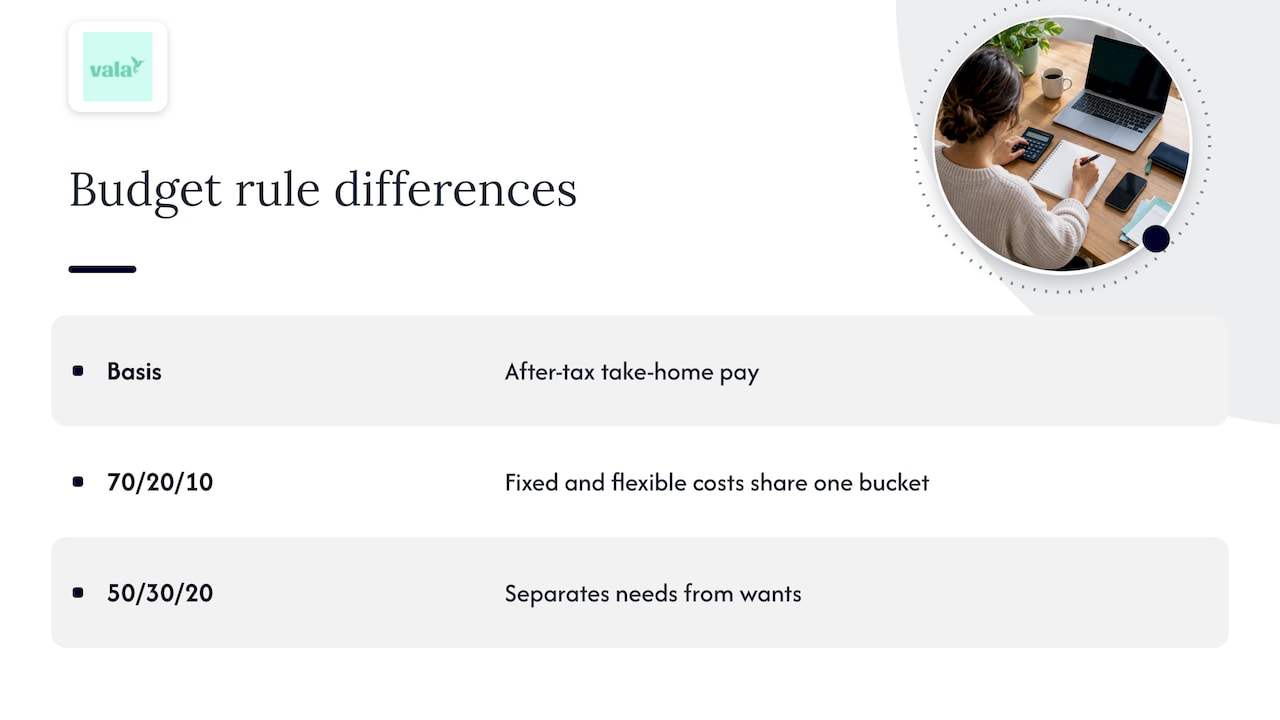
That grouping is the main difference from the better-known 50/30/20 budget, which separates needs from wants. With 70/20/10 you do not have to decide whether a gym membership is a need or a want. It all comes out of the same pot. If you prefer the separated version, see our guide to automating the 50/30/20 budget.
Why the definitions differ
You will see this rule explained in more than one way, and that is normal. Here are two versions from U.S. universities:
- Duke’s personal finance office describes it as 70% for any and all expenses, 20% for savings goals and 10% for paying down debt. It notes the approach may suit people with many financial responsibilities who want something less time-intensive.
- Iowa State’s Office of Student Financial Success published a different arrangement in 2015: 70% for living expenses, 20% for debt such as credit card balances and car loans, and 10% for savings and investments. It is aimed at people working on debt and savings at the same time.
The lesson: the 70% stays the same, but the 20% and 10% swap roles depending on who is writing. Decide which matters more to you right now. If you carry high-interest debt, the bigger slice can go to debt. If you have none, the bigger slice goes to savings.
How to calculate your 70/20/10 budget
Start with monthly take-home pay from steady sources. Use a pay stub, not your salary. If you are paid weekly, multiply a typical paycheck by 4. If you are paid every two weeks, multiply by 2. If your hours vary, use the lowest recent month so the plan holds up.
Then multiply by 0.70, 0.20 and 0.10.
| Monthly take-home | 70% spending | 20% saving | 10% extra debt or giving |
|---|---|---|---|
| $2,500 | $1,750 | $500 | $250 |
| $4,000 | $2,800 | $800 | $400 |
| $6,000 | $4,200 | $1,200 | $600 |
A worked example
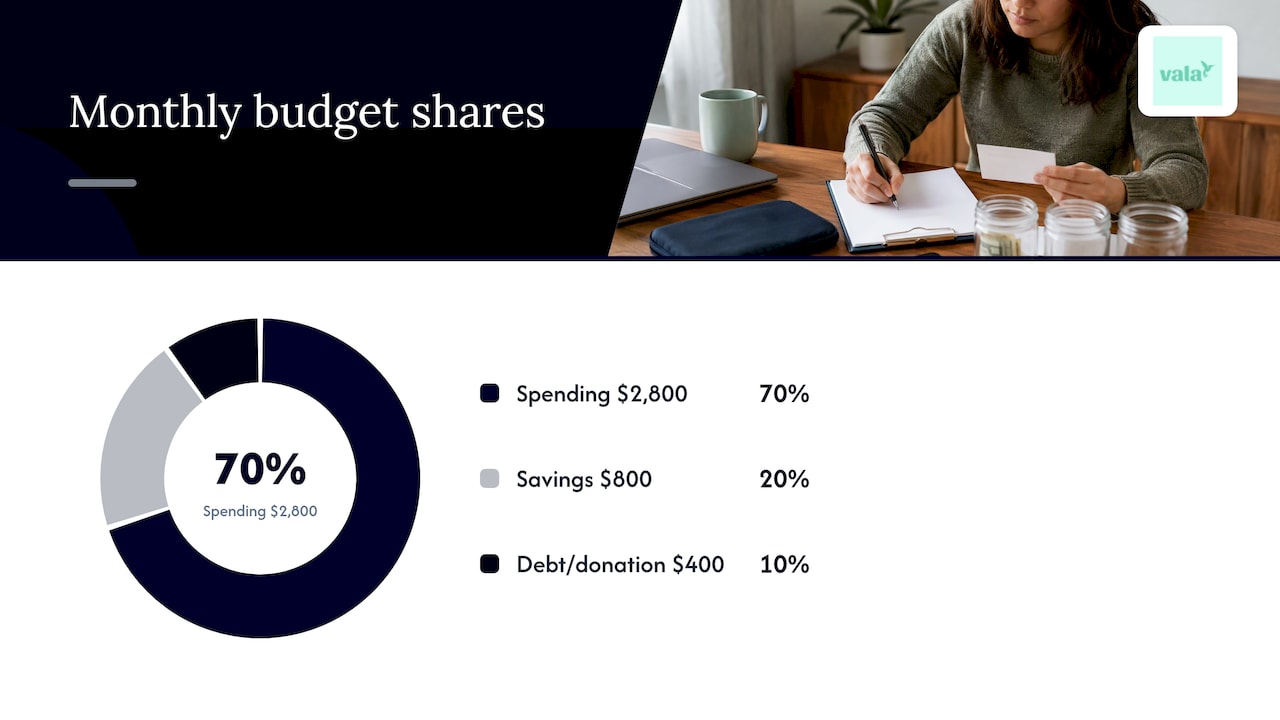
Say you are a young professional taking home $4,000 a month. Your 70% is $2,800. Rent of $1,400, a $120 student loan minimum, $350 for groceries, $150 for transit, $200 for phone and utilities, $100 for subscriptions and $300 for dining and fun adds up to $2,620. That leaves $180 of room inside the 70%.
Your $800 goes to savings, ideally moved the day you get paid. Your $400 goes to extra student loan payments, or to a cause you care about if you have no extra debt.
The same math works for any income. Only the dollar amounts change.
Where each kind of spending goes
This is where most people get stuck, so here is a plain sorting guide.
Inside the 70%:
- Rent or mortgage, utilities, groceries, transit and insurance
- Minimum payments on credit cards, student loans and car loans
- Dining out, entertainment, travel, clothing, streaming and gym memberships
The 20%:
- An emergency fund, a down payment, retirement contributions or other long-term goals
The 10%:
- Extra payments beyond your minimums on high-interest balances like credit cards, student loans or medical debt
- Charitable giving, if you do not have extra debt to pay down
One rule of thumb for the 10%: if you carry credit card debt at a high interest rate, send it there first. Giving can wait until the balance is gone, or you can split the 10% between the two.
How to set it up in five steps
- Find your real take-home number. Use the net amount from your pay stubs, plus any steady side income.
- Pull three months of bank and card statements. One month can be misleading. Three shows the pattern, including quarterly and annual charges.
- Sort what you spent. Mark fixed costs (rent, insurance, loan minimums) separately from flexible ones (food, fun, shopping). You are checking whether the total fits under 70%.
- Flag recurring charges. Streaming, meal kits, apps, gym memberships and cloud storage add up fast and rarely feel like decisions. This is the easiest place to free up room.
- Automate the 20% and the 10%. Set a transfer for payday so saving happens before spending. Our guide to automating personal savings goals walks through it.
At step 4, our Money Leak Detector is designed to do the digging for you: it identifies subscriptions, recurring charges and unexpected bill spikes from your spending, with bank connections made securely through Plaid. That turns a long evening with statements into a short review.
What to do if 70% is not enough
In high-cost cities, rent alone can use most of your 70%. That does not mean the method fails. It means you start where you are.
A reasonable path:
- Shrink the saving share for now. Even 5% saved automatically builds the habit. Raise it by one point every few months.
- Pause giving. If you give regularly, scale it back temporarily and use the 10% on high-interest debt first.
- Trim inside the 70%. Cancel unused subscriptions, shop for cheaper insurance and renegotiate your phone or internet plan.
- Raise income when possible. A raise or side income makes every percentage easier.
Because the 70% mixes essentials and extras, it is easy to overspend on extras without noticing. Checking that bucket weekly, not monthly, keeps it from drifting. Jeff Farrar, a certified financial planner who teaches budgeting at Fairfield University, told WSJ Buy Side that any budget that helps you hit your goals is a successful one. That is the right test for a percentage rule too.
70/20/10 vs. 60/30/10 vs. 50/30/20
All three are variations on the same idea: set percentages, spend inside them.
| Rule | Needs | Wants | Savings and debt |
|---|---|---|---|
| 70/20/10 | 70% for all spending together | (included in the 70%) | 20% savings, 10% extra debt or giving |
| 60/30/10 | 60% essentials | 30% discretionary | 10% saving and investing |
| 50/30/20 | 50% | 30% | 20% |
The 60/30/10 version separates essentials from discretionary spending, and one guide suggests shifting temporarily to 70/20/10 during a tight stretch. That makes the 70/20/10 a natural fit for seasons when costs are high. Move toward 50/30/20 as your income grows or your fixed costs shrink.
Which one should you choose?
- Choose 70/20/10 if you want one simple spending bucket and you are not an overspender by habit.
- Choose 60/30/10 or 50/30/20 if you want a visible line between essentials and wants.
- Start with 70/20/10 and move later if you are early in your career and your costs are heavy.
Using 70/20/10 when you split costs with friends
If you share dinners, trips, concert tickets or a rental with friends, your budget gets messy. The bill gets paid on one person’s card, and everyone else owes them money.
Here is how to keep your percentages honest:
- Count only your share. If you paid $240 for a group dinner and your share is $60, only $60 is your spending. The rest is money you are owed.
- Settle quickly. A reimbursement that sits for weeks makes your 70% look worse than it is, and makes the next budget review harder.
- Set a monthly “social” line inside the 70%. Decide how much you will spend on eating out, trips and events, and track it with your friends’ costs included.
- Plan trips ahead. A weekend trip can use a month of fun money. Put it in your budget before booking.
Our app handles shared expenses by splitting group costs automatically and connecting them to your overall budget view, so a friend’s reimbursement does not throw off your numbers. If you are comparing tools, our guide to budgeting and bill-splitting apps shows what to look for.
Lightweight apps fit percentage rules well. Business Insider’s roundup notes that both 50/30/20 and 70/20/10 work better with lightweight budgeting apps than with granular or big-picture ones. You need to see three numbers, not forty categories.
Keep your 70% honest with a recurring charge review
The 70% only works if it reflects real choices. Recurring charges are the sneaky ones, because you agreed to them once and then stopped looking. Three habits help:
- Review monthly. Scan card statements for names you do not recognize.
- Watch for price creep. A bill that rises by a few dollars a month is easy to miss.
- Check free trials. Set a reminder before they convert to paid plans.
Before you connect any budgeting tool to your accounts, check how trustworthy the site is. You can browse trust scores for finance sites to see how a site rates on safety and reputation signals.
For a monthly routine you can reuse, our monthly budget planner guide lays out a simple template. And if saving feels hard to keep up, setting realistic savings targets helps you pick numbers you will actually hit.
Try it with Vala
Vala is a money recovery app that identifies hidden leaks in your spending: subscriptions, recurring charges and unexpected bill spikes. Run the Money Leak Check to see what is eating into your 70%, then use budgeting, bill reminders, future cash flow simulations and savings goals to put the freed-up money to work. You can start with the free features, and the SaverLite plan is $2.99 per month if you want the full app.

Start your Money Leak Check to see where your money goes, or try the free Money Leak Calculator first.
Our perspective
Percentage rules are a good first step because they give you a clear target. But most people who fall short of 70/20/10 do not fail because of the percentages. They fall short because small recurring charges and surprise bills take a bite out of the 70% before they notice.
That is why we built Vala around finding those leaks, not just tracking totals. A budget that only shows you what you spent last month is a record. A budget that shows you which charges repeat, which ones rose and what is coming next is a plan. Our future cash flow simulations and automated bill reminders are designed to help with exactly that.
For friends who split costs, the same idea applies. When shared expenses connect to your own budget, your 70% reflects what you actually owe, and you can spend with more confidence.
SaverStride
FAQ
Is the 70/20/10 rule based on pre-tax or after-tax income?
It is based on after-tax income, the amount that lands in your account. Use the net figure from your pay stub. If your pay varies, average your last few months or use your lowest recent month to stay safe.
Do minimum debt payments count in the 70%?
Yes, in most versions. Minimum payments are treated as essential living expenses and sit inside the 70%. The 10% is for extra payments beyond the minimums, such as additional student loan or credit card payments, or for donations if you have no extra debt.
Can I change the percentages?
Yes. These rules are guidelines, not contracts. If your rent is high, start with a smaller savings share and raise it gradually. The goal is to hit your financial goals, and any split that gets you there is a good one.
What is the difference between 70/20/10 and 50/30/20?
The 50/30/20 rule separates needs (50%) from wants (30%) and sends 20% to savings and debt. The 70/20/10 rule puts needs and wants in one 70% bucket, then splits the rest between savings and extra debt or giving. It is simpler to run, but you need to watch the large bucket more closely.
Sources
- Budgeting & Spending Plans, Duke Personal Finance
- What’s the Right Amount to Spend on Every Budget Category?, Iowa State University
- The 5 Best Budgeting Methods, WSJ Buy Side
- Best Budgeting Apps, Business Insider
- 60/30/10 Budgeting Rule: The Definitive Guide
- Most Trusted Finance Sites, Verified