
Six rules cover most of what makes group money work: split core costs equally, charge optional extras by usage, name a steward for each budget category, keep a sinking fund for the big stuff, automate weekly contributions, and check in for five minutes every week. Groups that adopt even three of these stop arguing about who owes what.
Here’s phrasing you can paste into a group chat tonight:
- “Lodging and shared transport split evenly, no exceptions.”
- “Optional activities are pay-as-you-go. Opt in or skip, no guilt.”
- “[Name] owns the food budget. Questions go to them, not the group thread.”
- “We each put $25 into the trip account every Friday.”
- “Two-minute money check every Sunday. That’s it.”
A group of four roommates using rule one alone (equal split on rent, utilities, and groceries) cut their end-of-month reconciliation from an hour of receipt digging to a five-minute app check.
Key Takeaways
Group budget rules succeed when they pair clear category splits with automated contributions, decentralized stewardship, and a small flexible spending buffer.
| Point | Details |
|---|---|
| Split by cost type | Split core costs equally and charge optional extras only to participants who use them. |
| Assign category stewards | One person owns each budget line so tracking doesn’t fall on the whole group. |
| Automate the money movement | Schedule weekly contributions to a sinking fund so no one scrambles for deposits later. |
| Keep a guilt-free buffer | A small unrestricted allowance per person prevents the resentment that kills stricter budgets. |
| Use a tool built for it | Vala automates contributions, logs shared expenses, and gives stewards category-level visibility. |
Table of Contents
- What Are Examples of Successful Group Budget Rules Built On?
- Ten Group Budget Rules You Can Adopt This Week
- How Do You Put These Rules Into Practice?
- A Group of Six That Made This System Work for Five Years
- Why Flexible Structure Beats Strict Rules
- Where Vala Fits Into Your Group’s Money Rules
- Frequently Asked Questions
- Sources
What Are Examples of Successful Group Budget Rules Built On?
The rules above aren’t arbitrary. Five design principles explain why they hold up when a group’s enthusiasm fades after month two.
- Clarity of categories. Vague buckets like “trip stuff” invite disputes. Specific categories (lodging, transport, food, activities) let everyone see exactly what they’re paying for.
- Fair splits. Core costs get split equally because everyone benefits equally. Optional costs get split by usage because not everyone wants the $80 excursion.
- Decentralized ownership. One organizational case study found that assigning stewards to individual budget line items increased accountability and improved outcomes over a three-year period, largely because the person tracking the number also felt responsible for it.
- Automation. Rules people have to remember to follow get skipped. Rules that execute themselves don’t.
- Sustainability. A budget with zero flexibility gets abandoned. Building in a small guilt-free spending category and a sinking fund for irregular costs measurably raises the odds the whole system survives past the first disagreement.
Pro Tip: Phrase every rule as a shared standard, not a personal accusation. “We split lodging evenly” lands better than “You need to pay your share of the hotel.”
Ten Group Budget Rules You Can Adopt This Week
1. Split core lodging equally by bed or bedroom. Everyone sleeps somewhere, so everyone pays the same regardless of who booked the room. Fits travel groups and roommates alike. Sample phrasing: “Lodging splits evenly per person, per night.” Enforcement: settle before the trip, not after.
2. Make optional activities pay-as-you-go. The scuba dive shouldn’t get charged to someone who stayed on the beach. This keeps expensive add-ons opt-in so nobody feels pressured into spending they didn’t choose. Sample phrasing: “Optional activities are billed only to participants.” Enforcement: a sign-up list before booking.
3. Build a sinking fund or dedicated account. A shared account funded gradually beats scrambling for a $600 deposit two weeks before a trip. Fits any recurring group, from annual vacationers to a monthly dinner club. Sample phrasing: “We each contribute $X weekly to the group account.” Enforcement: automate the transfer so no one has to remember.
4. Use one payer, logged immediately. Rotating who fronts the card sounds fair, but slows everything down. A single designated payer who logs each purchase on the spot and reimburses within a set window keeps money moving predictably. Sample phrasing: “[Name] books and pays, logged same day.” Enforcement: a 7 day reimbursement deadline.
5. Set a daily or weekly spending cap. Useful for longer trips where costs can creep. Fits groups worried about scope creep more than upfront disagreement. Sample phrasing: “We’re aiming for $75 per person per day.” Enforcement: a mid-trip check-in if anyone’s tracking over.
6. Assign a steward per category. One person owns food, another owns transport, another owns lodging. This decentralized structure means no single person carries the whole mental load. Sample phrasing: “[Name] manages the food budget end to end.” Enforcement: stewards report a one-line update weekly.
7. Automate weekly contributions. Manual transfers get forgotten. Scheduled ones don’t. Fits any group with a recurring shared goal. Sample phrasing: “Contributions auto-transfer every Friday.” Enforcement: set it up once, review quarterly.
8. Set a cancellation and refund protocol upfront. Someone always drops out. Decide in advance whether deposits are refundable, transferable, or absorbed by the group. Sample phrasing: “Deposits are non-refundable after booking, but transferable to a substitute.” Enforcement: put it in writing before money moves.
9. Keep a guilt-free spending bucket. A small, unaccounted-for allowance per person prevents the resentment that kills stricter budgets. Sample phrasing: “$20 per person is unrestricted, no receipts needed.” Enforcement: cap it low enough that it doesn’t undercut the core budget.
10. Schedule a review and top-up point. Budgets drift. A simple receipt-level tracker with columns for payer, item, category, and split type makes the review five minutes instead of thirty. Sample phrasing: “We revisit the budget every Sunday, top up if needed.” Enforcement: whoever’s steward for that category flags shortfalls early.
How Do You Put These Rules Into Practice?
Getting a group budget running takes one focused conversation, not a committee. The sequence is simple: agree on the numbers, pick your accounts, assign stewards, automate contributions, log every expense, and check in weekly.
- Agree on category percentages first. A common starting split runs accommodation at 25 to 40 percent, transport at 20 to 35 percent, food at 15 to 25 percent, activities at 10 to 20 percent, with a 5 to 10 percent buffer for the unexpected.
- Choose your account setup. A dedicated shared account works for recurring groups; a designated card or a shared expense tracker works fine for one-off events.
- Assign stewards per category. Give one person food, another lodging, another activities. Rotate the role each trip if you want to spread the budget accountability around.
- Automate the contribution schedule. Weekly beats monthly for most groups because smaller amounts are easier to absorb and harder to skip.
- Log every expense the day it happens. Waiting until the trip ends to reconstruct who paid for what is where most group budgets fall apart.
- Settle imbalances within a week. A short reimbursement deadline keeps the group account from carrying a running debt no one tracks.
- Review weekly or monthly and adjust. Raise contributions if the sinking fund is falling behind target, lower them if it’s overshooting, and revisit the split method if usage-based costs keep causing friction.
For cancellations, decide the refund rule before anyone books anything, and make sure it applies the same way whether someone drops a $40 activity or a $400 flight.
A Group of Six That Made This System Work for Five Years
One group of six friends turned an annual trip into a five-year habit by keeping the money rules boringly simple. Their result was smooth finances with dedicated travel funds, automated per-person contributions, a designated booker reimbursed promptly, and quick top-ups if needed.
Their year-round rhythm ran in four phases: plan the destination and rough budget in January, book flights and lodging by spring using the accumulated fund, travel without worrying about who owes whom, then settle any small remaining balances within a week of getting home.
Why Flexible Structure Beats Strict Rules
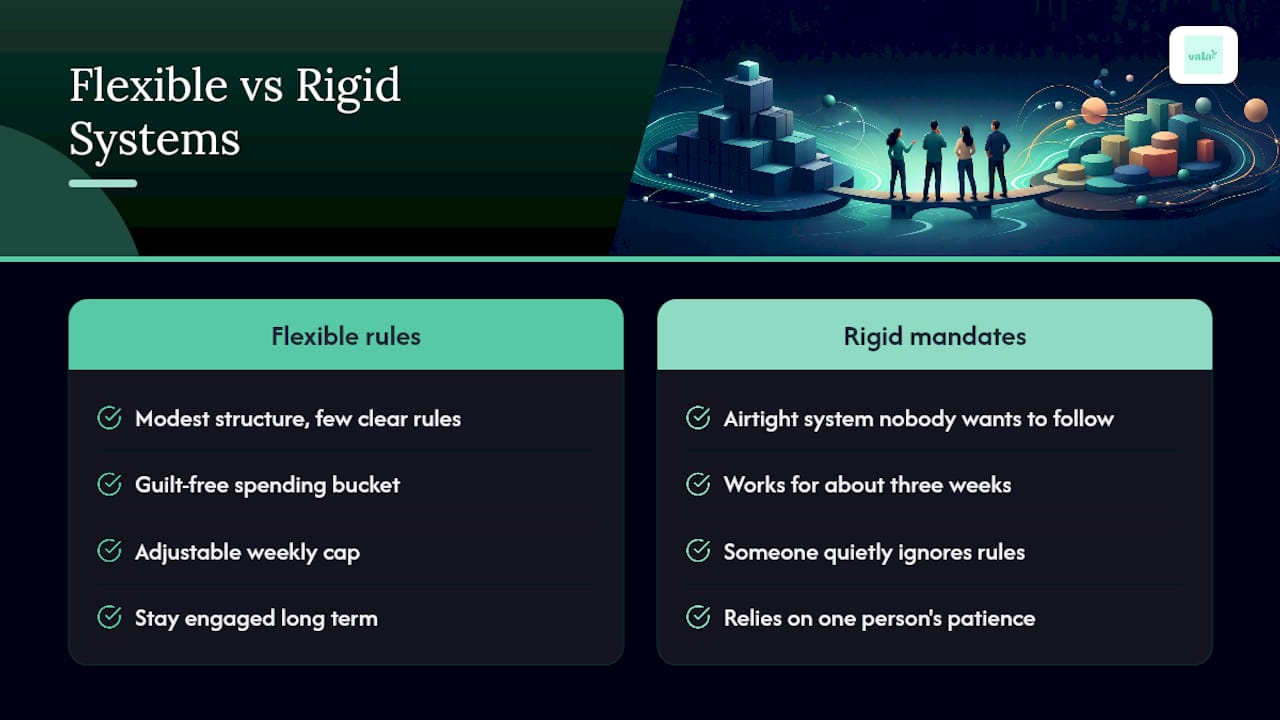
Modest structure with a few clear rules sticks better than an airtight system nobody wants to follow. Groups that build in flexibility (a guilt-free spending bucket, an adjustable weekly cap) stay engaged long after the initial excitement of “let’s get organized” fades. Rigid mandates work for about three weeks before someone quietly ignores them.
Shared ownership matters just as much as the rules themselves. When one person owns the food budget and another owns transport, the group isn’t relying on a single person’s patience to hold the whole system together. That distributed responsibility is what keeps people checking in voluntarily instead of resentfully.
Where Vala Fits Into Your Group’s Money Rules
Most of these rules live or die on whether someone actually tracks the numbers, and that’s the part a spreadsheet usually loses. Vala handles the mechanics behind the rules you just set: automated contributions for your sinking fund, shared expense logging so nobody has to reconstruct receipts from memory, category budgets your steward can monitor without chasing five people for updates, and weekly summaries that make your Sunday check-in take two minutes instead of twenty.

If your group is ready to stop tracking money in a group chat and a half-updated spreadsheet, the Vala personal finance app sets up shared categories and automated transfers in one sitting. Open an account and add your group’s first budget category today.
Frequently Asked Questions
What’s the simplest group budget rule to start with?
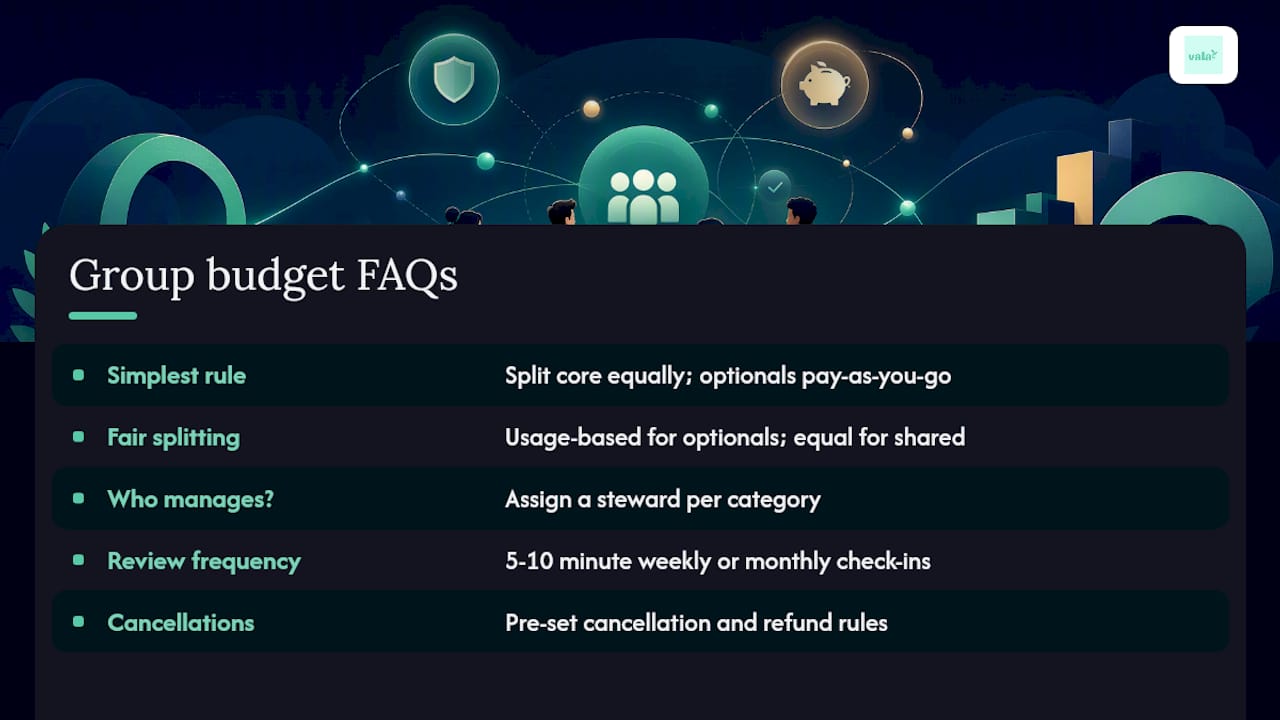
Split core costs like lodging and shared transport equally, and make everything optional pay-as-you-go. This one rule alone resolves most disputes before they start.
How do you split costs fairly when people use different amounts?
Use usage-based splitting for optional items and equal splitting for costs everyone shares regardless of participation, like a hotel room or a group Airbnb.
Who should manage a shared group budget account?
Assign a steward for each category, food, lodging, transport, so responsibility is distributed instead of falling on one organizer.
How often should a group review its budget?
A five to ten minute weekly or monthly check-in catches drift early and gives the group a chance to top up a sinking fund before it runs short.
What happens if someone cancels after paying into the group fund?
Set a cancellation and refund protocol before anyone books anything, deciding in advance whether deposits are refundable or transferable to a substitute.
Sources
- Can a team manage its own budget? Three years later, we have an answer. | The Civic Canopy
- Here’s How to Budget for Group Trips Based on a Five-Year Success Story | TravelAwaits
- How to build a budget that actually sticks this time | The Penny Hoarder
- Shared budget rules for clubs by receipt items: fair splits and workflows | Spark
- Group trip budget planning: a complete guide | Vacation Planner Blog