
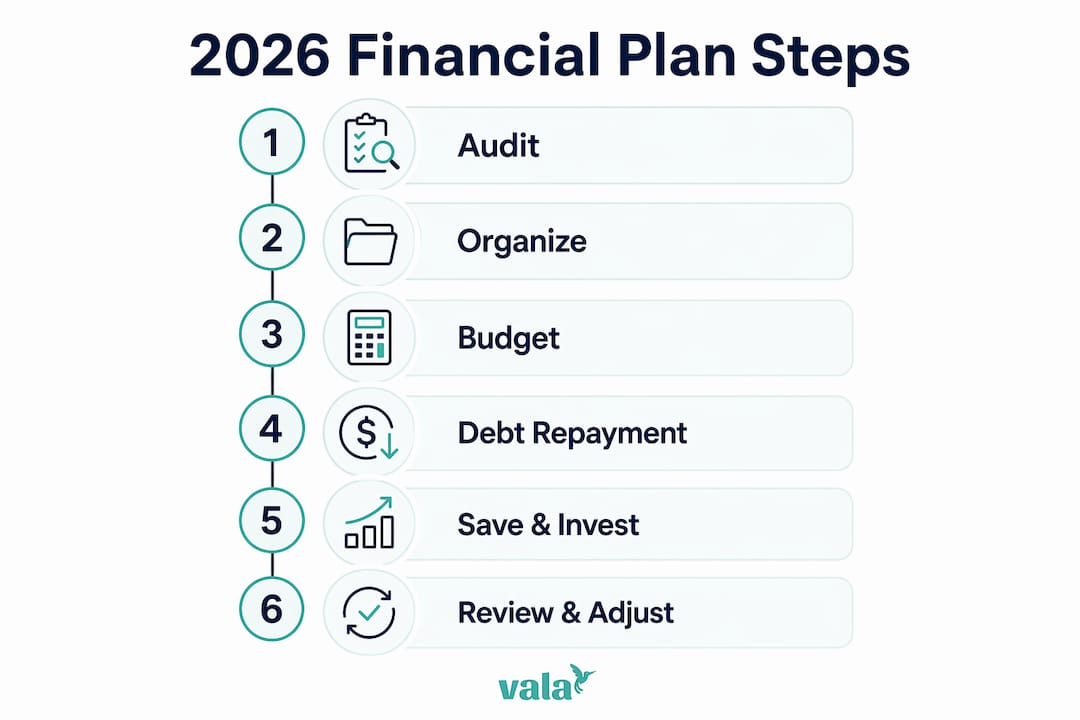
An annual financial plan is a structured roadmap that maps your income, expenses, debt, savings, and investments across a full calendar year. To create an annual financial plan for 2026, you need four core components: a realistic budget, a debt repayment strategy, a savings target, and an investment timeline. The most widely recommended starting framework is the 50/30/20 rule, which allocates 50% of after-tax income to needs, 30% to wants, and 20% to savings and debt repayment. Tools like Valapoint, the debt avalanche method, and SMART goal frameworks give you the structure to move from intention to measurable progress by December 2026.
What do you need before creating your 2026 financial plan?
Before you write a single budget line, you need a clear picture of where your money actually stands. Skipping this step is the most common reason financial plans fall apart before February. Gather everything in one place before you start allocating.
Here is what to collect:
- Net monthly income: Add up all after-tax income sources, including your salary, freelance work, rental income, and any side hustle revenue.
- Fixed monthly expenses: Rent or mortgage, car payments, insurance premiums, and loan minimums. These do not change month to month.
- Variable monthly expenses: Groceries, dining, entertainment, clothing, and subscriptions. Pull three months of bank statements to find your real average, not your estimated one.
- Debt inventory: List every debt with its current balance, interest rate, and minimum payment. This becomes the foundation of your repayment strategy.
- Savings and investment accounts: Note current balances in your emergency fund, 401(k), IRA, and any brokerage accounts.
Once you have this data, organize it in a spreadsheet or a budgeting app that supports real-time tracking. Spreadsheets work well for people who want full manual control. Apps work better for people who want automation and pattern recognition. Either way, the data must be current and complete before you move forward.
Pro Tip: Starting your planning 4 to 6 months early reduces rushed estimates and produces a more accurate plan. If you are reading this mid-year, start now rather than waiting for January.

How to build a realistic budget for 2026 using proven frameworks
A budget is not a restriction. It is a spending plan that tells your money where to go before the month begins. Two frameworks dominate personal budgeting: the 50/30/20 rule and zero-based budgeting. Each has a distinct use case.
The 50/30/20 rule is the most accessible starting point for most adults aged 25 to 50. You split your after-tax income into three buckets: 50% for needs like housing and utilities, 30% for wants like dining and travel, and 20% for savings and debt repayment. It requires minimal setup and is easy to adjust as income changes.
Zero-based budgeting assigns every dollar a specific job until your income minus your expenses equals zero. This method works best for people with irregular income or those who want granular control over every category. It takes more time to set up but leaves no money unaccounted for.
| Budgeting method | Best for | Setup effort | Flexibility |
|---|---|---|---|
| 50/30/20 rule | Beginners, stable income | Low | High |
| Zero-based budgeting | Detail-oriented planners, variable income | High | Medium |
| Envelope method | Cash spenders, overspenders | Medium | Low |
Common budgeting mistakes to avoid in 2026:
- Underestimating variable expenses. Most people budget what they wish they spent, not what they actually spend. Use real data from the last 90 days.
- Forgetting annual expenses. Car registration, holiday gifts, and annual subscriptions hit once a year but should be divided into monthly reserves.
- Setting a budget and never reviewing it. A budget that is not reviewed monthly becomes fiction within 60 days.
Pro Tip: Track your spending weekly for the first two months of your plan. Weekly check-ins catch overspending before it compounds into a monthly shortfall.
What debt repayment methods optimize your 2026 financial health?
Debt is the single largest drag on most people’s ability to save and invest. Choosing the right repayment method in 2026 can mean the difference between paying off debt in three years versus five.
The two primary methods are the debt avalanche and the debt snowball. The debt avalanche targets your highest-interest debt first while paying minimums on everything else. The debt avalanche saves borrowers over $1,000 annually in interest compared to other payoff methods. That is real money redirected toward savings or investments once the debt is cleared.
The debt snowball targets your smallest balance first, regardless of interest rate. It costs more in total interest but delivers faster psychological wins. Research consistently shows that early wins improve follow-through for people who struggle with motivation.
| Method | Interest cost | Payoff speed | Motivation boost |
|---|---|---|---|
| Debt avalanche | Lowest | Fastest mathematically | Lower early wins |
| Debt snowball | Higher | Slower mathematically | Strong early wins |
To integrate debt repayment into your annual plan, set a fixed monthly payoff amount above the minimum on your target debt. Use Valapoint’s debt payoff calculator to model exactly when each debt clears and how much interest you save. Treat this fixed amount as a non-negotiable line in your budget, the same way you treat rent.
One critical balance to maintain: do not pay down low-interest debt aggressively while ignoring your employer’s retirement match. Employer matching contributions are effectively free money with an immediate 50% to 100% return. Capture the full match before directing extra cash toward debt.
How to prioritize saving and investing in your 2026 annual plan
Saving and investing are not the same thing, and your 2026 plan needs both. Saving protects you from short-term disruption. Investing builds long-term wealth. The sequence matters.
Follow this order when allocating your 20% savings and investment bucket:
- Build a starter emergency fund. Target $500 to $1,000 first. This emergency fund baseline prevents you from going deeper into debt when an unexpected expense hits.
- Capture your full employer retirement match. If your employer matches 4% of your salary, contribute at least 4%. This is the highest guaranteed return available to most workers.
- Expand your emergency fund. Once you have the starter amount, build toward three to six months of living expenses. Keep this in a high-yield savings account, not a checking account.
- Pay down high-interest debt. Any debt above 7% to 8% interest deserves aggressive repayment before broader investing.
- Invest for medium and long-term goals. Use SMART goal frameworks to define goals with specific dollar amounts and deadlines. A short-term goal might be a $10,000 vacation fund by December 2027. A long-term goal might be $500,000 in retirement savings by age 60.
Insurance is a financial planning component most people overlook until it is too late. Health, disability, and term life insurance protect your income and assets from catastrophic loss. Review your coverage annually as part of your financial goal timeline to confirm it still matches your current life situation.
Pro Tip: Automate your savings transfers on payday. When money moves to savings before you see it in your checking account, you spend what remains rather than saving what is left over.
How do you maintain your financial plan throughout 2026?
A financial plan written in January and reviewed in December is not a plan. It is a wish list. Many personal financial plans fail because they are treated as a one-time effort rather than a living document with regular updates.
A rolling forecast updated monthly or quarterly keeps your plan relevant and responsive to real life. Rolling forecasts replace the static annual budget with a continuous 12-month view that shifts forward each month. This approach is standard practice in corporate finance and works equally well for personal finances.
Set these review checkpoints into your calendar now:
- Monthly: Review actual spending versus budget. Adjust next month’s allocations based on what changed.
- Quarterly: Reassess your debt payoff progress, savings balances, and investment contributions. Update your projections.
- Annually: Conduct a full plan reset. Recalculate net income, update goals, and revise your budget framework if your life circumstances changed.
Common pitfalls that derail plans mid-year include lifestyle creep after a raise, unplanned large expenses like car repairs or medical bills, and loss of motivation after a slow month. The fix for all three is the same: a scheduled review that catches drift early. Adaptive budgeting software and apps support version control and continuous updates far better than a static spreadsheet.
Pro Tip: Assign clear ownership of your plan. If you share finances with a partner, decide who reviews which categories and when. Clear plan ownership and a defined review cadence are the two factors most strongly linked to plan adherence.
Key takeaways
A complete 2026 financial plan requires a realistic budget, a structured debt strategy, a sequenced savings approach, and monthly reviews to stay on track.
| Point | Details |
|---|---|
| Start with a full financial audit | Collect income, expenses, debts, and savings data before writing a single budget line. |
| Use the 50/30/20 rule as your baseline | Allocate 50% to needs, 30% to wants, and 20% to savings and debt repayment. |
| Choose debt repayment strategically | The debt avalanche saves over $1,000 annually in interest versus other methods. |
| Sequence your savings correctly | Build a starter emergency fund first, then capture employer match, then invest. |
| Review your plan monthly | Rolling forecasts and monthly check-ins prevent plans from becoming irrelevant by Q2. |
Why flexibility beats perfection in your 2026 financial plan
The most common reason I see financial plans fail is not lack of discipline. It is rigidity. People build a detailed January budget, hit one unexpected expense in February, and abandon the entire plan because it no longer matches reality.
The plans that actually work are the ones built with revision in mind. I have found that separating aspirational targets from realistic forecasts is one of the most underrated planning moves you can make. Mixing both in a single document undermines the plan’s effectiveness because you can never tell whether you are on track or just optimistic.
Monthly recalibration is not a sign that your plan is broken. It is proof that your plan is working. A financial plan’s real value comes from the structured conversations about priorities it forces you to have with yourself, not from a static document you filed away in January.
Set ambitious goals. Write them down with specific dollar amounts and deadlines. Then build a realistic monthly budget that gets you there incrementally. The psychological benefit of hitting a $200 savings milestone in March beats the frustration of missing a $2,000 target every single time. Progress compounds. So does confidence.
— SaverStride
Track your 2026 plan with Valapoint
Building your plan is step one. Sticking to it is where most people need support.
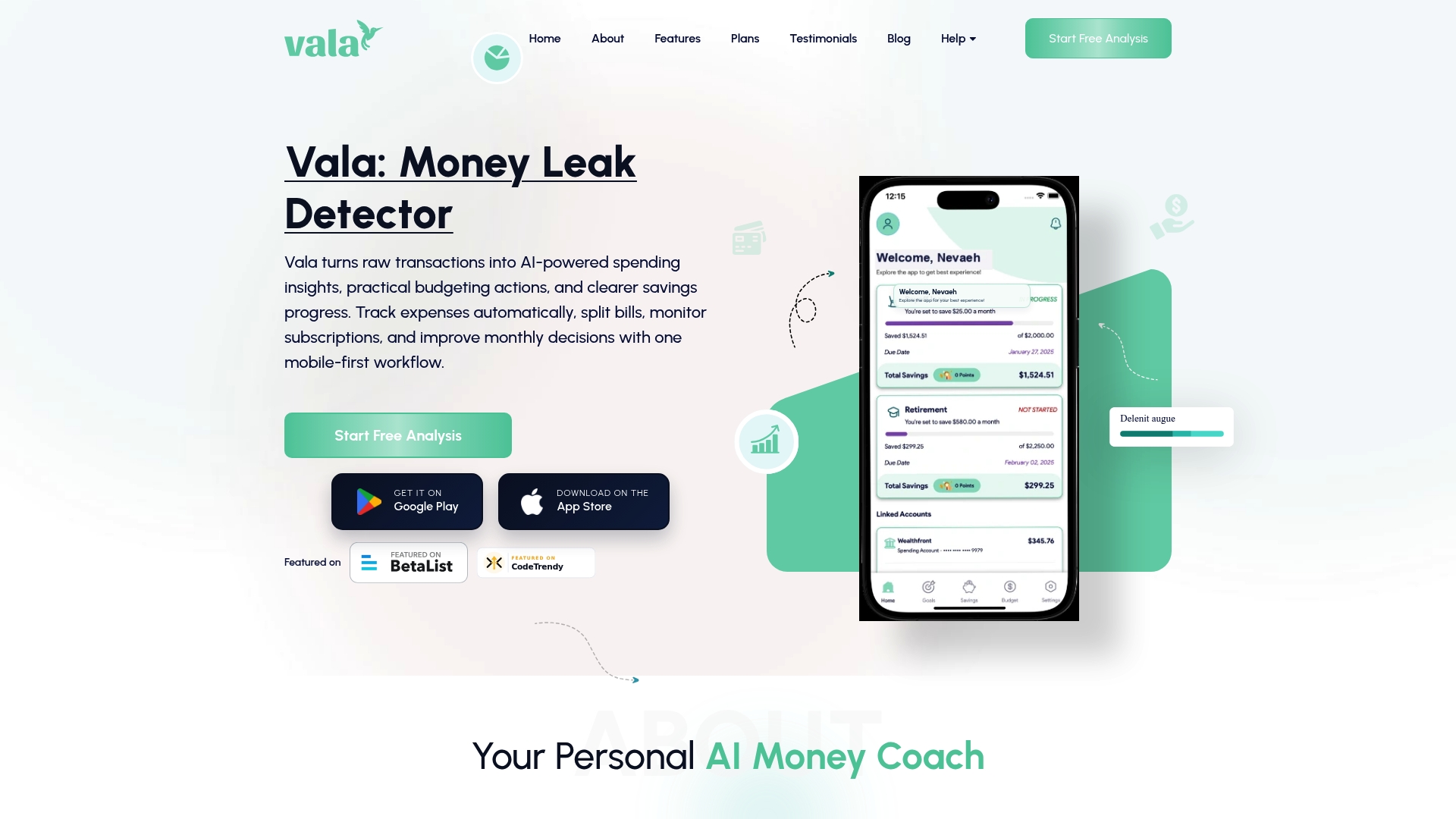
Valapoint’s personal finance app gives you real-time expense tracking, budget management, and goal progress in one place. You can set up your 50/30/20 budget, track debt payoff milestones, and get automatic alerts when spending drifts off course. The AI-powered insights surface hidden spending patterns you would not catch manually, so you spend less time reviewing spreadsheets and more time making progress. Valapoint also supports couples and groups, making it easy to manage shared finances without the back-and-forth. Start your 2026 plan with the tools that keep it alive all year.
FAQ
What is an annual financial plan?
An annual financial plan is a structured document that outlines your income, budget, debt repayment strategy, savings targets, and investment goals for a full calendar year. It serves as a decision-making guide for every major financial choice you make throughout the year.
How do I start creating a financial plan for 2026?
Start by calculating your net monthly income, listing all fixed and variable expenses, and inventorying your debts and savings accounts. Once you have that data, apply a budgeting framework like the 50/30/20 rule to allocate your income across needs, wants, and savings.
What is the best budgeting method for 2026?
The 50/30/20 rule is the most accessible method for most individuals, allocating 50% to needs, 30% to wants, and 20% to savings and debt repayment. Zero-based budgeting is a stronger choice for people with variable income or those who want full control over every spending category.
How often should I review my annual financial plan?
Review your plan monthly to compare actual spending against your budget, and conduct a full quarterly review to assess debt payoff progress and savings growth. Plans reviewed monthly are significantly more likely to stay on track than those reviewed only once or twice a year.
Should I pay off debt or invest first in 2026?
Capture your full employer retirement match before aggressively paying down debt, since employer matching delivers an immediate guaranteed return. After securing the match, prioritize paying off any debt with an interest rate above 7% to 8% before directing additional funds toward investing.