
Setting realistic savings targets means defining personalized, achievable financial goals that align with your actual income and expenses. Goal-setters save consistently at a rate of 75% compared to 62% for those without specific goals. That gap is not a coincidence. The SMART framework, the professional standard for setting financial objectives, turns vague intentions into clear plans with deadlines and dollar amounts. Financial professionals also recommend saving 20% of net income as a baseline, though starting as low as 5% is a perfectly valid entry point.
How to set realistic savings targets using the SMART framework
The SMART framework is the most effective structure for converting a savings wish into a working plan. Each letter stands for a quality your goal must have: Specific, Measurable, Achievable, Relevant, and Time-bound. Without all five, your goal is just a hope.
Here is what each element looks like in practice:
- Specific: Name the exact goal and the exact amount. “Save money” fails. “Save $5,000 for a car down payment” works.
- Measurable: Attach a number you can track weekly or monthly. If you cannot measure progress, you cannot course-correct.
- Achievable: Your monthly contribution must fit inside your actual budget. A goal that requires cutting food spending to zero is not achievable.
- Relevant: The goal must matter to your life right now. Saving for a house makes sense if you plan to buy within three years. Saving for a boat when you have credit card debt does not.
- Time-bound: Set a firm deadline. “By december 2027” forces you to calculate what you need to save each month.
A vague goal sounds like: “I want to save more this year.” A SMART savings goal sounds like: “I will save $3,600 for an emergency fund by december 2026 by transferring $300 to a dedicated account every month.”
Pro Tip: Name your savings account after the goal, such as “Emergency Fund” or “Vacation 2027.” Labeled accounts reduce the temptation to dip into them because the money feels already spoken for.
One underused SMART tactic is creating separate goal buckets for each objective. Mixing your vacation fund and your emergency fund in one account makes it hard to track either. Separate accounts give you a clear progress bar for every goal you are working toward.
How to determine a realistic savings target based on your budget
Your savings target must be grounded in your actual numbers, not in what you think you should be saving. Financial professionals recommend a 20% savings rate as the baseline, but they also advise starting at 5% and increasing by 1% every three months. That gradual ramp prevents the shock of a sudden lifestyle change.

The 50/30/20 rule gives you a clear structure for finding that 20%. The rule allocates 50% of your after-tax income to needs, 30% to wants, and 20% to savings and debt repayment. If your take-home pay is $3,500 per month, your savings target under this rule is $700 per month.
To check if a specific goal is feasible, use this formula: divide the total amount you still need to save by the number of months until your deadline. That gives you your required monthly contribution. If that monthly figure exceeds 20% of your net income, you have two options: extend the deadline or reduce the goal amount. Quitting is not the third option.
| Goal | Total Amount | Timeline | Monthly Contribution Needed |
|---|---|---|---|
| Emergency fund | $1,000 | 5 months | $200 |
| Vacation | $2,400 | 12 months | $200 |
| Car down payment | $5,000 | 18 months | $278 |
| Home down payment | $20,000 | 48 months | $417 |
The table above assumes no existing savings toward each goal. Adjust the starting balance to reflect what you already have set aside.
Pro Tip: Use the savings calculator from Valapoint to run these numbers in seconds. Plug in your goal amount, timeline, and current savings to see exactly what monthly contribution you need.
If your math shows you cannot hit a goal at your current income, that is useful information. It tells you to either extend the timeline, reduce the target, or look for ways to increase income before committing to the plan.
What tools and strategies help you automate and track savings goals
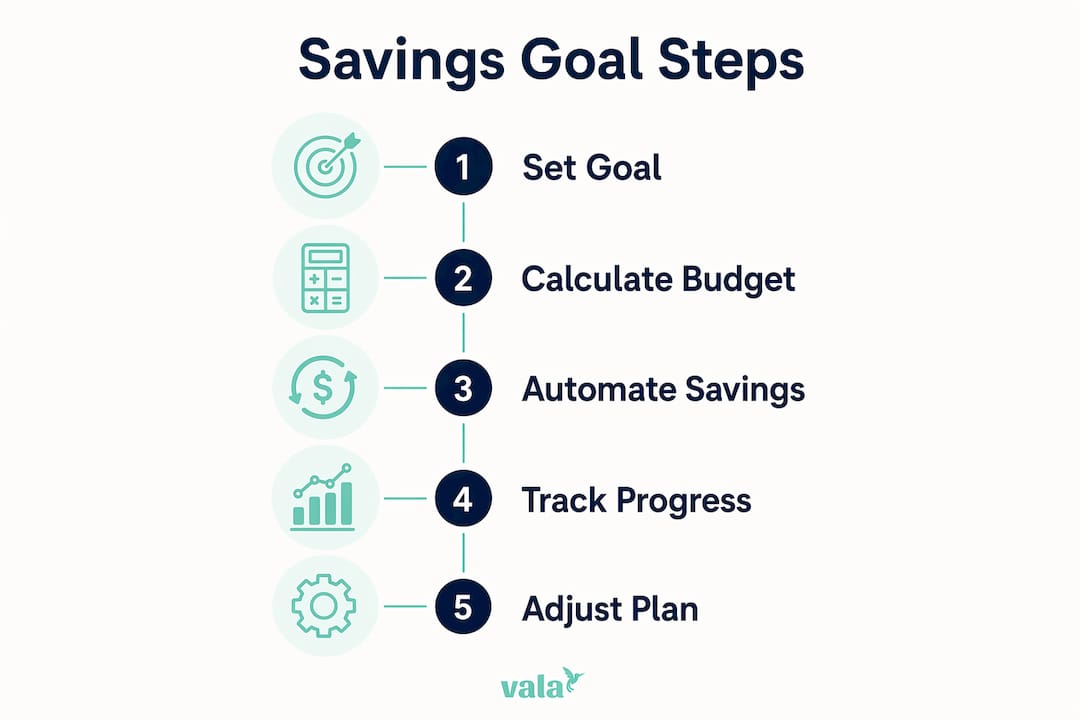
Automation is the single biggest predictor of hitting a savings goal. Splitting your direct deposit or scheduling a recurring transfer the day after payday removes the decision entirely. You never see the money in your checking account, so you never spend it.
The most effective automation methods are:
- Direct deposit splitting: Ask your employer to send a fixed percentage or dollar amount directly to your savings account. This works before you even log in to check your balance.
- Scheduled transfers: Set a recurring bank transfer for the day after each paycheck arrives. Timing it right after payday mimics the effect of direct deposit splitting.
- Goal-progress programs: Some banking apps track savings goals every purchase to the nearest dollar and transfer the difference to savings. The amounts are small, but the habit builds over time.
- Goal-specific accounts: Open a separate account for each major savings goal. Label each one clearly. This makes it easy to see exactly how close you are to each target.
Tracking progress matters as much as automating contributions. Check your savings balances once a month, not once a year. Monthly reviews let you catch problems early, such as a month where an unexpected expense forced you to skip a transfer. Personal finance planning tools built for your age group can show spending patterns that reveal where your money actually goes, which makes it easier to protect your savings contributions.
Adjust your goals dynamically. If you get a raise, increase your monthly contribution. If you face a large unexpected expense, reduce the contribution temporarily rather than stopping entirely. Consistency over time matters more than perfection in any single month.
Common mistakes that make savings targets unrealistic
The most common mistake is setting a total savings goal without calculating the monthly contribution it requires. A $10,000 goal sounds reasonable until you realize it requires $833 per month on a $2,500 take-home salary. Without that monthly calculation, the plan fails before it starts.
- Ignoring monthly affordability. Always run the monthly contribution formula before committing to a goal. If the number does not fit your budget, adjust the goal before you start, not after you fail.
- Setting aspirational rather than realistic targets. Goal setting works best when it reflects your actual financial situation, not an idealized version of it. Adjusting deadlines or amounts is always better than abandoning the plan entirely.
- Skipping the starter emergency fund. A $1,000 emergency fund covers roughly 70% of typical unexpected expenses and builds the savings habit before you tackle bigger goals. Start here if you have nothing saved.
- Putting short-term savings in the stock market. For any goal under five years, avoid market exposure and use high-yield savings accounts or certificates of deposit instead. Market volatility can wipe out a down payment fund right before you need it.
- Treating a missed month as a failure. One skipped transfer does not ruin a savings plan. Missing six months in a row does. Adjust and continue rather than stopping.
“Savings goals are dynamic and can evolve as life circumstances change. Adopting a flexible approach is a hallmark of sustainable financial health.” — Fidelity
The psychological side of savings is real. When a goal feels too far away, motivation drops. Breaking a large goal into smaller milestones, such as celebrating every $500 saved toward a $5,000 target, keeps the momentum going. Automating savings habits removes the willpower requirement entirely, which is why it works even when motivation fades.
Key Takeaways
Setting realistic savings targets requires a specific monthly contribution plan, a clear deadline, and automation to make the habit stick.
| Point | Details |
|---|---|
| Use the SMART framework | Define goals with exact amounts, deadlines, and monthly contributions to make them achievable. |
| Start with 5%, scale to 20% | Begin at a savings rate you can sustain and increase by 1% every three months. |
| Calculate monthly contributions first | Divide your total goal by months remaining to confirm the plan fits your budget before committing. |
| Automate every transfer | Schedule contributions right after payday so savings happen before spending decisions do. |
| Adjust goals, never quit | When life changes, extend the timeline or reduce the amount rather than abandoning the plan. |
Why I think most savings advice sets people up to fail
Most savings guides lead with the 20% rule and leave it there. That number is a benchmark, not a starting point. Telling someone earning $2,800 a month to save $560 immediately is a fast way to make them feel like budgeting is not for them.
What actually works is starting embarrassingly small. A $50 automatic transfer every two weeks builds the identity of someone who saves. That identity is worth more than any specific dollar amount in the first three months. Once the habit is there, scaling up feels natural rather than forced.
I have also seen how much named savings buckets change behavior. Calling an account “Emergency Fund” instead of “Savings Account 2” makes it psychologically harder to raid. The label creates a mental contract. It sounds minor, but the effect on spending decisions is real.
The other thing most guides skip is the review cadence. Setting a goal in january and checking it in december is not a plan. Monthly reviews, even a five-minute check of your balances, catch problems before they compound. Life changes constantly. Your savings plan should change with it, and flexible savings planning is what separates people who reach their goals from those who restart from zero every year.
Do not be discouraged by a month where you saved nothing. The goal is a long-term average, not a perfect streak. Adjust, continue, and trust that small consistent actions compound into real results.
— SaverStride
Valapoint makes your savings goals visible and automatic
Knowing what to do and actually doing it are two different things. Valapoint’s personal finance app connects your budget, your spending patterns, and your savings goals in one place so nothing falls through the cracks.

With Valapoint, you can set up named goal buckets, track your monthly contributions in real time, and get AI-powered insights that show exactly where your money is going. The app flags spending patterns that quietly drain your savings capacity, so you can redirect that money toward goals that matter. Whether you are building your first $1,000 emergency fund or saving for a home down payment, Valapoint gives you the clarity to stay on track. Try the budget goal tracker and see how close you already are to your next milestone.
FAQ
What is a realistic savings target for beginners?
A realistic starting savings target is 5% of your net income. Increase that rate by 1% every three months until you reach 20%, which is the professional benchmark for long-term financial health.
How do I calculate my monthly savings contribution?
Divide the total amount you need to save by the number of months until your deadline. If that number exceeds 20% of your monthly take-home pay, extend your timeline or reduce the goal amount.
What is the SMART framework for savings goals?
SMART stands for Specific, Measurable, Achievable, Relevant, and Time-bound. Applying all five criteria turns a vague savings intention into a concrete plan with a deadline and a monthly dollar target.
Should I invest my savings for short-term goals?
No. For any goal with a timeline under five years, keep your savings in a high-yield savings account or a certificate of deposit. Stock market volatility can reduce your balance right when you need the funds.
How do I stay motivated when progress feels slow?
Break large goals into smaller milestones and celebrate each one. Automating your contributions removes the need for daily motivation, since the transfer happens whether you feel inspired or not.