
The best thing you can do right now is set a simple budget and automate one transfer to savings. That single action, done today, starts the cycle that every other money habit builds on. Here is the short checklist to follow:
- Daily (2 minutes): Open your banking app and confirm no unexpected charges.
- Weekly (10 minutes): Review spending by category and flag anything over budget.
- Monthly (30 minutes): Reset your budget, check your savings balance, and pay down any extra debt.
Expect a small cash buffer within 30 days, noticeably faster debt payments by 90 days, and visible net worth progress by 365 days. FINRA’s five-step financial roadmap confirms this sequence works: take inventory, understand interest, pay off debt, build retirement, then optimize taxes. Tracking net worth alongside monthly spending also keeps motivation steady through uneven months.
Key Takeaways
Automating one savings transfer and reviewing spending weekly are the two habits that move every other money goal forward faster.
| Point | Details |
|---|---|
| Start with three core numbers | Know your take-home income, essential expenses, and net worth before building any budget. |
| Use a percentage framework | The 50/30/20 rule or Fidelity’s 60/30/10+15 guideline gives you a tested starting split. |
| Build an emergency fund first | Aim for $500–$1,000 to start, then grow to 3–6 months of essential expenses over time. |
| Pick a debt strategy and automate it | Snowball builds momentum; avalanche saves interest. Set minimums on autopay and direct extra dollars to your target debt. |
| Valapoint automates the follow-through | Vala connects accounts, tracks categories, and alerts you before you overspend, so the plan stays active without manual effort. |
Table of Contents
- How do you calculate the numbers that drive your money?
- What budget framework actually works for beginners?
- How do you track spending without it becoming a chore?
- How much emergency fund do you actually need?
- Debt snowball vs. avalanche: which one should you use?
- Where should you put extra savings after debt?
- How do you protect what you have built?
- How do you make budgeting a habit that actually sticks?
- How does an AI app like Vala support every step of this plan?
- The one habit that changed how I manage money
- Vala makes it easier to follow through on your plan
- Useful resources for going deeper
- Sources
How do you calculate the numbers that drive your money?
Three figures run everything: your monthly take-home income, your essential expenses, and your net worth snapshot.
Monthly take-home income is what actually hits your account after taxes and deductions. If your income varies, use a 12-month rolling average from your bank statements. That average becomes your planning baseline. Consumer recommends this approach specifically for irregular earners.
Essential expenses split into fixed (rent, car payment, insurance) and variable (groceries, utilities, gas). Pull three months of statements and average the variable ones. The total tells you your floor: the minimum you need each month no matter what.
Net worth is simply assets minus liabilities. Add up savings, retirement accounts, and any property value, then subtract every debt balance. You do not need precision here. A rough number updated monthly shows whether you are moving forward.
Pro Tip: Write all three numbers on one page before you build any budget. Seeing income, expenses, and net worth together in one place makes priorities obvious and removes the guesswork from every decision that follows.
What budget framework actually works for beginners?
Two frameworks cover most situations. Pick the one that fits your income structure.
| Framework | Essentials | Wants / Nonessentials | Short-Term Savings | Retirement |
|---|---|---|---|---|
| 50/30/20 | 50% | 30% | 20% | Included in 20% |
| Fidelity 60/30/10+15 | 60% | 30% | 10% | +15% pre-tax |
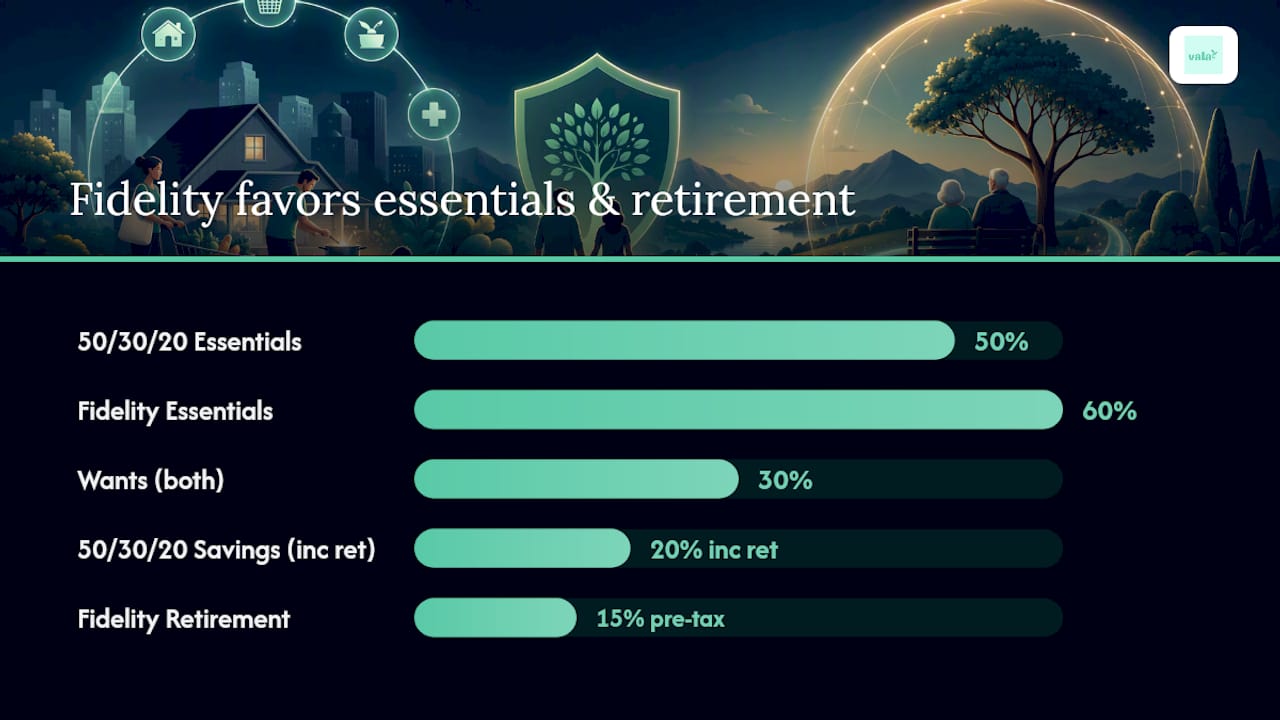
Fidelity’s money management guide outlines both models. The 50/30/20 rule works well when your income is moderate and retirement is already handled through a workplace plan. Fidelity’s 60/30/10+15 guideline suits higher earners who want to separate retirement from short-term goals.
Sinking funds solve the problem of predictable irregular expenses. Instead of scrambling when your car registration or annual insurance bill arrives, divide the total by 12 and move that amount to a labeled savings bucket each month. Common sinking funds: car maintenance, home repairs, holiday gifts, and annual subscriptions.
To set up your first budget:
- List every expense category from last month’s statements.
- Assign each category to essentials, wants, or savings.
- Apply your chosen percentage split to your take-home income.
- Compare the target to your actual spending. Adjust one or two categories, not everything at once.
- Run it for 30 days before making further changes.
Pro Tip: Fidelity’s financial planning steps recommend starting with the basics first: budget, insurance, and emergency fund. Get those three solid before you optimize anything else.
How do you track spending without it becoming a chore?
Manual tracking with a spreadsheet gives you full control and zero subscription cost. An AI-assisted Excel budget template can speed up the setup if you prefer that route. The trade-off is time: you enter every transaction yourself, which works well if you have fewer than 20 transactions a week.
Automated apps like Mint connect directly to your accounts, pull transactions, and categorize them without manual entry. That automation is what makes tracking stick long-term. U.S. Bank’s money management guide advises defining your financial priorities before choosing any tool, so the app serves your goals rather than the other way around.
When evaluating any tracking tool, check for:
- Auto-import: Does it connect to your bank and credit cards securely?
- Categorization accuracy: Does it correctly sort groceries, subscriptions, and dining?
- Goal and sinking-fund support: Can you set savings targets by category?
- Privacy and security: Does it use read-only bank connections and encrypt your data?
A simple adoption plan: connect your accounts on day one, set your categories on day two, automate any recurring rules on day three, then check in weekly. That four-step setup takes under an hour. For a deeper look at budgeting app options, Valapoint’s blog covers practical adoption tips and feature comparisons.
How much emergency fund do you actually need?
Start with $500–$1,000. That starter target, recommended by Experian’s beginner money guide, gives you enough to cover a car repair or a medical copay without touching a credit card. Once you hit that milestone, build toward one full month of essential expenses, then extend to 3–6 months over time.
Three reliable ways to fund it faster:
- Round-ups: Some apps round each purchase to the nearest dollar and transfer the difference automatically.
- Percentage of each paycheck: Even 3–5% of each direct deposit adds up quickly.
- Small side income: A single freelance project or a sold item can jump-start the fund without touching your regular budget.
Keep the emergency fund in a high-yield savings account or money market account, separate from your checking. The separation removes the temptation to spend it, and the higher rate means your buffer earns something while it sits.
Pro Tip: Automate the transfer the day after your paycheck lands. When the money moves before you see it, you stop thinking of it as available to spend.
Debt snowball vs. avalanche: which one should you use?
Both strategies work. The difference is psychology versus math.
The debt snowball pays the smallest balance first, regardless of interest rate. You clear accounts faster, which builds momentum. The debt avalanche targets the highest interest rate first, saving more money over the full payoff period. Fidelity’s money management resource covers both trade-offs clearly.
When to use each:
- Choose avalanche if you carry high-rate credit card debt and can stay motivated without quick wins.
- Choose snowball if you have several small balances and need visible progress to keep going.
- Consider consolidation or a low-rate balance transfer when your credit score qualifies and the transfer fee is less than the interest you would otherwise pay.
For student loan borrowers, repayment strategy examples from Titan Prep walk through income-driven and standard options that interact with these payoff methods.
Implementation checklist:
- List every debt with its balance, minimum payment, and interest rate.
- Set all minimums on autopay.
- Direct every extra dollar to your target debt (smallest or highest rate).
- Track your projected payoff date and update it monthly.
Pro Tip: Even $25 extra per month on a credit card balance cuts months off the payoff timeline. Start small and increase the extra payment as your budget frees up.
Where should you put extra savings after debt?
Follow this priority order, drawn from Fidelity’s financial planning steps:
- Step 1: Fully fund your emergency cushion (3–6 months of essentials).
- Step 2: Contribute enough to your 401(k) to capture the full employer match. That match is an immediate 50–100% return on those dollars.
- Step 3: Max your HSA if you have a high-deductible health plan. HSA contributions are triple tax-advantaged: deductible going in, tax-free for medical use, and taxable-but-penalty-free after 65.
- Step 4: Scale retirement contributions toward 10–15% of gross income across 401(k) and IRA.
- Step 5: Use a taxable brokerage account for goals beyond retirement (a home down payment, a sabbatical, a business start).
The Investor makes the case for starting early better than any paragraph can. Run your own numbers: even modest monthly contributions grow substantially over 20–30 years.
Pro Tip: Automate every contribution the day you set it up. A contribution you schedule manually each month will eventually get skipped. One that moves automatically never does.
How do you protect what you have built?
Insurance and credit hygiene prevent a single event from erasing months of progress.
Essential coverage to have in place:
- Health insurance (prevents catastrophic medical debt)
- Auto insurance at or above your state’s minimum liability requirement
- Renters or homeowners insurance (often under $20–$30/month for renters)
- Disability insurance if your employer offers it, especially if you are the primary earner
- Term life insurance if others depend on your income
Credit hygiene basics:
- Pay every bill on time. Payment history is the single largest factor in your credit score.
- Keep credit utilization below 30%, and aim for under 10% if you are actively building your score.
- Check your credit reports at AnnualCreditReport.com once a year. All three bureaus are free.
Fraud prevention:
- Enable transaction alerts on every account.
- Freeze your credit at all three bureaus if you are not actively applying for credit. It is free and takes minutes.
- Use tracking apps that connect via read-only, encrypted bank links rather than stored passwords.
How do you make budgeting a habit that actually sticks?
Budgeting works best as a repeating cycle, not a one-time setup.
- Daily: Spend two minutes scanning for unexpected charges or overdraft risk.
- Weekly: Review each spending category against your budget. Reallocate if one category is running over.
- Monthly: Reset allocations, confirm savings transfers went through, and update your debt balances.
- Quarterly: Review your financial goals. Did your income change? Did a major expense appear? Adjust the budget to match your current life, not the one you planned for three months ago.
When you spot a category consistently over budget, you have two choices: cut spending in that category or move money from a lower-priority one. Neither is wrong. The goal is alignment between your spending and your actual priorities.
Track three numbers over time: your cash buffer (emergency fund balance), your savings rate (savings divided by take-home income), and your total debt balance. Those three metrics tell you whether the plan is working faster than any single monthly budget review can.
Pro Tip: Net worth is a better long-term motivator than monthly spending totals. A month where you overspent on groceries but paid down $300 in debt still moved your net worth forward. Zoom out.
How does an AI app like Vala support every step of this plan?
Each step in this plan maps directly to a feature in an app like Vala.
- Account aggregation: Connects all your bank and credit card accounts in one place, so your full financial picture is always current.
- Category automation: Sorts transactions automatically and flags patterns you would miss reviewing statements manually. Automated expense tracking reduces both workload and categorization errors.
- Sinking-fund buckets: Lets you label savings by purpose (car fund, holiday, insurance) so every dollar has a clear role.
- Debt payoff tracking: Monitors balances and projects payoff dates as you make extra payments.
- Spending alerts: Notifies you when a category approaches its limit, before you overspend.
Three quick use cases: a single earner with irregular freelance income uses the 12-month average baseline and Vala’s alerts to avoid overspending in high-income months. A couple sharing household costs uses the shared expense splitting feature to keep contributions fair without manual calculations. A saver paying down credit cards uses the debt tracker to watch balances drop in real time, which sustains motivation through the avalanche method.
AI-driven budget personalization takes this further by adapting category suggestions to your actual spending patterns rather than a generic template.
Pro Tip: Start with one connected account and one budget category. Get comfortable with the weekly check-in before adding more. U.S. Bank’s guidance and Fidelity’s advice both point to the same truth: one manageable habit beats ten abandoned ones.
The one habit that changed how I manage money
The habit that made the biggest difference was the weekly 10-minute review. Not a full budget overhaul, not a spreadsheet rebuild. Just opening the app every Sunday, scanning the week’s categories, and moving any leftover money to savings or debt before the next week started.

The challenge was consistency. The first few weeks felt pointless because the numbers barely moved. But by week six, the pattern was clear: dining out was consistently over budget, and subscriptions I had forgotten about were quietly draining $40 a month. Fixing those two things freed up real money without changing anything else.
The practical mechanics: set a recurring calendar reminder for Sunday evening, keep the session under 15 minutes, and automate any transfer you decide on immediately rather than planning to do it later. The review reveals the problem; the automation fixes it before the next week starts.
Pick one habit from this article and start it today. Not next month.
Vala makes it easier to follow through on your plan
Most people know what they should do with their money. The gap is follow-through, and that is exactly where Vala closes it. Vala’s personal finance app connects your accounts, categorizes spending automatically, and surfaces the patterns that drain your budget quietly, like forgotten subscriptions and creeping variable costs.

The freemium version covers basic tracking and budgeting. The paid plan adds AI-driven spending insights, sinking-fund buckets, shared expense splitting, and bill reminders that keep every deadline visible. Setup takes under 10 minutes: connect your accounts, confirm your categories, set one savings goal, and let the automation handle the weekly tracking you would otherwise skip.
Visit Valapoint’s personal finance tools to run your numbers and see where your money is actually going.
Useful resources for going deeper
- Money management tips | Fidelity — covers the 50/30/20 rule, Fidelity’s 60/30/10+15 guideline, and debt payoff strategy trade-offs.
- Financial planning steps | Fidelity — a sequenced guide from budget basics through retirement and tax optimization.
- 11 money management tips for beginners | Experian — practical starter goals including emergency fund targets and automation tactics.
- 5 Steps to Take Control of Your Finances | FINRA — a concise five-step roadmap from inventory to tax-smart investing.
- Investor — free tool to project how regular contributions grow over time.
- Mymoney — free government worksheets and calculators for self-led financial planning.
- Consumer — straightforward budgeting guidance including tips for handling irregular income.
This article is general information, not a substitute for advice from a qualified financial advisor. Consult a qualified financial professional about your own circumstances before acting on anything here.
Sources
- Money management tips | Fidelity
- Financial planning guide: Steps to create a financial plan | Fidelity
- 11 money management tips for beginners | Experian
- How to manage money: 10 tips to improve your finances | U.S. Bank
- 5 Steps to Take Control of Your Finances | FINRA
- Investor