
What financial awareness actually means for your money
Financial awareness is not the same as knowing what a mutual fund is. It’s the active recognition that your financial decisions matter, combined with the drive to build the skills that make those decisions better. The TIAA Institute defines it as recognizing responsible financial behavior and proactively seeking the knowledge to support it, which sets it apart from passive financial literacy.
That distinction has real consequences. You can read every personal finance book on the shelf and still make poor money choices if you’re not motivated to apply what you’ve learned. Financial awareness is the ignition. Literacy is the engine. Without awareness, even solid financial knowledge tends to sit unused.
The research backs this up clearly:
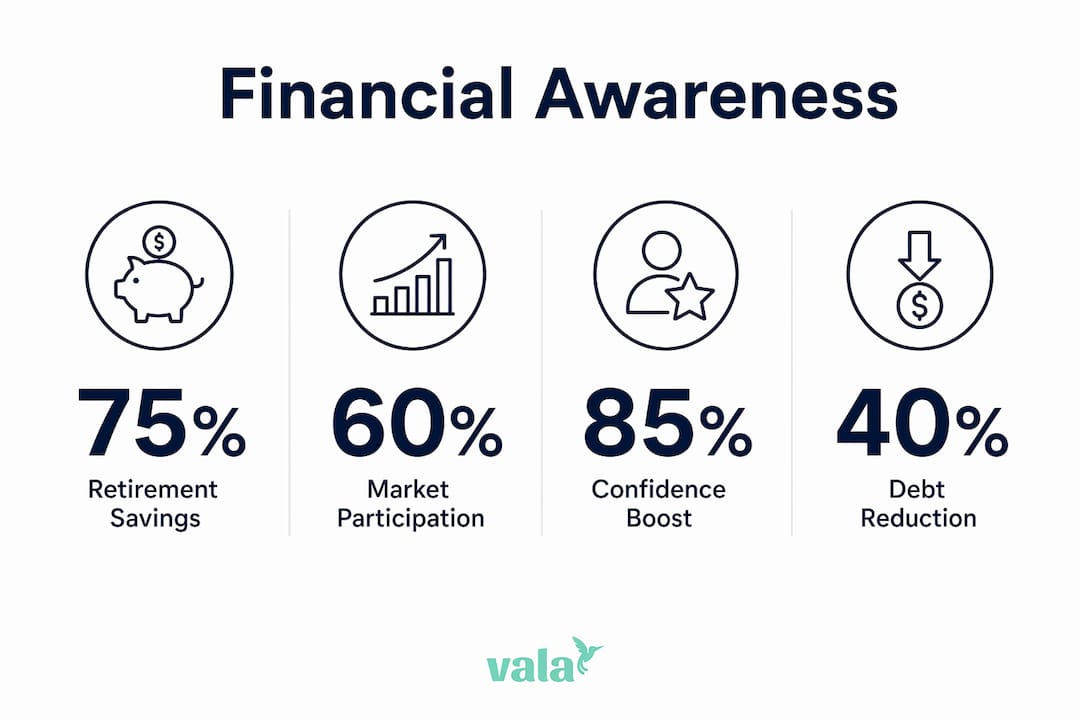
- Higher financial awareness correlates with higher 529 plan balances, lower credit card delinquency rates, and greater IRA participation.
- People with low financial awareness are more likely to engage in passive learning when financial education is offered, which sharply reduces how much they benefit.
- Financial awareness affects not just individual outcomes but economic equity and market efficiency at a broader level.
Financial awareness, in short, is what turns knowledge into behavior. And behavior is what determines your financial future.
How financial awareness shapes what you actually do with money
The gap between knowing and doing is where most people lose ground financially. Financial awareness closes that gap by making money management feel personal and urgent, not abstract.
Research from the TIAA Institute found that a one-unit increase in the financial awareness index for credit management predicts a 1.09% decrease in credit card delinquency rates. That’s a measurable behavioral shift driven purely by attention and awareness, not by income or education level. People who pay attention to their credit situation make fewer costly mistakes.
“Financial awareness is essential human capital to navigate the complex modern financial environment, including new instruments like crypto and reverse mortgages.”
— Annamaria Lusardi, leading financial literacy researcher
Lusardi’s framing matters here. She treats financial awareness as human capital, the same category as job skills or education. That means building it pays dividends over time, and neglecting it has compounding costs.
The behavioral differences between high and low awareness individuals show up across every major financial category:
| Financial behavior | High awareness | Low awareness |
|---|---|---|
| Retirement savings (IRA participation) | Higher contribution rates | Lower or no participation |
| Credit card management | Lower delinquency rates | Higher delinquency risk |
| Education savings (529 plans) | Higher account balances | Lower or no savings |
| Budgeting consistency | Regular, proactive | Reactive or absent |
| Response to financial education | Active engagement | Passive or disengaged |

Financial awareness also affects who participates in financial markets at all. People who are aware of investment opportunities are more likely to act on them, which over time contributes to wealth accumulation and reduces inequality. The importance of financial literacy research from the American Economic Association found that financial literacy, driven by awareness, accounts for a meaningful share of wealth inequality near retirement in the US.
Context shapes awareness levels too. Where you grew up, what media you consume, and whether your community discusses money openly all influence how attuned you are to financial matters. That’s not an excuse. It’s a starting point for understanding where to focus your attention.
Core skills and learning approaches that build lasting financial awareness
Building financial awareness isn’t a one-time event. It’s a practice, and it requires developing specific skills that work together.
The foundational competencies include:
- Budgeting: Tracking income against expenses so you know where your money goes each month. Consumer.gov’s budget-building guide is a solid free starting point.
- Saving: Understanding the difference between short-term emergency funds and long-term wealth building. The Consumer Financial Protection Bureau recommends building an emergency fund as a first financial priority.
- Debt management: Knowing how interest compounds, how to prioritize payoff, and how debt affects your credit score.
- Credit understanding: Reading a credit report, recognizing what moves your score, and using credit as a tool rather than a crutch.
- Investing basics: Grasping compound growth, risk tolerance, and the difference between saving and investing for the long term.
These core financial skills form the practical layer of financial awareness. Without them, awareness stays theoretical.
How you learn matters as much as what you learn
Formal financial education programs, workplace financial wellness workshops, and structured curricula all show measurable results. But the quality of the program determines the outcome. The National Financial Educators Council notes that financial education programs produce the strongest results when they drive real behavioral change, not just knowledge transfer.

Self-directed learning through reputable resources like Investopedia, the CFPB, or the Corporate Finance Institute can be equally effective when you approach it with intention. The key is active engagement, not passive reading.
Pro Tip: Set a specific financial question to answer each week, such as “How does my credit utilization ratio affect my score?” Focused questions produce faster skill-building than broad reading.
Barriers that get in the way
Psychological biases are the most common obstacle. Optimism bias leads people to underestimate future financial risk. Present bias makes saving feel less urgent than spending today. Cultural norms around discussing money can make it hard to ask for help or admit gaps in knowledge.
Media exposure plays a measurable role too. Research confirms that media-based public education significantly shapes financial awareness levels across populations, particularly in retirement planning. If your information environment doesn’t include financial topics, your awareness naturally stays lower. Changing what you read and watch is a legitimate strategy for raising it.
What financial awareness looks like in practice
Financial awareness doesn’t stay abstract for long. Once you’re paying attention, your behavior changes in concrete, trackable ways.
Consider someone who starts monitoring their monthly subscriptions after reading about financial leaks. Within a few weeks, they cancel services they forgot they had and redirect that money toward a savings goal. No income change. No major sacrifice. Just awareness applied to a specific problem.
The FDIC studied the intermediate-term impact of a financial literacy program and found that 6–12 months after completing it, participants were significantly more likely to hold a checking account, budget consistently, and save for retirement. Before the program, a small portion of respondents had a checking account. Afterward, this figure increased significantly. Many participants also reported increased savings.
“Financial education is the difference between those who are controlled by money and those who reign as the masters of money.”
— National Financial Educators Council
Those numbers reflect something important: awareness interventions don’t just teach facts. They shift how people relate to their own finances. The stress reduction that follows is real. When you know what’s in your accounts, what you owe, and where your money is going, financial anxiety drops because uncertainty is what drives most of it.
Financial awareness also acts as a defense against cycles of financial disaster, including unsustainable debt, bankruptcy, and foreclosure. People who recognize warning signs early, an overdraft pattern, a rising credit utilization rate, a lack of emergency savings, can course-correct before a problem becomes a crisis. That’s the preventive power of awareness in action.
The ripple effects extend beyond your bank account. Financially aware people report higher confidence in major life decisions, from buying a home to changing careers, because they understand the financial implications before they commit.
How Valapoint’s Vala app supports your financial awareness every day
Understanding financial awareness is one thing. Maintaining it through the noise of daily life is another. That’s where technology makes a real difference, and it’s exactly what Valapoint built Vala to do.
Vala is an AI-powered personal finance app that turns passive money management into active financial awareness. It tracks your expenses automatically, surfaces spending patterns you’d never catch manually, and gives you a clear picture of where your money actually goes versus where you think it goes.
Here’s what Vala brings to your financial practice:
- Automatic expense tracking: Every transaction is logged and categorized in real time, so you always know your current financial position.
- Budget management: Set spending limits by category and get notified before you exceed them, not after.
- Spending pattern detection: Vala identifies hidden financial leaks, recurring charges, and irregular spending spikes that quietly drain your accounts.
- Group cost splitting: Manage shared expenses with partners, roommates, or travel groups without the awkward math.
- Intelligent insights: Vala analyzes your data and surfaces personalized recommendations, not generic advice.
“Tools that foster calm confidence enable informed decisions, reducing financial anxiety and supporting long-term goals.”
That calm confidence is exactly what Vala is designed to create. When you can see your finances clearly, you stop reacting and start planning. The anxiety that comes from not knowing your numbers fades when the numbers are always in front of you.
Vala also reinforces the behavioral habits that financial awareness builds. Seeing your budget update in real time after a purchase creates a feedback loop that passive bank statements never do. Over time, that loop rewires how you make spending decisions. Research on personal finance automation consistently shows that automation reduces the mental load of money management, which makes it easier to stay consistent.
For those who want to go deeper, Vala’s AI-personalized budgeting adapts to your income patterns and spending behavior, so your budget reflects your actual life rather than a generic template. Custom AI solutions for financial services, like those developed by arosplatforms, demonstrate how tailored financial technology can translate complex data into clear, personalized guidance.
Pro Tip: Connect Vala at the start of a new month and let it run for 30 days without changing your behavior. The first report you get will show you exactly where your awareness gaps are, and that’s the most honest starting point you can have.
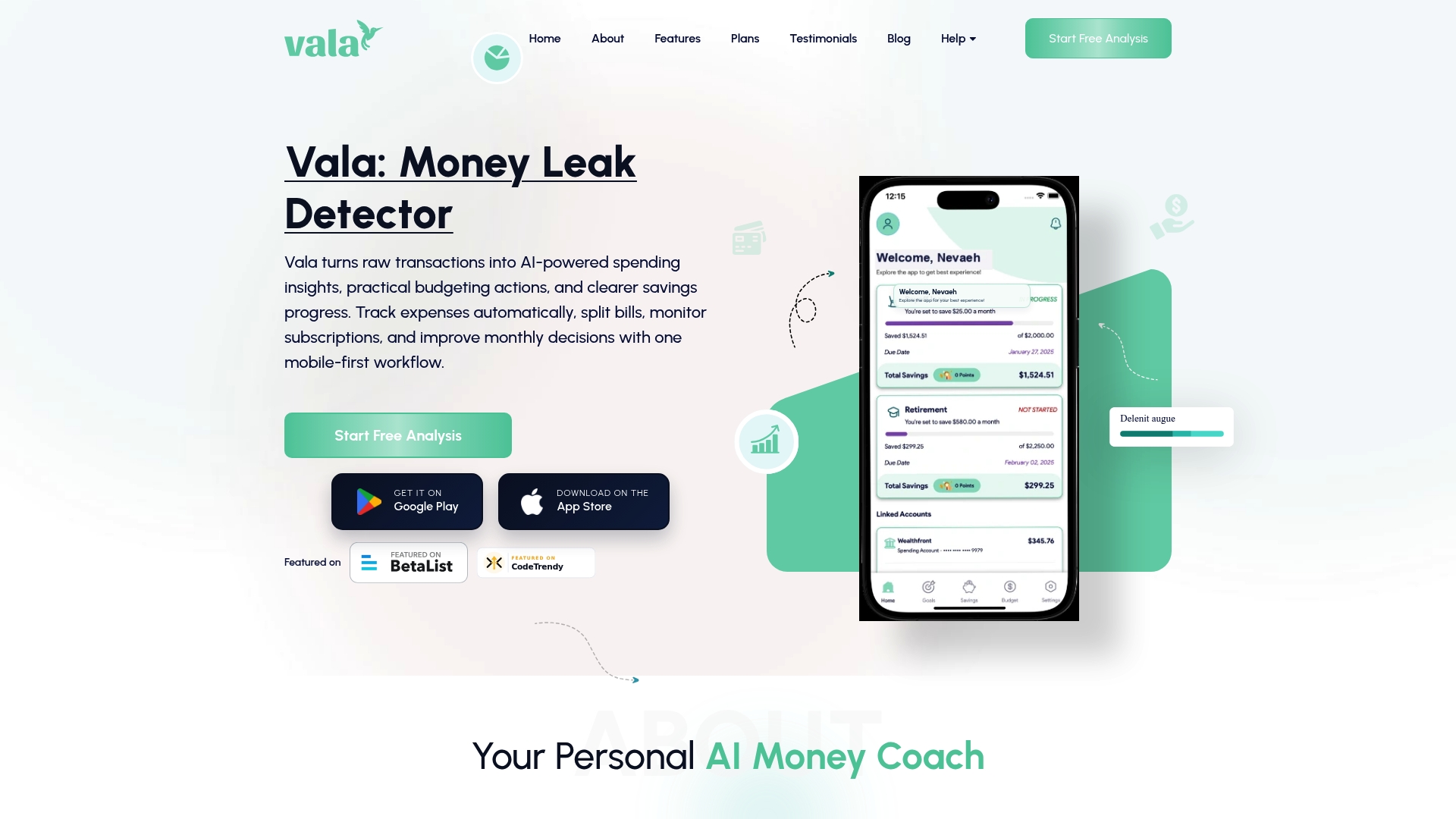
Ready to turn financial awareness into financial action? Start tracking with Vala and get a clear picture of your money in minutes.
Key Takeaways
Financial awareness drives better financial behavior by turning knowledge into consistent, proactive money habits, and the research from the TIAA Institute, FDIC, and Annamaria Lusardi confirms this connection is measurable and significant.
| Point | Details |
|---|---|
| Awareness drives behavior | Financial awareness motivates applying knowledge, producing lower debt and higher savings rates. |
| Measurable outcomes | A one-unit increase in the credit awareness index predicts a 1.09% drop in credit card delinquency. |
| Education timing matters | Behavior changes most significantly 6–12 months after a financial education intervention. |
| Skills are the foundation | Budgeting, saving, debt management, credit, and investing basics are the core competencies to build. |
| Technology reinforces habits | Real-time tracking tools like Vala create feedback loops that sustain financial awareness daily. |