
A financial plan is a structured document that maps your current financial situation, including income, debt, investments, insurance, and taxes, to the goals you want to reach over time. According to Thrivent and Fidelity, this document serves as a decision-making guide for everything from monthly spending to long-term retirement savings. Think of it as the difference between driving with GPS and driving blind. Without one, you make financial decisions in isolation. With one, every choice connects to a bigger picture.
What is a financial plan and what does it actually include?
A financial plan is more than a budget spreadsheet. Fidelity describes it as guidance for allocating money to fund the life you envision, which means it covers far more than just tracking what you spend.
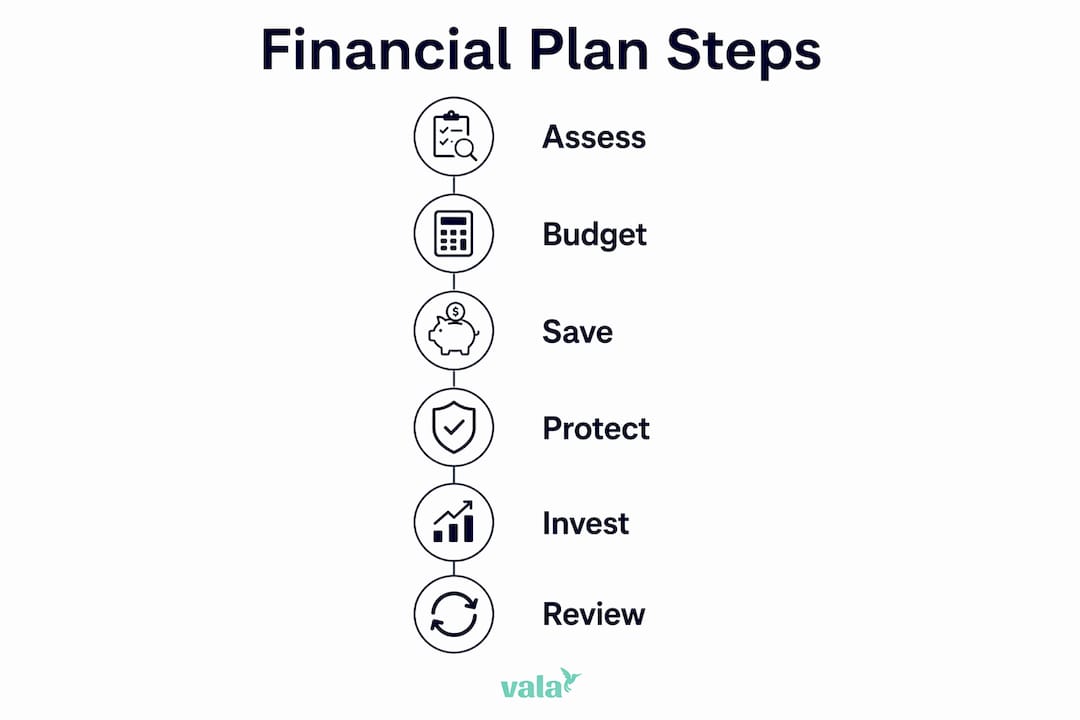
The concept of financial planning spans six core areas:
- Budgeting and cash flow: Tracking income against expenses to identify where money goes each month
- Emergency fund: A liquid savings buffer to cover unexpected costs without going into debt
- Insurance and risk protection: Coverage that shields your income and assets from major setbacks
- Debt management: A clear payoff strategy prioritizing high-interest balances first
- Retirement and investment planning: Long-term accounts like 401(k)s, IRAs, and taxable brokerage accounts
- Tax strategy: Legal methods to reduce your tax burden and keep more of what you earn
The order of these components matters. Fidelity recommends building cash-flow stability and risk protection before focusing on investment optimization. Skipping ahead to investments while carrying high-interest debt or no emergency fund creates fragility. One unexpected expense can force you to sell assets or borrow at high rates, undoing months of progress.
| Component | Purpose |
|---|---|
| Budget and cash flow | Controls spending and identifies savings capacity |
| Emergency fund | Prevents debt accumulation during income disruptions |
| Insurance coverage | Protects income, health, and assets from major losses |
| Debt payoff plan | Reduces interest costs and frees up monthly cash flow |
| Retirement savings | Builds long-term wealth through compound growth |
| Tax optimization | Maximizes take-home pay and investment returns |

Pro Tip: Start your emergency fund with a $1,000 target before tackling anything else. Once you hit that, build toward 3 to 6 months of essential expenses in a separate, liquid account. This two-stage approach keeps the goal from feeling overwhelming.
Why your financial plan needs to change as your life does
A financial plan is not a document you write once and file away. NerdWallet confirms that plans must be updated after significant life changes to stay relevant and useful. The plan you build at 24 will look completely different from the one you need at 38.
Life events that require a plan update include:
- Getting married or divorced
- Having or adopting a child
- Changing jobs or receiving a major raise
- Buying a home or taking on a large mortgage
- Receiving an inheritance or financial windfall
- Approaching retirement age
Each of these events shifts your income, expenses, tax situation, or risk profile. Updating one component of your plan affects the others. A new mortgage, for example, changes your monthly cash flow, your insurance needs, and the size of emergency fund you require. Integrated financial planning requires systemic revisits rather than isolated changes to a single line item.
“Financial planning is a lifetime journey.” — Ann Dowd, CFP®, Fidelity
That quote captures the importance of a financial plan better than any checklist. The goal is not perfection at a single point in time. The goal is a living document that grows with you.
Pro Tip: Schedule a 30-minute financial review every six months. Put it on your calendar like a doctor’s appointment. Review your budget, check progress toward goals, and ask whether any major life changes require a plan adjustment.
Professional financial planner vs. DIY: which approach fits you?
Both approaches work. The right choice depends on your financial complexity, your confidence level, and your budget for advice.
A professional financial advisor integrates budgeting, investment management, retirement planning, and risk evaluation into a single coordinated strategy. Fidelity notes that advisors help keep plans aligned and identify opportunities while managing risks you might not see on your own. This is especially valuable when your finances involve multiple income streams, business ownership, or significant assets.
DIY planning, on the other hand, costs less and teaches you more about your own money. Personal finance apps now handle much of the tracking and analysis that once required a professional. Tools like Valapoint’s AI-powered platform and Fidelity’s digital planning tools let you monitor income, expenses, and investment progress in real time.
| Feature | Professional advisor | DIY with apps |
|---|---|---|
| Cost | $1,000 to $5,000+ per year | Free to $15/month |
| Personalization | High, with expert guidance | Moderate, based on your inputs |
| Complexity handled | High (tax, estate, business) | Low to moderate |
| Learning opportunity | Limited | High |
| Accountability | Built-in with advisor check-ins | Self-directed |
The honest answer is that most people under 35 benefit from starting with DIY tools and graduating to professional advice when their financial picture grows complex. AI-powered budgeting apps now deliver personalized insights that close much of the gap between self-directed and professionally guided planning.
Pro Tip: If you decide to hire a financial advisor, look for a fee-only fiduciary. Fee-only advisors charge flat fees or hourly rates instead of commissions, which means their recommendations are not influenced by product sales.
How to create a financial plan step by step
Building your first financial plan does not require a finance degree. It requires honest numbers and a clear sequence of steps.
-
Calculate your net worth. Add up everything you own (savings, investments, property) and subtract everything you owe (loans, credit card balances, mortgage). This single number tells you where you actually stand today.
-
Map your monthly cash flow. Track every dollar of income and every expense for at least one full month. Categorize spending into fixed costs (rent, insurance, subscriptions) and variable costs (food, entertainment, clothing). This step reveals your real spending habits, not the ones you assume you have.
-
Set specific financial goals. Vague goals like “save more money” do not work. Specific goals do. Write down targets with dollar amounts and deadlines. Examples: “Save $5,000 for a car down payment by December 2026” or “Pay off $8,000 in credit card debt within 18 months.”
-
Build your budget around those goals. Allocate income to cover fixed expenses first, then savings goals, then discretionary spending. The 50/30/20 rule (50% needs, 30% wants, 20% savings and debt) is a useful starting framework for most people in their 20s and 30s.
-
Fund your emergency account. Before investing, keep emergency savings liquid and separate from your spending account. A high-yield savings account works well for this purpose.
-
Address insurance gaps. Review your health, renters or homeowners, auto, and life insurance coverage. Gaps here represent the biggest financial risk most young adults overlook.
-
Start retirement contributions. If your employer offers a 401(k) match, contribute at least enough to capture the full match. That match is an immediate 50% to 100% return on your contribution, which no investment can reliably beat.
-
Automate and track. Automation removes the discipline requirement from saving and investing. Set up automatic transfers to savings and retirement accounts on payday. Use a personal finance app to track progress and catch spending leaks before they derail your goals.
NerdWallet emphasizes that a financial plan is a practical tool to track progress and adjust as your situation changes. This is especially true for younger adults whose income, expenses, and goals shift frequently. Treat your plan as a working document. Refine it every six months and rebuild it after any major life change.
Pro Tip: Use Valapoint’s AI money coach to get personalized goal tracking and spending insights without building complex spreadsheets. The app identifies hidden spending patterns and suggests adjustments automatically, which makes it far easier to stay on track.
Key takeaways
A financial plan is the single most effective tool for turning income into long-term financial security, and it works only when you treat it as a living document rather than a one-time task.
| Point | Details |
|---|---|
| Definition of a financial plan | A structured document covering income, debt, savings, insurance, and goals. |
| Build in the right order | Stabilize cash flow and protect against risk before optimizing investments. |
| Update after life changes | Marriage, job shifts, and major purchases all require a plan revision. |
| DIY tools close the gap | AI-powered apps now deliver personalized insights comparable to basic advisor services. |
| Automate to stay consistent | Automatic transfers and app tracking remove reliance on willpower alone. |
My take on what most people get wrong about financial planning
Most people treat financial planning as a one-time project. They sit down, build a budget, open a savings account, and feel done. Six months later, nothing has changed because the plan was never connected to their daily decisions.
The real purpose of financial planning is not to produce a document. It is to build a habit of looking at your money clearly and adjusting when things shift. I have seen people with detailed, color-coded spreadsheets who are still living paycheck to paycheck because they built the plan and then ignored it. I have also seen people with a simple notes app and a clear monthly routine who consistently hit their savings targets.
The uncomfortable truth is that flexibility matters more than precision. A plan that is 80% accurate and reviewed monthly beats a perfect plan that sits untouched for two years. Life changes faster than any spreadsheet can predict, and the people who manage money well are the ones who stay curious about their numbers rather than intimidated by them.
Technology has genuinely changed what is possible for DIY planners. AI-driven tools now surface spending patterns and savings opportunities that used to require a professional to identify. That does not replace the value of a good advisor when your finances grow complex. But for most people in their 20s and 30s, the right combination of a clear plan, consistent tracking, and smart automation is more than enough to build real financial momentum.
— SaverStride
Start building your financial plan with Valapoint
You now know what a financial plan includes and how to build one. The next step is putting it into practice with tools that do the heavy lifting for you.

Valapoint’s personal finance app tracks your income, expenses, and savings goals in one place, using AI to surface spending patterns and suggest adjustments in real time. Whether you are building your first budget or refining a plan you already have, Vala makes it easy to stay on track without spending hours on spreadsheets. You can also use Valapoint’s finance tools and calculators to model debt payoff scenarios, set savings targets, and measure progress toward every goal in your plan.
FAQ
What is a financial plan in simple terms?
A financial plan is a document that outlines your current money situation and the steps you will take to reach your financial goals. It covers income, expenses, savings, debt, insurance, and investments.
What should a financial plan include?
A complete financial plan includes a budget, an emergency fund, insurance coverage, a debt payoff strategy, retirement savings, and a tax plan. Fidelity’s planning guide lists these as the foundational components for most individuals.
How often should you update your financial plan?
You should review your financial plan at least twice a year and update it after any major life event such as a job change, marriage, or the birth of a child. Financial planning is a lifelong process that requires regular adjustments to stay relevant.
Do I need a financial advisor to create a financial plan?
No. Many people build effective financial plans using personal finance apps and free online tools. A professional advisor adds the most value when your finances involve significant complexity, such as business income, estate planning, or large investment portfolios.
What is the purpose of financial planning for young adults?
The purpose of financial planning for young adults is to build a clear path from where you are now to where you want to be financially. Starting early gives compound growth more time to work and helps you avoid costly financial mistakes during high-earning years.