
A spending pattern is defined as the consistent way you allocate money across categories of spending over time. It is not a single purchase or a bad month. It is the repeating structure of where your money goes, from rent and groceries to subscriptions and weekend dining. The Consumer Financial Protection Bureau recommends reviewing your current spending to build an “as-is” monthly budget that reflects actual behavior, not wishful thinking. Understanding your spending pattern is the foundation of every budgeting decision you will ever make.
What is a spending pattern and how is it defined?
A spending pattern is best understood as how a person or household allocates money across categories over a defined period, typically monthly or annually. The pattern reveals not just totals, but proportions. You might spend 40% on housing, 15% on food, and 10% on transportation without ever consciously deciding those were your priorities.
In personal finance, the standard industry term for this analysis is spending behavior analysis. It covers both the categories you spend in and the frequency, regularity, and triggers behind those purchases. Recognizing this structure gives you real leverage over your budget because you are working with facts, not assumptions.

The CFPB’s guidance frames this clearly: your spending pattern is your financial reality before any changes are made. That baseline is what makes budgeting honest and effective.
How are spending patterns measured and categorized?
Governments and financial institutions use standardized frameworks to measure and compare spending across populations. The most widely used is COICOP, the Classification of Individual Consumption According to Purpose. The UK Office for National Statistics applies COICOP in its annual Family Spending bulletin to segment household expenditure into consistent, comparable categories.
One detail that surprises most people: capital mortgage repayments are excluded from these measurements. That is because paying down a mortgage builds wealth rather than consuming it. Consistent spending definitions prevent analysts from mistaking wealth-building transactions for consumption changes. For your personal budget, this same logic applies. Paying off debt is not a spending category in the same sense as groceries or utilities.
Here is how standardized spending categories typically break down:
- Housing and utilities: Rent, mortgage interest, electricity, water, and internet
- Food and non-alcoholic beverages: Groceries and household food purchases
- Transport: Car payments, fuel, public transit, and ride-sharing
- Recreation and culture: Streaming services, gym memberships, hobbies, and travel
- Restaurants and hotels: Dining out, takeout, and overnight stays
- Miscellaneous goods and services: Personal care, financial services, and other irregular costs
The table below shows how these categories translate into a personal budget context:
| Spending category | What it typically includes |
|---|---|
| Housing | Rent or mortgage interest, utilities, home insurance |
| Food | Groceries, meal delivery, dining out |
| Transport | Fuel, car insurance, public transit passes |
| Health | Insurance premiums, prescriptions, gym memberships |
| Discretionary | Entertainment, clothing, subscriptions, gifts |
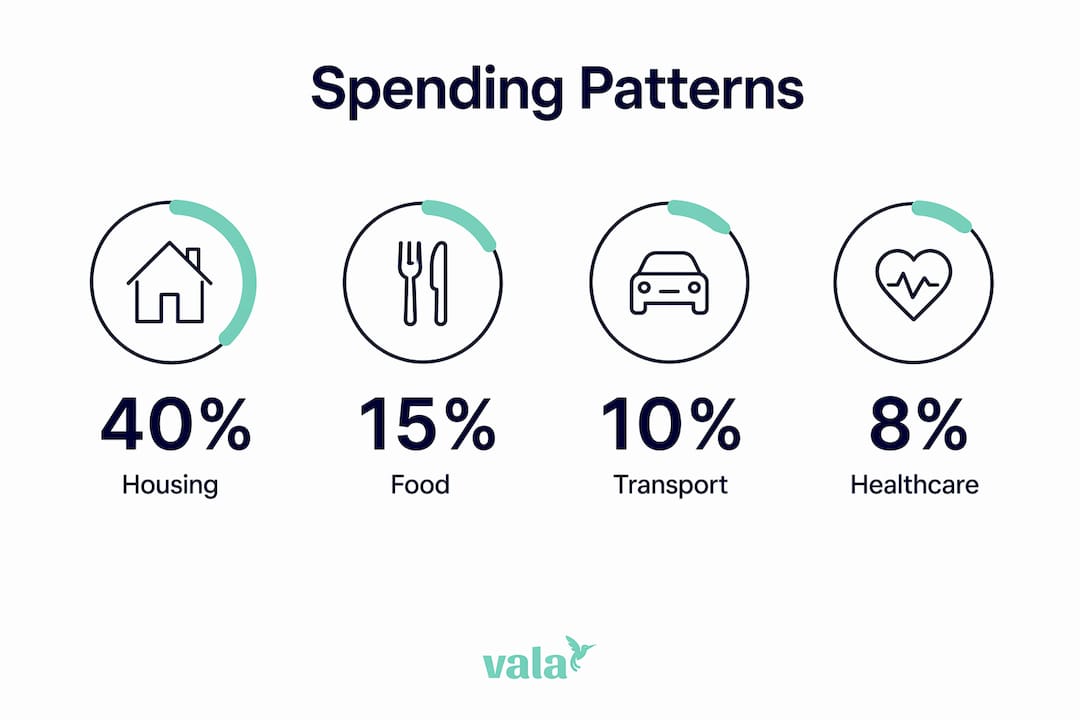
Household surveys collect this data by tracking receipts, bank statements, and self-reported purchases over weeks or months. The goal is consistency over time, not a single snapshot. That same principle applies when you track your own spending habits.
How do spending patterns vary across income groups?
Spending patterns differ significantly by income level, and recent data makes this more concrete than ever. New York Fed research from 2026 identifies a K-shaped spending divergence across income brackets, where high-income households increased retail and discretionary spending while lower-income households pulled back, particularly on gasoline. This is not a minor statistical gap. It reflects structurally different financial realities playing out in real time.
Average spending trends can mask significant differences between income groups, which means national averages are often misleading for your personal planning. If you earn $45,000 a year and read that the average American spends 30% on housing, that number may be completely irrelevant to your situation.
Beyond income, behavioral factors shape spending patterns just as powerfully. Emotional triggers, social norms, subscription creep, and convenience spending all push budgets off course without any single large purchase being the culprit. Understanding your own group spending habits, especially if you share finances with a partner, roommates, or a household, requires tracking collective behavior, not just individual transactions.
| Income bracket | Typical spending focus | Common pattern shift |
|---|---|---|
| Lower income | Essentials dominate (housing, food, transport) | Cuts discretionary spending under pressure |
| Middle income | Balanced mix with some discretionary | Vulnerable to lifestyle inflation |
| Higher income | Larger discretionary and investment share | Increases spending during economic uncertainty |
Pro Tip: Do not benchmark your spending against national averages. Compare your current pattern to your own previous months. That comparison is far more useful for spotting real changes in your behavior.
How to track and analyze your personal spending patterns
Tracking your spending pattern starts with pulling three to six months of bank and credit card statements. One month is not enough. A single month might include an unusual expense like a car repair or a birthday gift that distorts the picture. Multiple months reveal the true baseline.
Follow these steps to build an accurate picture of your spending behavior:
- Gather your statements. Download three to six months of transactions from every account you use, including checking, savings, and all credit cards.
- Categorize every transaction. Group purchases into the standard categories: housing, food, transport, health, and discretionary. Be honest about where things belong.
- Add irregular expenses. The CFPB specifically advises including infrequent payments like insurance, gifts, and vacations by averaging them into your monthly figures. Skipping these is the most common reason budgets feel inaccurate.
- Create a miscellaneous category. Some spending resists neat labels. A miscellaneous bucket prevents you from ignoring these costs entirely.
- Compare your budget to your bank balance. The CFPB recommends validating your budget against actual cash flow each month. If your account balance does not match your projections, something is misclassified or missing.
- Adjust and repeat. Spending analysis is not a one-time task. Review your categories every quarter to catch new patterns before they become problems.
Technology makes this process significantly faster. Apps that automate expense categorization reduce the manual burden and surface patterns you might miss when reviewing statements line by line. An expense tracker app can flag when a category spikes unexpectedly, giving you real-time visibility instead of a monthly surprise.
Pro Tip: Set a recurring 20-minute calendar block each month to review your spending categories. Consistency matters more than perfection. A quick monthly check catches drift before it compounds.
Here is what to look for once your data is organized:
- Categories that consistently exceed your expectations
- Subscriptions or recurring charges you forgot about
- Months where discretionary spending spiked and why
- The gap between what you planned to spend and what you actually spent
How understanding spending patterns improves your budgeting
Once you know your actual spending pattern, you can choose a budgeting framework that fits your life rather than forcing yourself into a generic template. The most widely used frameworks each serve a different financial personality.
- 50/30/20: Allocates 50% to needs, 30% to wants, and 20% to savings or debt repayment. Works well for people with stable income and moderate discretionary spending.
- Zero-based budgeting: Every dollar is assigned a purpose before the month begins. Best for people who want maximum control and are willing to plan in detail.
- Reverse budgeting: You pay yourself first by moving savings to a separate account immediately after each paycheck, then spend the rest freely. Works well for people who struggle with restriction but are consistent savers.
- Money mapping: A visual approach that maps all income flows and spending categories to identify leaks and priorities at a glance.
Analyzing your spending pattern creates a realistic picture of current behavior that empowers more effective future decisions. This matters psychologically as much as financially. When your budget reflects how you actually live, you stop feeling guilty about every purchase and start making deliberate choices instead.
Savings and emergency funds become easier to build once you see exactly where your money goes. Most people who struggle to save are not spending recklessly. They are simply unaware of the cumulative weight of small, recurring costs. Spending behavior analysis makes those costs visible and manageable.
Key takeaways
Knowing your spending pattern is the single most important step toward building a budget that actually works for your life.
| Point | Details |
|---|---|
| Define your baseline first | Review three to six months of transactions before building any budget. |
| Include irregular expenses | Average infrequent costs like gifts and insurance into your monthly figures to avoid underestimating. |
| Income group averages mislead | Your pattern may differ sharply from national data due to income, region, and behavior. |
| Validate against your bank balance | Compare budget projections to actual account outcomes monthly to catch errors fast. |
| Match your framework to your pattern | Choose a budgeting method that fits your real spending behavior, not an idealized version of it. |
Why most people misread their own spending
Most people believe they know where their money goes. In practice, they know where the big items go. Rent, car payments, and utilities are easy to account for. The real surprises live in the middle: the $14 subscriptions, the $40 takeout orders that happen three times a week, the irregular costs that never make it into the mental budget.
What I have found consistently is that people underestimate discretionary spending by 20 to 30 percent when they rely on memory alone. The moment they pull actual statements, the gap becomes undeniable. That gap is not a character flaw. It is a data problem, and data problems have data solutions.
The 2026 K-shaped spending divergence from New York Fed research is a useful reminder that economic context shapes your pattern whether you realize it or not. If your income has stayed flat while prices have risen, your spending pattern has shifted even if your habits have not. Recognizing that shift is the first step toward responding to it deliberately.
The other mistake I see often is treating budgeting as a one-time exercise. You set a budget in January, ignore it by March, and feel like you failed. The better approach is to treat your spending pattern as a living document. Review it quarterly. Adjust categories when life changes. Use tools that do the tracking automatically so the friction stays low. Small, consistent habits outperform ambitious plans that collapse under real-world pressure.
Start with one month of honest categorization. That single exercise will tell you more about your finances than any budgeting article ever could.
— SaverStride
See your spending clearly with Valapoint
Understanding your spending pattern is straightforward when you have the right tools doing the heavy lifting.
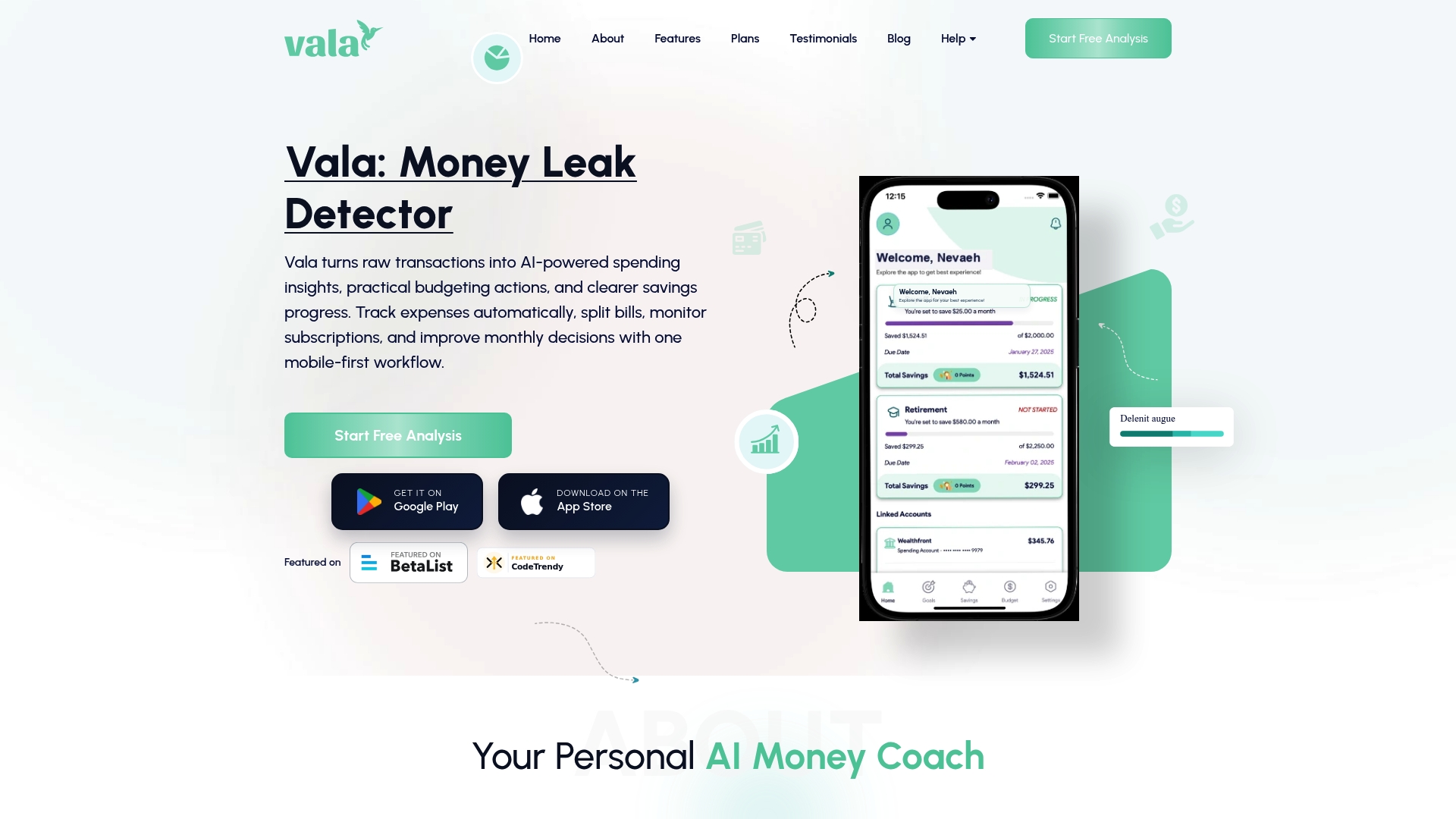
Valapoint’s personal finance app automatically categorizes your transactions, tracks spending across every account, and surfaces patterns you would otherwise miss. Whether you are managing solo finances, splitting costs with a partner, or tracking group expenses with roommates, Vala gives you a clear, real-time view of where your money goes. You can also use Valapoint’s finance calculators and tools to model budgets, set savings targets, and stress-test your spending plan before committing to it. No spreadsheets. No guesswork. Just clear numbers and confident decisions.
FAQ
What is a spending pattern in simple terms?
A spending pattern is the consistent way you distribute your money across categories like housing, food, transport, and discretionary purchases over time. It reflects your actual financial behavior, not your intentions.
What is a group spending pattern?
A group spending pattern describes how a household, couple, or shared living arrangement collectively allocates money across shared expenses. Tracking group spending habits requires combining all members’ transactions into unified categories to see the full picture.
How do I find my personal spending pattern?
Pull three to six months of bank and credit card statements, categorize every transaction, and include irregular expenses by averaging them monthly. The CFPB recommends comparing your projections to your actual account balance to validate accuracy.
Why do spending patterns differ between income groups?
New York Fed research shows a K-shaped divergence where higher-income households increase spending while lower-income households cut back, particularly on fuel and discretionary items. Income level, regional costs, and behavioral habits all drive these differences.
Which budgeting framework works best for my spending pattern?
The best framework depends on your actual pattern. The 50/30/20 rule works for stable incomes, zero-based budgeting suits detail-oriented planners, and reverse budgeting fits people who save consistently but resist strict category limits. Start by analyzing your real spending before choosing a method.