
Incremental budgeting builds each new budget by taking the prior period’s figures as a baseline and applying planned adjustments for inflation, headcount changes, or new contracts. According to the Association of Chartered Certified Accountants (ACCA), those increments should explicitly account for inflation and any known cost changes, not just carry numbers forward unchanged. The Corporate Finance Institute positions it as a conservative method best suited to stable environments, and AccountingTools notes that its long-term risks, particularly budgetary slack and perpetuated inefficiency, deserve serious attention before you commit to it as your default approach.
Table of Contents
- How incremental budgeting works, with a worked example
- The disadvantages you need to plan around
- When should you actually use incremental budgeting?
- How to build an incremental budget, step by step
- How incremental budgeting compares to other methods
- Common mistakes and how to fix them
- Key Takeaways
- The part most guides skip about incremental budgeting
- Vala makes incremental budget tracking straightforward
- Useful sources for further reading
How incremental budgeting works, with a worked example
The core mechanic is straightforward: you start with last year’s approved budget (or actuals, if they differ significantly), then apply a documented adjustment to each line. Bill.com’s practical walkthrough shows how to express those adjustments either as a percentage increase or as an absolute dollar amount, depending on what drives the cost.
Common adjustment types include:
- Inflation: Use the Bureau of Labor Statistics CPI release as your baseline inflation input for cost-of-living-sensitive lines like salaries and supplies.
Here is a spreadsheet-ready example for a single department:
| Budget Line | Prior Budget | Increment | New Budget |
|---|---|---|---|
| Salaries | — | +3% (CPI-linked) | — |
| Office supplies | — | +2% (inflation) | — |
| Software licenses | — | +$1,500 (new seat) | — |
| Travel | — | 0% (no change) | — |
To roll this up to a consolidated budget, sum each department’s new total, then reconcile against the organization’s revenue forecast. A quick sanity check: total incremental spend growth should not outpace projected revenue growth without a documented reason.
The disadvantages you need to plan around
The risks here are behavioral as much as technical. AccountingTools flags budgetary slack as one of the most persistent problems: managers learn that requesting more than they need protects their future allocation, so padding becomes a rational strategy rather than an honest estimate.
Key risks:
- Use-it-or-lose-it spending: Tutor2u describes how teams rush to spend remaining budget before the period closes, purely to avoid a cut next year.
“Incremental budgeting creates inertia. Without a governance trigger that forces periodic re-evaluation, the budget becomes a record of past decisions rather than a plan for future priorities.” — synthesized from tutor2u
The GAO has noted in public-sector audits that unchecked incremental approaches in government budgeting can perpetuate outdated allocations for years, recommending periodic comprehensive reviews as a corrective.
When should you actually use incremental budgeting?
The honest answer is: when your cost structure is genuinely stable and your priorities are not changing fast.
Good fits:
- Government departments and public agencies with legislated spending mandates
- Established businesses with predictable revenue and fixed overhead
- Households with stable income and fixed monthly obligations
- Long-term infrastructure or multi-year project budgets where scope is locked
Poor fits:
- Startups or businesses in rapid growth phases (the Federal Reserve’s small business survey data documents how frequently small employers face shifting cost structures)
- Organizations undergoing restructuring or entering new markets
- Teams where discretionary spending is a significant share of the budget
- Any environment where last year’s cost drivers no longer reflect current operations
Quick decision checklist — ask yourself these four questions:
- Has your cost structure stayed broadly stable for the past two years?
- Can you document a clear driver (inflation, headcount, contract) for each planned change?
- Is your organization’s strategic direction unchanged from last year?
- Do you have the governance in place to challenge lines that grow without justification?
If you answered yes to all four, incremental budgeting is a reasonable default. Two or more “no” answers suggest a more thorough review method is worth the extra effort.
How to build an incremental budget, step by step
A typical departmental or household cycle takes one to two weeks from data pull to approval. Here is the process:
- Set monitoring checkpoints (Ongoing): Schedule monthly variance reviews. Track expense categories against budget in real time so you catch drift early.
Sample column structure for your spreadsheet:
| Column | Content |
|---|---|
| Line item | Name of cost category |
| Prior actuals | Last year’s actual spend |
| Increment driver | CPI / headcount / contract / none |
| Increment % or $ | Documented adjustment |
| New budget | Prior actuals × (1 + %) or + $ |
| Owner | Named responsible person |
| Notes | Any one-off context |
Pro Tip: Schedule a forced zero-based review for any line that has grown more than 15% over three consecutive years, or whenever your organization launches a new strategic initiative. That trigger prevents incremental drift from compounding silently.
How incremental budgeting compares to other methods
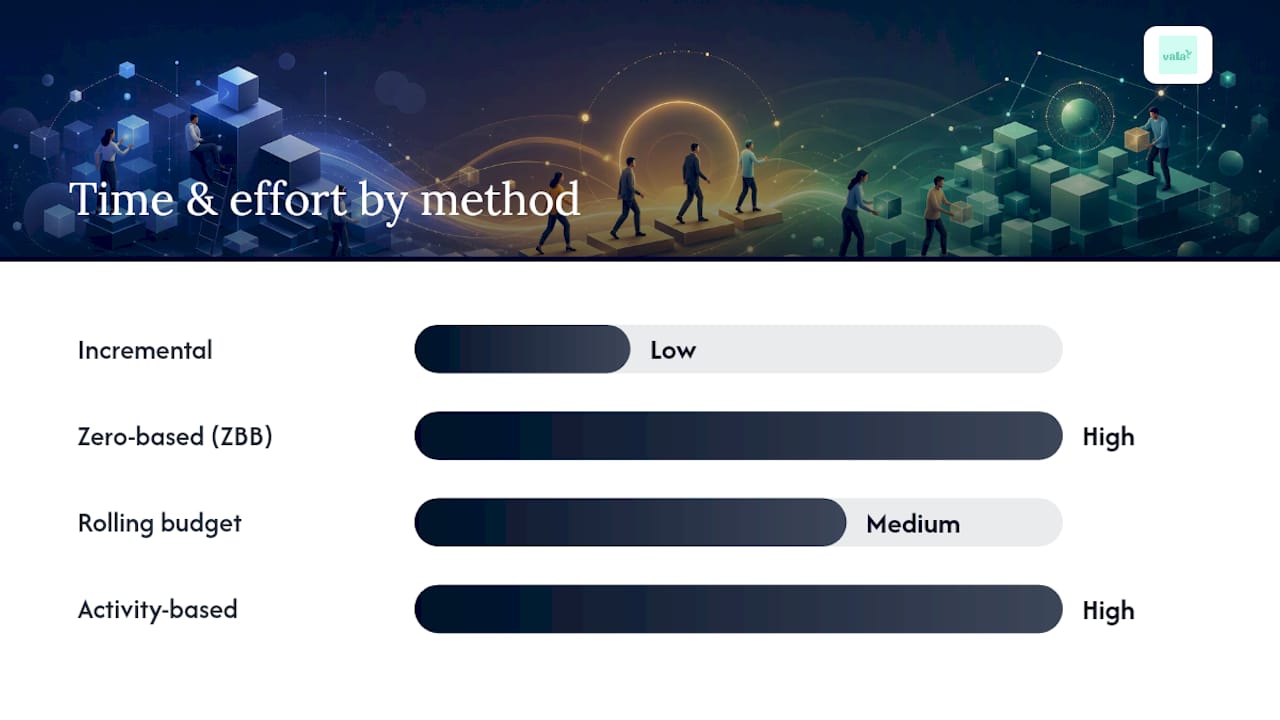
No single method wins in every situation. The table below compares four common approaches on the dimensions that matter most for your decision.
| Method | Best for | Time & effort | Accuracy for current needs | Risk of outdated costs | Resource cost |
|---|---|---|---|---|---|
| Incremental | Stable orgs, predictable costs | Low | Moderate | High without reviews | Low |
| Zero-based (ZBB) | Restructuring, discretionary spend | High | High | Low | High |
| Rolling budget | Fast-changing environments | Medium | High | Low to medium | Medium |
| Activity-based | Complex cost structures, overhead allocation | High | High | Low | High |
The most practical approach for most organizations is a hybrid: use incremental budgeting for the majority of years to save time, then run a zero-based budget review every three to five years, or apply ZBB specifically to discretionary categories like marketing and travel every year. AccountingTools recommends exactly this kind of periodic comprehensive review to clear out accumulated inefficiencies without abandoning the speed advantage of the incremental method.
For early-stage companies weighing these options, startup budgeting essentials offer a useful framework for deciding when a more rigorous baseline-building exercise is worth the investment.
Common mistakes and how to fix them
Most incremental budgeting failures trace back to a small set of avoidable errors.
- Ignoring inflation: Applying a flat 0% increment to salary lines while the CPI is rising means you are effectively cutting real compensation. Fix: pull the current BLS CPI figure and apply it as a floor for cost-sensitive lines.
- Skipping periodic comprehensive reviews: The GAO’s findings on public budgets show that without a scheduled reset, outdated allocations survive indefinitely. Fix: put a ZBB review on the calendar now, even if it is three years out.
A simple corrective policy: any line item requesting an increment above your threshold requires a one-paragraph written justification tied to a measurable business driver. That single rule eliminates most padding.
Key Takeaways
Incremental budgeting works best when your cost structure is stable, your adjustments are documented, and you schedule periodic zero-based reviews to clear out accumulated inefficiencies.
| Point | Details |
|---|---|
| Definition | Incremental budgeting starts from prior actuals and applies documented adjustments for inflation, headcount, or contracts. |
| Core strength | Low time and effort make it practical for stable organizations and households with predictable monthly costs. |
| Main risk | Budgetary slack and use-it-or-lose-it spending accumulate unless governance forces periodic justification. |
| Hybrid approach | Use incremental most years; schedule a zero-based review every three to five years or for discretionary categories annually. |
| Valapoint | Valapoint’s budget tracking and goal tools let you set a baseline, apply increments by category, and monitor variance in real time. |
The part most guides skip about incremental budgeting
The standard advice on incremental budgeting focuses on its simplicity, and that is fair. But the real risk is not the method itself — it is the false confidence it creates. When a budget looks reasonable because it is only slightly different from last year, it tends to pass review without scrutiny. That is exactly when outdated assumptions survive longest.
The fix is not to abandon incremental budgeting. It is to treat the increment decision as the moment of accountability, not just a mechanical calculation. Tie every increment to a named driver. If you cannot name the driver, the increment does not belong in the budget. That one discipline turns a passive carry-forward into an active, defensible plan.
For personal finance users, the same principle applies. Adjusting last month’s budget by a few percent is fine. But once a year, sit down and ask whether each category still reflects how you actually want to spend. That annual reset, even a quick one, prevents lifestyle inflation from quietly compounding year after year.
Vala makes incremental budget tracking straightforward
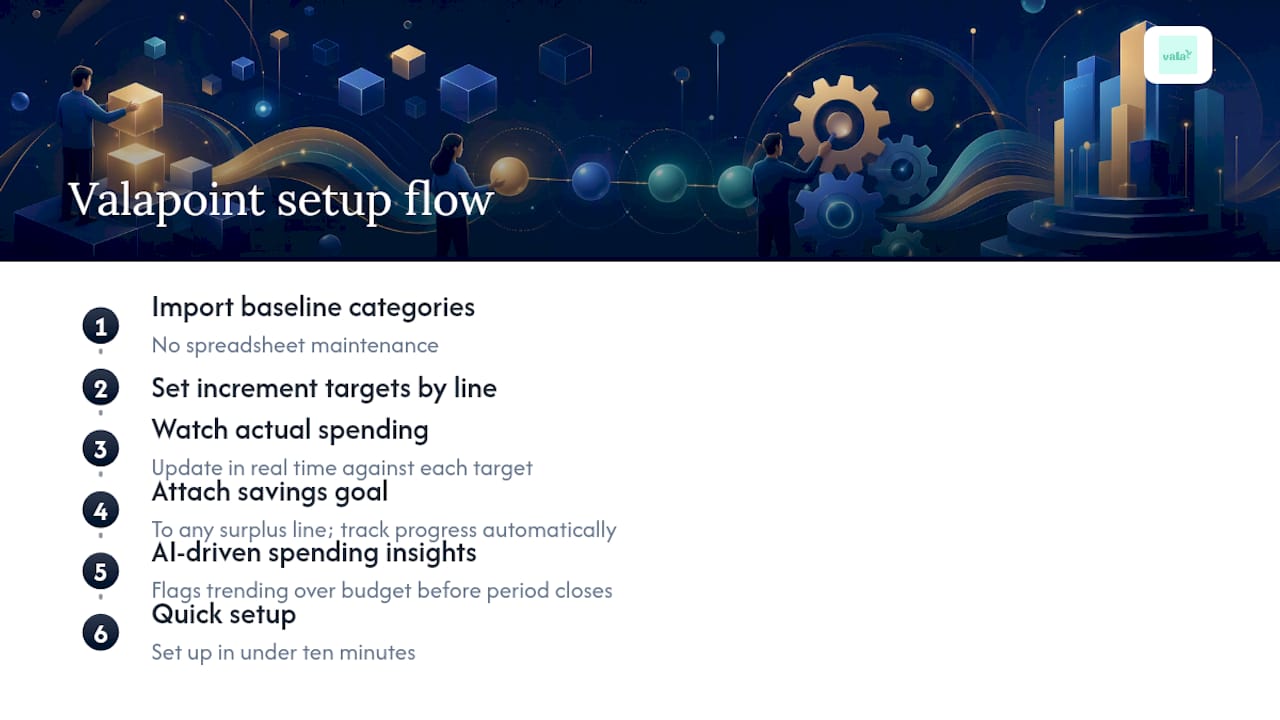
Knowing the method is one thing. Keeping it current throughout the year is where most people lose momentum. Valapoint’s budget tracking app lets you import your baseline categories, set increment targets by line, and watch actual spending update in real time against each target. No spreadsheet maintenance, no end-of-month scramble to reconcile figures.

The budget goal tracker adds a savings layer on top: once your incremental budget is set, you can attach a savings goal to any surplus line and track progress automatically. AI-driven spending insights flag when a category is trending over budget before the period closes, so you can adjust early rather than explain the variance after the fact.
Try Valapoint free and set up your first incremental budget in under ten minutes. Your spending categories, your baseline, your targets — all in one place.
This article is general information, not financial or professional advice. Confirm current figures and regulations with a qualified professional or the relevant primary source.
Useful sources for further reading
- Comparing budgeting techniques | ACCA
- What is incremental budgeting? | AccountingTools
- Incremental budgeting | Corporate Finance Institute
- Budgeting methods – incremental budgeting | tutor2u
- Incremental Budgeting: Definition and Examples | Bill.com
- CPI news release | BLS
- GAO report GAO-25-107795
- 2025 report on employer firms | FedSmallBusiness