
Before you start browsing listings, know your number. A solid target for saving for an apartment is your total move-in costs plus two months of true monthly expenses. In practice, that works out to roughly 2–4 months’ rent as a combined move-in and runway cushion, according to rent.com. The one-line plan: calculate your full move-in cost, set a timeline, open a dedicated savings account, and automate transfers from every paycheck.
If you’re in a high-cost city like New York or San Francisco, stretch that target to several months, especially in higher-cost cities. If you’re splitting costs with a roommate, 3 months may be enough. The math changes, but the structure stays the same.
Table of Contents
- What does it actually cost to move into an apartment?
- How do you turn that total into a monthly savings goal?
- How do you build a monthly budget that landlords will approve?
- What does moving and furnishing actually cost?
- What documents and credit steps should you prepare before applying?
- Three copyable savings plan templates you can use right now
- Key Takeaways
- Why the boring approach actually works
- Vala makes apartment saving straightforward
- Useful sources and further reading
What does it actually cost to move into an apartment?
Most first-time renters underestimate the upfront bill by a wide margin. The listed rent is just one line item. Here’s what you’re actually paying before you sleep in the new place:
- Security deposit: — Usually one month’s rent, sometimes two in competitive markets
On the recurring side, rent.com notes that combined utilities (electricity, water, internet, trash) run a moderate amount per month for a typical one-bedroom.
Worked example: Say your target apartment rents for $1,500/month.
| Cost Category | Low Estimate | Typical | High Estimate |
|---|---|---|---|
| Security deposit | $1,500 | $1,500 | $3,000 |
| First + last month | $1,500 | $3,000 | $3,000 |
| Application + admin fees | $50 | $100 | $200 |
| Moving costs | $200 | $600 | $2,000 |
| Basic furnishing | $500 | $1,500 | $3,000 |
| Supplies + groceries | $100 | $200 | $300 |
| Total move-in | $3,800 | $6,900 | $12,100 |
That typical column of $6,900 is about 4.5 months of rent. Add two months of living expenses as a runway buffer, and your full savings target sits closer to $10,000 before you hand over the keys.
How do you turn that total into a monthly savings goal?
The formula is simple: savings target ÷ months available = monthly savings requirement. The Apartment Notes first-apartment calculator formalizes this as: Savings Goal = Move-In Cost + (Monthly Budget × 2), which captures both the upfront cash and the runway.
Here’s how that plays out across three realistic timelines, using the $6,900 typical move-in figure plus a $2,600/month total living cost (rent + utilities + basics):
3-month plan: Target = $6,900 + ($2,600 × 2) = $12,100 → save $4,033/month. This is aggressive. It works if you’re living rent-free with family and have minimal expenses right now.
6-month plan: Same $12,100 target → save $2,017/month. More realistic for someone earning $45,000–$55,000/year with moderate current expenses.
12-month plan: Same target → save $1,008/month. Achievable for most full-time earners. This timeline also gives you time to build credit and gather documents.
Choosing your timeline comes down to three factors: how stable your income is, whether you already have an emergency fund (don’t drain it for the apartment), and what other financial goals are competing for the same dollars. If you’re carrying high-interest debt, the 12-month plan gives you room to pay minimums and still save consistently.
How do you build a monthly budget that landlords will approve?
Landlords use two standard benchmarks to screen tenants. The 30% rule says your rent should not exceed 30% of your gross monthly income. The 3x rent qualifier means landlords typically want your monthly income to be at least three times the rent. On a $1,500 apartment, that means showing $4,500/month in verifiable income.
Some financial advisers suggest keeping rent closer to 25% of your take-home pay for better cash flow, especially if you’re also paying off student loans. With a roommate, both thresholds become much easier to hit.
Once you know your rent, your true monthly cost is higher than the lease says. Savvy Nickel’s first-apartment checklist notes that rent plus utilities and recurring expenses typically runs 20–40% higher than the listed rent alone.
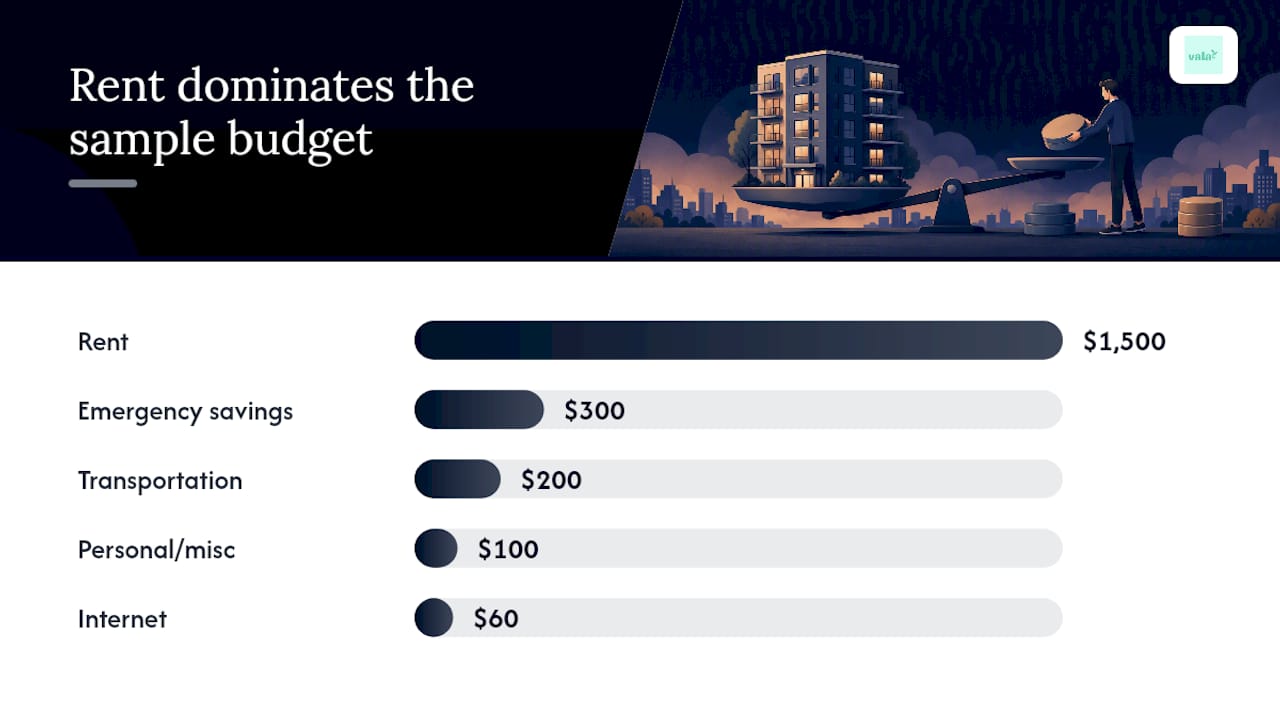
Sample monthly budget for $4,500/month take-home pay:
| Category | Monthly Amount |
|---|---|
| Rent ($1,500 apartment) | $1,500 |
| Internet | $60 |
| Transportation (gas or transit) | $200 |
| Phone | $60 |
| Subscriptions | $40 |
| Personal/miscellaneous | $100 |
| Emergency/runway savings | $300 |
That leaves $1,690/month for debt payments, retirement contributions, and discretionary spending. If your numbers look tighter, the roommate option or a lower-rent unit changes the math significantly.
Documents landlords typically require at application:
- Government-issued photo ID
- Two to three recent pay stubs
- W-2 (or 1099 for freelancers/self-employed)
- Two to three months of bank statements
- Personal or professional references
- Proof of renter’s insurance (sometimes required before move-in)
HUD’s fair housing resources outline what landlords can and cannot ask for during screening, which is worth reviewing so you know your rights alongside your responsibilities.
What does moving and furnishing actually cost?
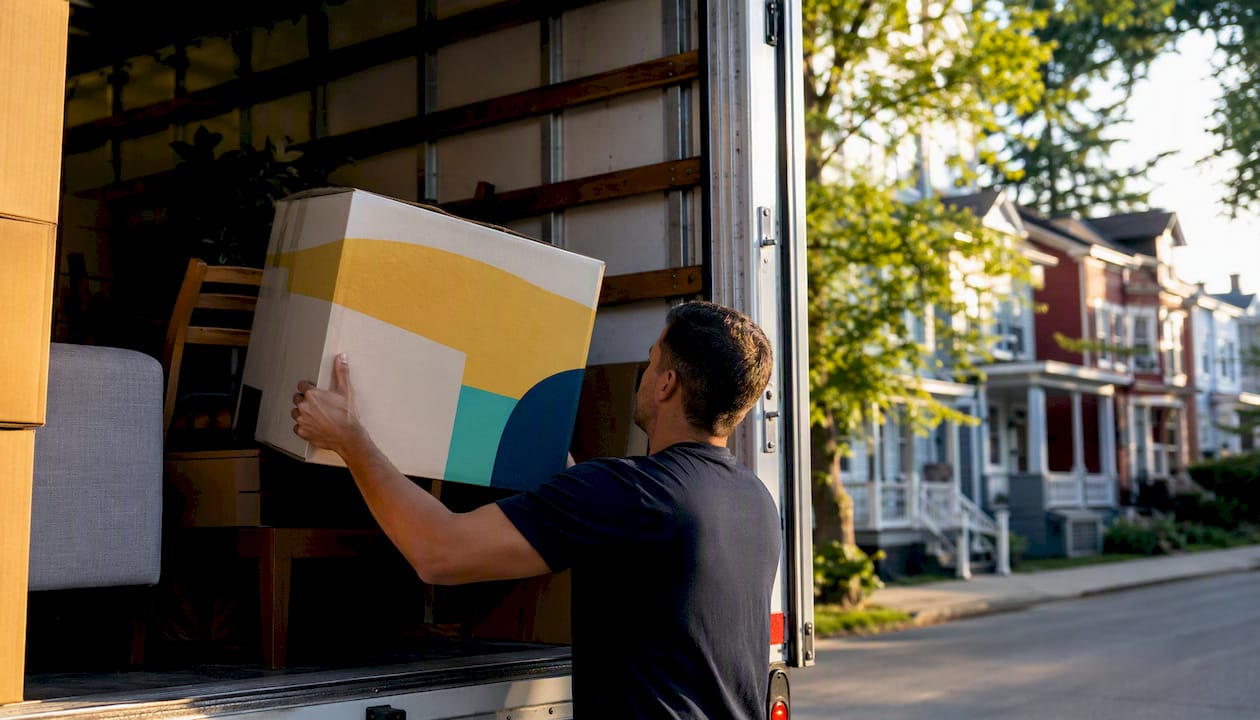
Moving costs vary widely based on how much help you hire. Here’s a realistic range:
| Moving Method | Typical Cost | Best For |
|---|---|---|
| Friends + borrowed truck | $50–$200 (gas, food, supplies) | Minimal furniture, local move |
| DIY truck rental (U-Haul, Penske) | $150–$500 | Studio or one-bedroom, local |
| Hybrid (rent truck + hire loaders) | $400–$800 | One-bedroom, moderate distance |
| Full-service movers | $800–$2,500+ | Larger moves or long distance |
For furnishing, a minimal setup (bed frame, mattress, basic kitchen items, a few storage pieces) runs $500–$1,500 if you shop smart. A fuller setup with a couch, dining table, and desk can reach $2,500–$4,000 buying new.
Ways to cut furnishing costs significantly:
- Facebook Marketplace and Craigslist for gently used furniture
- Thrift stores (Goodwill, Salvation Army, local shops) for kitchen items and décor
- Curb alerts and “free” sections on local community boards
- Hand-me-downs from family or friends who are also moving or downsizing
- IKEA or Amazon Basics for affordable new essentials when used isn’t available
One-time setup costs that often get overlooked:
- Internet installation or activation fee ($50–$100)
- Utility deposits for electricity or gas ($50–$150 per utility)
- Small appliance purchases (toaster, microwave, vacuum): $100–$300
- Cleaning supplies and basic tools: $50–$100
- Curtains, shower curtain, bath mat, and hangers: $75–$150
Budget $300–$600 for these incidentals even if your furnishing plan is minimal.
What documents and credit steps should you prepare before applying?
Preparing your paperwork before you start touring apartments saves real money. Rushed applications lead to missed deadlines, backup choices, and higher rents. Apartment List recommends starting at least 60 days before your intended move-in date to give yourself time to fix problems before they cost you.
Document checklist:
- Valid government-issued photo ID (driver’s license or passport)
- Two to three recent pay stubs (or offer letter for new jobs)
- Most recent W-2 or 1099 tax form
- Two to three months of bank statements showing consistent deposits
- Contact information for two references (employer or previous landlord preferred)
- Proof of renter’s insurance if the landlord requires it at signing
Credit steps to take 60–90 days out:
- Pull your free credit report at AnnualCreditReport.com and check for errors
- Dispute any inaccurate negative items in writing; corrections can take 30–45 days
- Pay down credit card balances to reduce your utilization ratio, which directly affects your score
- Avoid opening new credit accounts in the 60 days before applying
- If your score is below 620, ask a trusted family member about co-signing; many landlords accept this
A stronger credit profile doesn’t just improve approval odds. It can also reduce or eliminate the need for a double security deposit, which some landlords require from applicants with thin or damaged credit.
Three copyable savings plan templates you can use right now
These templates use a $1,500/month rent and a $12,100 savings target (move-in + 2-month runway) as the base. Adjust the numbers to your actual rent.
-
3-month sprint plan
- Monthly savings needed: $4,033
- How to reach it: eliminate dining out entirely, pause all non-essential subscriptions, add side income of $500–$1,000/month, and redirect any bonus or tax refund directly to the fund
- Best for: someone living rent-free with family and earning $60,000+/year
- When to extend: if you can’t hit $4,000/month without depleting your emergency fund, move to the 6-month plan
-
6-month steady plan
- Monthly savings needed: $2,017
- How to reach it: cut dining and subscriptions by $300/month, add one side income stream ($300–$500/month), and automate the rest from your paycheck split
- Best for: most full-time earners in the $40,000–$55,000 range
- Irregular income tip: if you’re paid irregularly, save 45% of every deposit instead of a fixed dollar amount
-
12-month build plan
- Monthly savings needed: $1,008
- How to reach it: automate $1,000/month to a HYSA, keep current spending mostly intact, and apply any windfalls (tax refund, bonus, overtime) as lump-sum boosts
- Best for: someone balancing student loan payments, building an emergency fund, or earning under $40,000/year
- Debt and retirement note: continue paying minimums on all debt, and keep contributing to a 401(k) up to any employer match before redirecting extra dollars to the apartment fund. Free employer match is a guaranteed return you shouldn’t skip.
For all three plans, use percentage-based contributions if your income varies. Saving 30–45% of each paycheck toward the apartment goal works better than a fixed dollar target when paychecks fluctuate.
Key Takeaways
Saving for an apartment requires a concrete cash target (move-in costs plus two months of living expenses), a realistic timeline, and automated contributions that remove the need for daily willpower.
| Point | Details |
|---|---|
| Set your cash target first | Aim for move-in costs plus two months of living expenses, roughly 2–4 months’ rent total. |
| Match timeline to income | A 3-month plan needs $4,000+/month in savings; a 12-month plan needs around $1,000/month. |
| Automate from day one | Schedule transfers on payday to a separate HYSA so the money moves before you can spend it. |
| Start 60 days early | Use the lead time to gather documents, check your credit report, and correct any errors before applying. |
| Use Valapoint to stay on track | Vala’s goal tracker, subscription scanner, and automated transfers keep your apartment fund moving without manual effort. |
Why the boring approach actually works
The plans that succeed aren’t the ones that demand the most sacrifice. They’re the ones that require the fewest decisions. When your savings transfer is automatic, you don’t have to choose between saving and spending every pay period. That single structural change, moving money before you see it, does more for your progress than any amount of motivation.
What most first-time renters underestimate isn’t the cost of moving. It’s the cost of not being ready. A weak credit file, missing documents, or a savings account that’s $2,000 short means settling for a worse apartment, paying a higher deposit, or delaying the move entirely. The 60-day planning window and the 3–4 month savings target aren’t arbitrary rules. They’re the margin between a smooth move and a stressful one.
Modest, consistent actions compound. A $1,000/month automated transfer over 12 months gets you to the same place as a $4,000/month sprint over 3 months, with far less strain. The goal isn’t to suffer for your apartment. It’s to build a system that works quietly in the background while you live your life.
Vala makes apartment saving straightforward
Tracking your apartment fund manually across spreadsheets and bank accounts is tedious, and it’s easy to lose momentum when progress isn’t visible. Vala gives you a clear, real-time view of your savings goal, flags the subscriptions draining your fund, and automates the transfers so your plan runs on schedule.

Set your apartment savings goal in Vala, connect your bank account, and let the app surface exactly where your money is going. The subscription scanner alone typically uncovers $50–$150/month in charges worth cutting. Vala is free to start, with premium features available for users who want full AI insights, shared expense splitting, and advanced goal tracking.
Open your apartment savings goal in Vala today, or explore the full feature set at valapoint.com/personal-money-app.
Useful sources and further reading
- portal.hud.gov
- First-Time Apartment Renter’s Guide: 20 Step Checklist
- How much money should you save for an apartment?
- Renting Your First Apartment: The Complete Financial Checklist | Savvy Nickel
- First Apartment Costs Calculator — Apartment Notes
- How Much You Should Save Before You Move Out | Capital One