
Finding a budgeting app that makes daily and shared expense management easy without complex setup or manual spreadsheets is a real challenge. Many popular apps either require detailed manual categorization, lack real-time alerts, or limit shared budgeting to higher-priced plans. This comparison covers features, automation, and shared budgeting support across three leading options so you can pick the best fit for your needs.
Table of contents
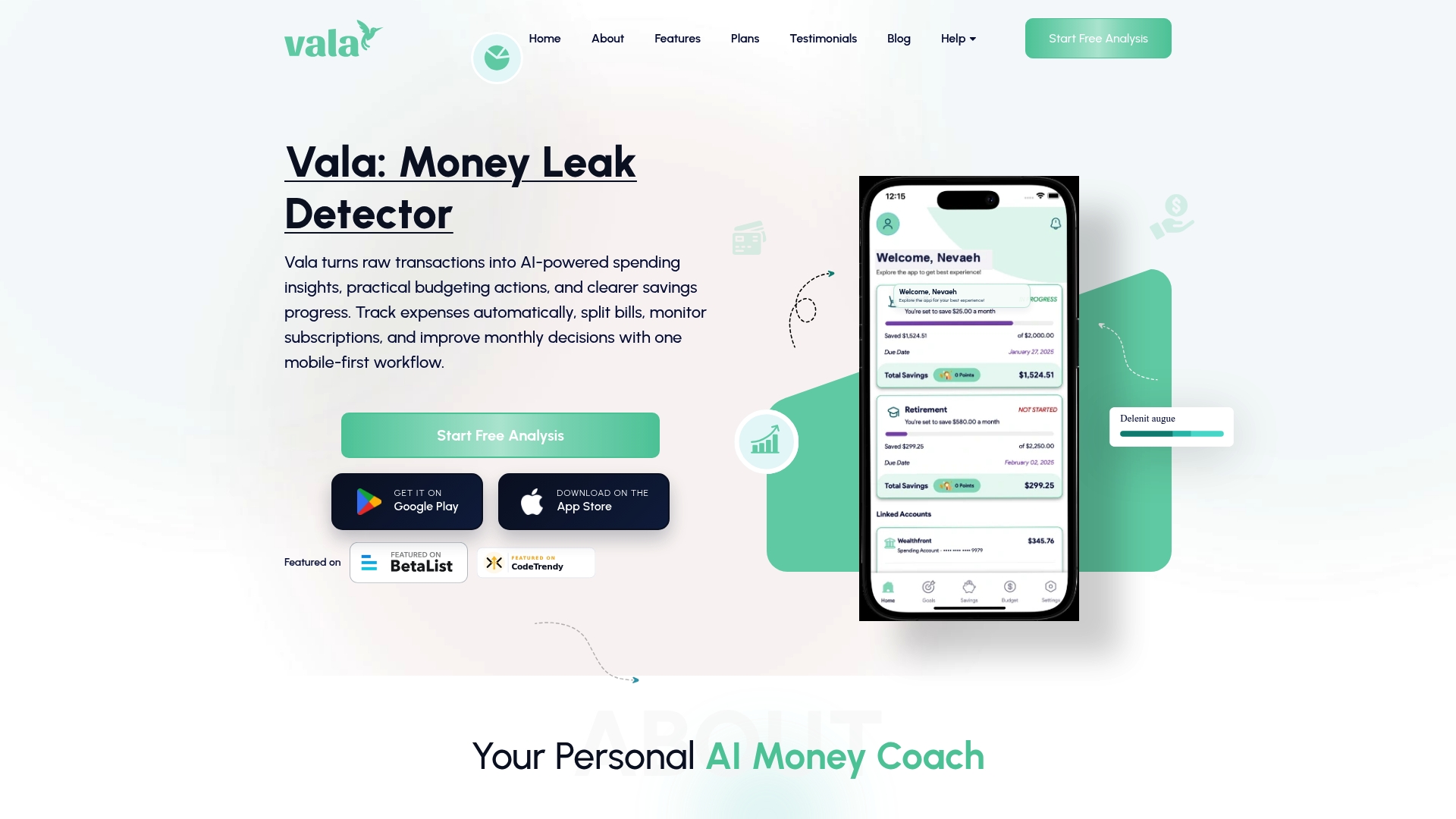
Vala: money leak detector
At a glance
Vala turns raw transactions into spending insights, budgeting actions, and savings progress tracking. The app emphasizes an AI Coach that gives context aware budgeting suggestions tied to your actual purchases. It targets U.S. households and shared budgets with a mobile first interface and security focused architecture.
Core features
- AI Coach App for context aware budgeting suggestions that learn from your transactions.
- Automatic expense categorization to reduce manual sorting and show where money flows each month.
- Bill splitting tools for roommates, partners, or family members to share and settle expenses.
- Budget savings tracker with recurring contributions that shows progress toward goals like emergency funds.
- Secure bank account linking for a consolidated view of balances, transactions, and fast tracking of expenses.
- Financial goal tracker for debt payoff and milestone based targets.
- Real time alerts for bills, subscriptions, and spending spikes to prevent surprises.
- Subscription tracking to surface recurring charges you can cancel or reduce.
Key differentiator
AI driven, context aware financial insights power Vala’s recommendations while the design focuses on mobile first use and shared household budgets. That combination lets the app suggest actions based on how you actually spend and who you share expenses with. The emphasis on shared workflows makes budgeting a group task rather than something you do alone. This focus suits people splitting rent, recurring bills, or family expenses.
Pros
-
Intuitive mobile first design makes budgeting quick on your phone and reduces friction for daily tracking.
-
Secure bank linking gives a broader financial picture so you do not toggle between multiple apps.
-
Personalized insights and real time alerts help you spot subscription leaks and unexpected spending fast.
-
Shared budgeting features work for couples, families, and roommates so everyone sees the same balances and plans.
-
Flexible plan options include free features for basic tracking and premium tools for savings goals and advanced alerts.
Cons
- Pricing details are shown inside the app only, so you may not see exact costs until you sign up.
Who it’s for
Vala fits U.S. individuals and households that want a mobile first, AI assisted budgeting tool. Choose Vala if you split bills with roommates or a partner and need clear shared ledgers. The app also suits young professionals who want automated savings nudges without manual spreadsheets.
Unique value proposition
The AI Coach that converts transaction context into suggested actions reduces time you spend categorizing and planning. That means you get concrete steps such as trimming a subscription or setting a recurring transfer to savings. For shared budgets, Vala moves cost splitting and alerts into the same workflow so money management becomes a coordinated task.
Real world use case
A young professional links bank accounts to Vala, which categorizes purchases and highlights recurring charges. They split utilities with roommates inside the app and automate a weekly transfer to a savings goal. Real time alerts stop overspending during a busy month and keep the budget on track.
Pricing
Current plans and pricing are shown in the app. Vala offers a free tier with basic tracking and premium capabilities behind a paid plan. Exact features and costs are disclosed inside the app during signup.
Website: https://valapoint.com
YNAB (you need a budget)
At a glance
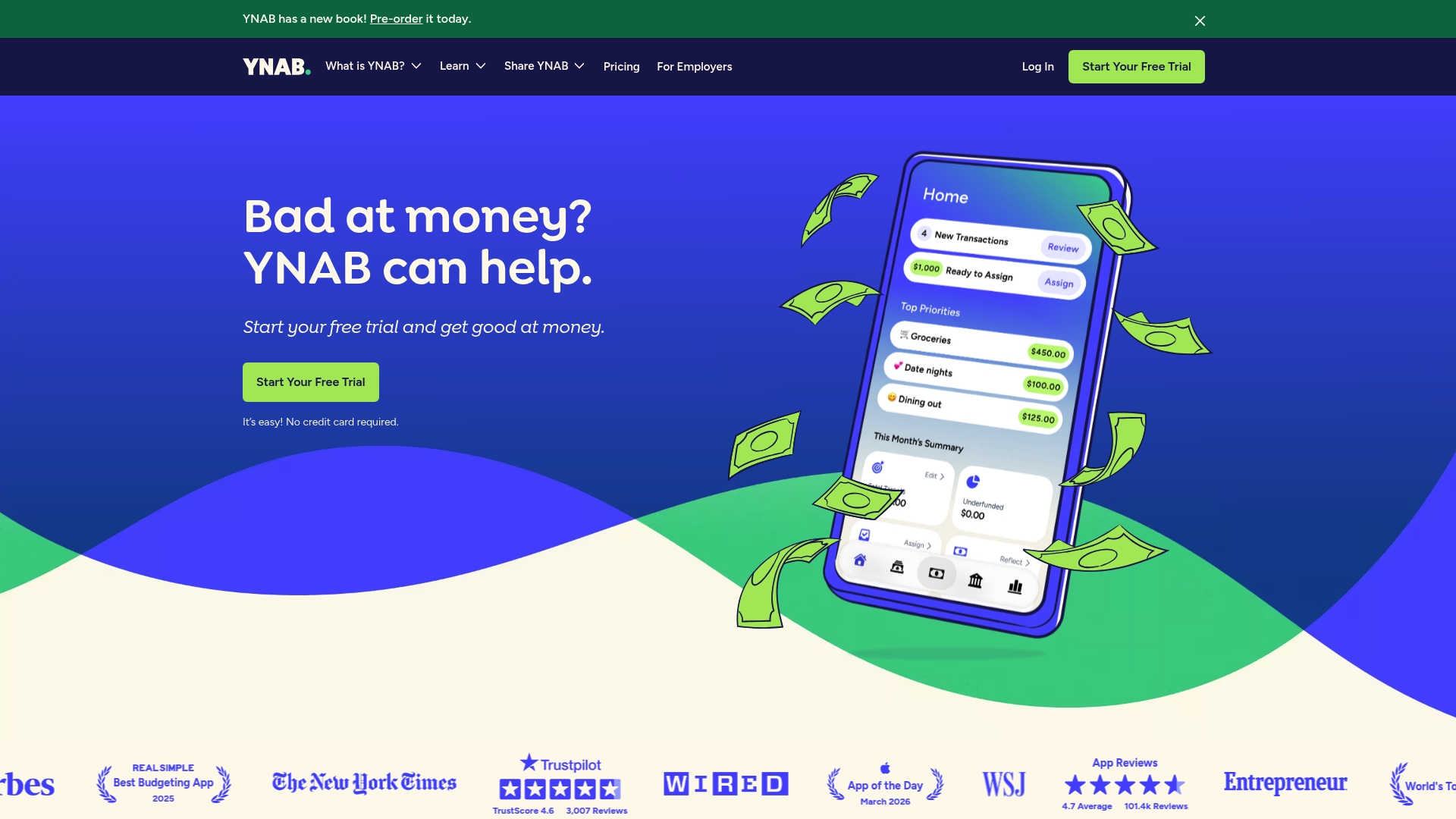
YNAB reports a 4.8 star app store rating with more than 75,000 reviews. The app uses a strict budgeting method that asks users to assign every dollar a job and track progress by category. That focus pairs with active community support and a strong library of educational resources.
Core features
- Give every dollar a job: Assign funds to categories so you plan spending before it happens.
- Set and track savings goals: Create target amounts and watch category balances move toward them.
- Integrated loan calculator: Model paydown scenarios and see how payments affect your budget.
- Real-time sync across devices: Web, iOS, and Android stay updated.
- Subscription sharing for up to six people: Share one plan for household or partner budgeting.
Key differentiator
YNAB centers its workflow on a single budgeting principle: assign every dollar a purpose. The app teaches that principle with guided lessons, forums, and live workshops. That education-first approach makes YNAB more of a financial course plus app than a passive tracker. Users who want habit change will notice the difference quickly.
Pros
- Effective for debt reduction and saving. Users report clearer payoff plans and visible progress when they follow the method.
- Promotes disciplined money habits. The budgeting framework forces decisions about priority spending rather than reactive tracking.
- Well regarded in the press and app stores. The vendor cites coverage from outlets like Forbes and the New York Times, which reinforces credibility.
- Ad-free and privacy focused. The product emphasizes a cleaner interface without in-app ads and a privacy forward stance.
- Strong community and learning materials. Weekly workshops, guides, and an active forum help new users adopt the method.
Cons
- Steep learning curve for beginners. New users often need time and coaching to apply the method to irregular income.
- Bank sync can be unreliable for some institutions. The vendor notes occasional connection and balance discrepancies.
- Higher subscription cost than some alternatives. The annual plan sits above many free or lower cost budgeting apps.
- Limited multi currency support inside a single plan. That restriction affects frequent travelers and international households.
When it may not fit
If you prefer automatic categorization with minimal setup, YNAB will feel hands on and time consuming. Small households that need multi currency support will find the plan limiting. Teams that rely on flawless bank sync for real time reconciliation may need a backup process.
Notable integrations
- Bank account linking for transaction import. This covers most mainstream U.S. and international banks though reliability varies.
- Apple Card import is supported with region dependent behavior. Availability depends on how card providers expose data.
Who it’s for
YNAB fits individuals and couples who want a guided, educational approach to budgeting. It works well for people focused on paying off debt and building savings. Tech savvy adults who like learning and using a rules based workflow will get the most value.
Real world use case
A couple shares one subscription and maps monthly paychecks to budget categories. They track savings toward a home down payment and use the loan calculator to plan debt paydown. The shared plan forces weekly money conversations and prevents surprise shortfalls.
Pricing
YNAB charges $109 USD per year or $14.99 USD per month. The vendor offers a free 34 day trial with no credit card required so you can test the method before subscribing.
Website: https://ynab.com
Roo
At a glance
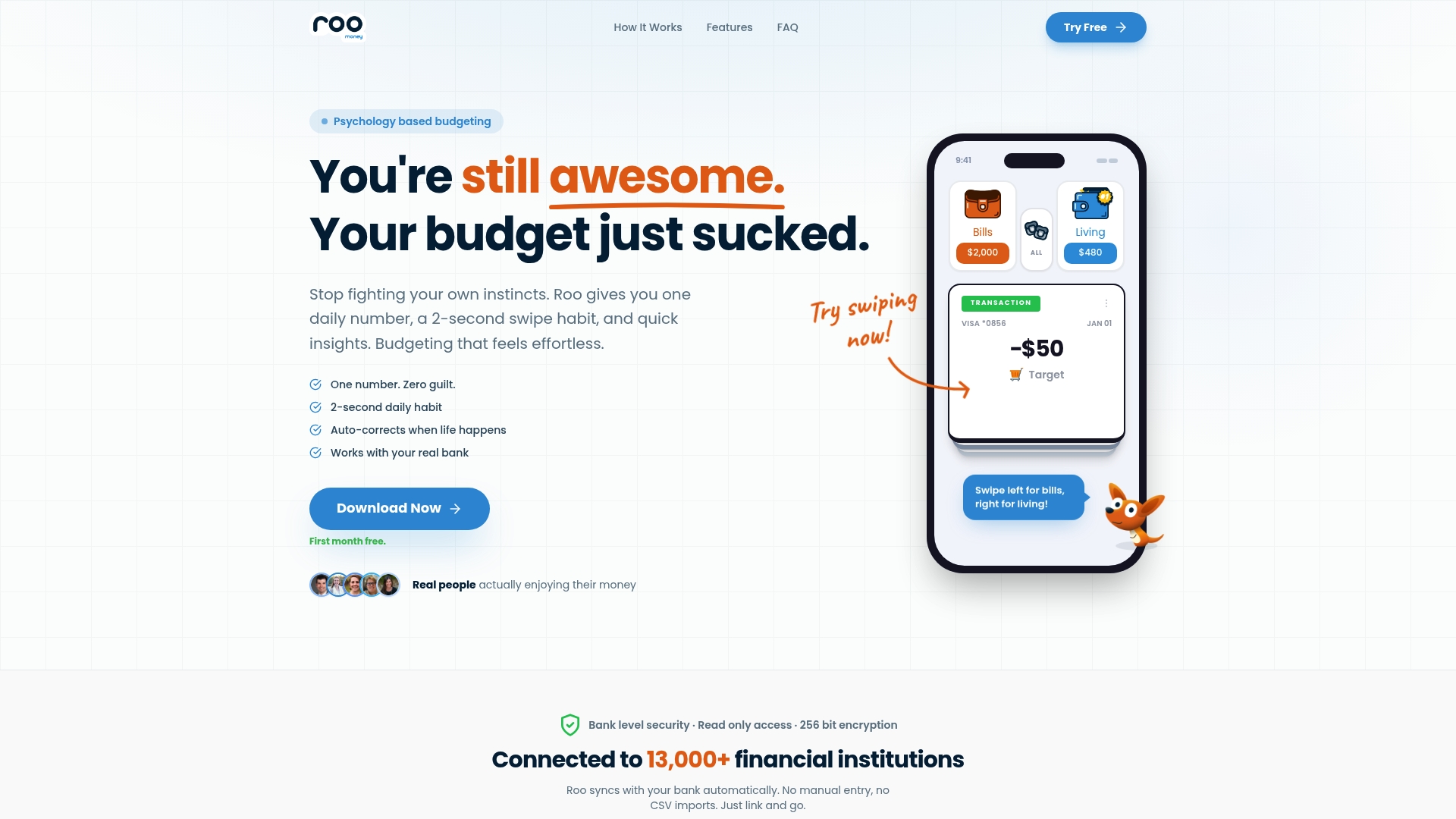
Roo centers your budget on a single daily number you check each morning. That number reflects what you can safely spend after accounting for Bills and Living money. The app uses a three-step swipe workflow to sort transactions and keep the daily figure accurate.
Core features
Roo simplifies daily money decisions with a compact set of tools.
- One daily number that shows how much you can spend today.
- Swipe system to sort transactions into Bills or Living quickly.
- Auto-corrects when your income or bills change so the daily number updates.
- Account sync works with most bank accounts for automatic transaction import.
- Custom pouches for savings goals and tucked-away expenses.
These features remove spreadsheets and long category trees. You get immediate feedback each morning.
Key differentiator
Roo is built around behavioral psychology and a swipe interface that makes budgeting a daily habit. The app focuses on a simple routine instead of detailed categories. That design aims to reduce decision fatigue and keep people on track with small daily actions.
Pros
- Simple interface reduces friction. The swipe workflow makes sorting transactions fast and repeatable.
- Proactive controls help prevent overspending. The daily number nudges you before mistakes happen.
- Psychology-first design lowers frustration. Users avoid long setup and complex rule building.
- Real-time insights and automatic corrections help you adapt when bills or income shift.
- No spreadsheets or many categories. The minimal setup suits people who want an easy habit.
Cons
- Limited long-term budgeting tools. Roo does not provide deep multi-month budget breakdowns.
- Sparse public reviews. External user feedback is currently limited and mostly anecdotal.
- May struggle with multiple complex goals. Managing many simultaneous savings targets feels constrained.
- Possible account compatibility gaps with some banks. You may need manual imports in rare cases.
When it may not fit
Roo is not a good match if you need granular category reports or multiaccount forecasting. People who track dozens of subcategories or run multi-month budget scenarios will find the interface too simplified. If you require complete compatibility with every financial institution you may face occasional sync gaps.
Who it’s for
Choose Roo if you want a low-effort way to control daily spending without spreadsheets. It suits people who prefer a habit driven approach and quick morning check ins. It also fits users who find traditional category budgets too time consuming.
Real world use case
A user links checking and credit accounts and opens Roo each morning. They swipe new transactions into Bills or Living and glance at the Living pouch number. That single figure guides spending decisions for the day and reduces impulse purchases.
Pricing
Roo offers an Early Access price that the company advertises as lockable forever. The plan runs at $12/month or $96/year after a first free month. The model is a single subscription for full app access.
Website: https://roo.money
Comparison of alternatives
For individuals exploring alternatives to Mint by Intuit, comparing features and focus areas of various budgeting applications is vital to make an informed decision. Applications like Vala, YNAB, and Roo each provide unique strengths tailored to different financial management needs.
Analytical subsection 1: customization and integration
Vala introduces an AI Coach to transform transactional data into insights. It combines this with shared budgeting tools, enhancing transparency in managing joint expenses. By contrast, YNAB’s focus on assigning every dollar to a category requires active user engagement but nurtures disciplined spending habits via learning resources. Roo adopts a simplified approach, emphasizing minimal interaction by generating a daily spending figure for quick decision-making. Therefore, Vala caters to nuanced spending habits, YNAB fosters financial understanding, and Roo simplifies expense tracking.
Analytical subsection 2: usability and learning curve
Vala prioritizes ease of use with a mobile-first design and automation in tracking and recommendations. YNAB’s structure, while requiring a higher time investment upfront, rewards users with insights into expense categorization. Meanwhile, Roo’s immediate and straightforward daily spending updates serve those desiring simplicity. Thus, Vala suits collaborative users, YNAB benefits analytical planners, and Roo aids those new to structured budgeting.
Best fit
- For individuals and households looking for tailored financial insights combined with shared budget functionality, Vala is. Its AI-driven predictions offer effective management for shared expenses and savings goals.
- Users who are deeply interested in understanding financial management methods and dedicated to structuring budgets benefit from YNAB, which excels due to its educational resources and habit-building framework.
- For those seeking an uncomplicated approach to daily budgeting without delving into extensive setups, Roo provides an ideal interface focused on concise expense guidance.
Our pick
Valapoint.com excels in delivering AI-driven contextual financial insights, complemented by its support for shared workflows, making it an excellent choice for users with collaborative financial goals or those appreciating automated suggestions. However, if one’s priorities lie in extensive budget planning education, competitors like YNAB might prove to be the preferable choice. Ultimately, the ideal selection depends on evaluating one’s budgeting priorities and routine.
To navigate the selection of a budgeting app that aligns with users’ goals, preferences, and interface requirements, the following table compares key characteristics among leading options.
| Product | Core Feature/Use Case | Key Differentiator | Best For | Pricing | Notable Limitation |
|---|---|---|---|---|---|
| Valapoint | AI-driven budgeting and shared household features | Mobile-first design with AI-powered financial insights | U.S. households with shared budgeting needs | Not disclosed | Pricing disclosed inside app only |
| YNAB | Category-based proactive budgeting with educational tools | Method-focused approach and extensive learning resources | Individuals/families seeking disciplined financial habits | $109/year or $14.99/month | Steep learning curve for beginners |
| Roo | Daily spending tracker with behavioral focus | Psychology-based, swipe interface for simple daily habits | Users desiring minimal effort daily budgeting | Early access: $96/year or $12/month | Limited multi-month breakdown tools |
Discover a smarter alternative to Mint.intuit.com with Valapoint
Finding the right money management tool can feel overwhelming. Many users of mint.intuit.com alternatives seek clear budgeting, automatic expense tracking, and an easy way to manage shared finances. Valapoint addresses these key challenges by offering an AI-powered app that not only tracks your spending but also suggests actionable steps to help you save more and split costs effortlessly.
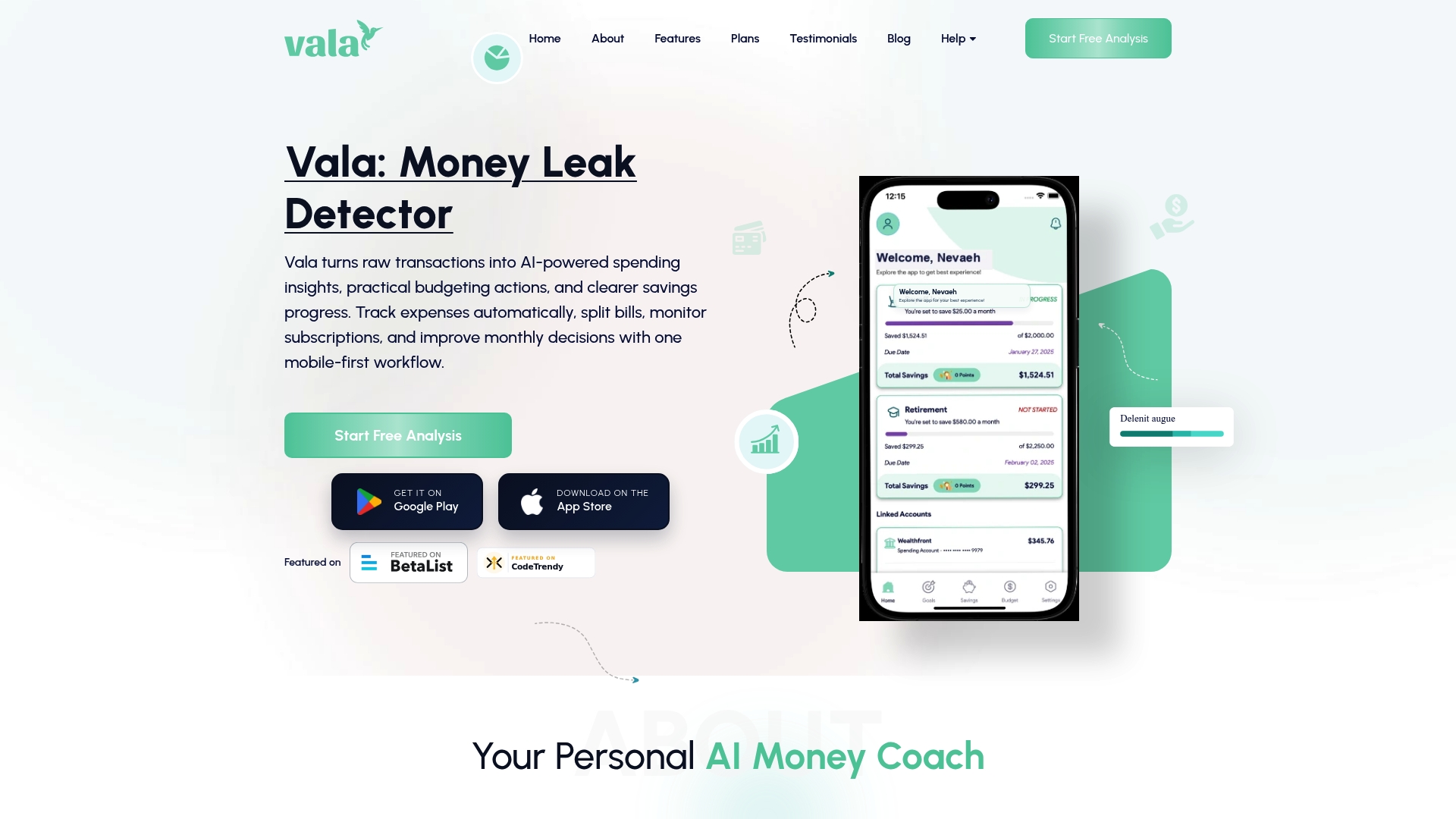
Take control of your finances with Valapoint’s intuitive features that simplify budgeting for individuals, couples, and groups. Start by linking your accounts for a consolidated view, then let the AI Coach highlight spending leaks and help you automate savings. Visit Valapoint to experience budgeting designed just for you and start gaining financial clarity today.
FAQ
What are the primary budgeting features offered by Valapoint?
Valapoint provides an AI Coach that offers context-aware budgeting suggestions, automatic expense categorization, and a budget savings tracker. These features help users gain insights into their spending and track progress toward their financial goals.
How does valapoint’s shared budgeting feature compare to ynab’s approach?
YNAB excels in promoting a disciplined budgeting method by encouraging users to assign every dollar a job, making it suitable for those who prefer a strict framework. Valapoint, on the other hand, offers shared budgeting tools that focus on simplicity, allowing couples and roommates to track shared expenses together easily.
What benefits does Valapoint provide in real-time spending alerts?
Valapoint allows users to receive real-time alerts for bills, subscriptions, and spending spikes. This feature helps prevent unexpected overspending, ensuring users can manage their finances more effectively.
Is Valapoint compatible with multiple bank accounts?
Yes, Valapoint supports secure bank account linking, providing a consolidated view of balances and transactions. This allows users to manage their finances in one place, making it easier to track spending across different accounts.
How does valapoint’s pricing structure compare to other budgeting apps?
Valapoint offers flexible plan options, including a free tier for basic tracking and premium tools for advanced features. This allows users to choose a plan that fits their needs without a substantial initial commitment, similar to other budgeting apps.
Can Valapoint help users automate savings?
Yes, Valapoint features a budget savings tracker that encourages recurring contributions to savings goals, making it easier for users to automate saving over time. This can help build an emergency fund or achieve other financial milestones.