
Predictive budgeting with AI forecasts your near-term spending, suggests budgets based on your real habits, flags recurring charges you may have forgotten about, and splits shared costs automatically. It works for individuals who want less manual tracking, couples who split bills, and small groups managing shared expenses. The goal is simple: fewer surprises, clearer numbers, and more confidence in your next money move.
TL;DR:
- Predictive budgeting relies heavily on accurate transaction categorization; poor categorization reduces forecast quality.
- Seasonal spikes and recurring charges are identified through trend detection, helping prevent unexpected expenses.
- Household behavior modeling tailors advice to different spending habits, making forecasts more relevant but less uniform across households.
- Bank data delays or slow updates can cause inaccuracies, emphasizing the importance of regular category review and maintaining a safety buffer.
- Securing bank connections through modern APIs and understanding data policies are essential to protect privacy and ensure trustworthy forecasts.
Table of Contents
- How AI forecasts your spending and splits shared costs
- What predictive budgeting helps you do, and where it can fall short
- How to choose an AI budgeting app that fits your needs
- Setting up predictive budgeting the safe way
- Privacy, security, and what regulators want you to know
- Who should try predictive budgeting now
- Try Vala’s predictive budgeting for yourself
- Sources
- FAQ
How AI forecasts your spending and splits shared costs
Every prediction starts with your transaction history. The app pulls in your bank data, sorts each purchase into a category, and builds a picture of your habits over time. Better categorization means better forecasts, since the model can only predict what it correctly understands.
From there, time-series models look for patterns: your regular bills, seasonal spikes, and the small purchases that add up. These models flag trends and repeat charges, which is how the app catches a subscription you forgot about or a spending spike before it drains your account.
Personalization adds another layer. Research on AI financial advice from Stanford Graduate School of Business found that AI-generated guidance can move people closer to sound financial decisions, though the effect depends heavily on the quality of the input and the user’s own financial literacy. Separately, NBER research on household spending shows that machine learning can sort households into behavior types, such as tightly constrained or naturally cautious spenders, and that two households with similar incomes can respond very differently to the same suggestion.
For shared expenses, the same categorization engine tags recurring group charges (rent, utilities, subscriptions) and calculates each person’s share automatically. You can read more on how AI personalizes budgets for a deeper look at the categorization process.
- Transaction categorization is the foundation: weak categorization means weak forecasts.
- Trend detection catches seasonal spikes and recurring charges before they surprise you.
- Household-type modeling tailors suggestions instead of applying a generic budget to everyone.
- Shared expense splitting relies on the same tagging system used for personal transactions.
One finding worth remembering: the Stanford working paper documents high classification accuracy alongside real gains for many users, but those gains are not uniform across every household.
What predictive budgeting helps you do, and where it can fall short
Used well, predictive budgeting takes work off your plate. You get earlier alerts on low balances, automatic budget suggestions that adjust as your income changes, and a clearer view of the subscriptions quietly draining your account. Many people also report saving more simply because the friction of manual tracking disappears, a pattern covered in more detail in this piece on saving automatically with AI insights.
The limits are real, though. NBER’s household research confirms that outcomes vary by household type, so a forecast tuned for one person’s habits will not always fit another’s. If your bank feed lags or updates slowly, the model can misjudge your balance and increase the risk of an overdraft. And because many of these systems do not fully explain their reasoning, it can be hard to know why a budget suggestion looks the way it does.
- Benefit: earlier alerts on spending trends and low balances.
- Benefit: automated recurring-charge detection that catches forgotten subscriptions.
- Limit: stale or delayed bank data can produce inaccurate forecasts.
- Limit: opaque recommendations make it hard to question a suggestion you disagree with.
Predictive budgeting tends to work best for steady, predictable income and worst for irregular or seasonal earnings, where the model has less reliable history to learn from.
Pro Tip: Keep a small cash buffer in your checking account so a slightly off forecast never turns into an overdraft fee.
How to choose an AI budgeting app that fits your needs
Not every app handles security, accuracy, or group expenses the same way. A short checklist keeps the decision simple.
- Check the connection method. Apps using secure API connections tend to be more reliable and safer than those relying on older screen-scraping methods, a distinction FINRA highlights as worth checking before you link any account.
- Look for transparency. Favor apps that explain how a budget was calculated rather than handing you a number with no context.
- Match the feature set to your life. If you split bills with a partner or roommates, confirm the app supports group expense splitting and recurring subscription review, not just personal tracking.
- Understand the pricing shape. Most apps offer a free tier for basic tracking, with paid plans unlocking predictive forecasts and group tools, similar to the freemium-plus-subscription pattern common across the category.
- Watch for red flags. Skip any app with a vague terms of service, no mention of data-rights compliance, or unclear policies on overdraft risk and refunds.
Testing a free trial with a few weeks of real transactions is the fastest way to see if the forecasts actually match your habits before committing to a paid plan.
Setting up predictive budgeting the safe way
Getting reliable forecasts takes a little setup work up front, but it pays off quickly.
- Set your goals first. Decide what you’re solving for (saving faster, splitting bills fairly, catching leaks) then link your accounts using secure, API-based connections where the app offers them.
- Clean up your categories. Spend ten minutes reviewing how the app tagged your recent transactions and correct anything it got wrong. Cleaner data means sharper forecasts.
- Build in a safety buffer. Keep an extra one to three days of average spending in your checking account so a forecasting error does not turn into an overdraft.
- Turn on recurring-charge review and group splitting. This is where most of the value lives for couples and small groups managing shared bills.
- Recheck your budget after life changes. A new job, a move, or a change in shared living arrangements should trigger a manual review, since NBER research on budgeting inertia found that people often fail to reoptimize on their own after major shifts.
For a deeper walk-through of short-term forecasting, this guide on personal cash flow forecasting covers the shift from spreadsheets to app-based tracking.
Pro Tip: Review your categories weekly for the first month. After that, a monthly check is usually enough to keep forecasts accurate.
Privacy, security, and what regulators want you to know
The CFPB’s personal financial data rights rule gives consumers the ability to securely share their financial data with authorized third-party apps, which is part of what makes modern budgeting tools possible. That right comes with responsibility on your end: check how an app handles your data before you connect an account.
- Confirm the app uses secure, modern connections rather than outdated methods that FINRA flags as carrying higher aggregation risk.
- Read what data the app collects, how long it retains it, and whether it shares information with third parties.
- Look for multi-factor authentication and encryption at rest as baseline protections.
- Confirm you can revoke access or export your data at any time.
A few minutes spent checking these details before granting account access is worth far more than the time it takes.
Who should try predictive budgeting now
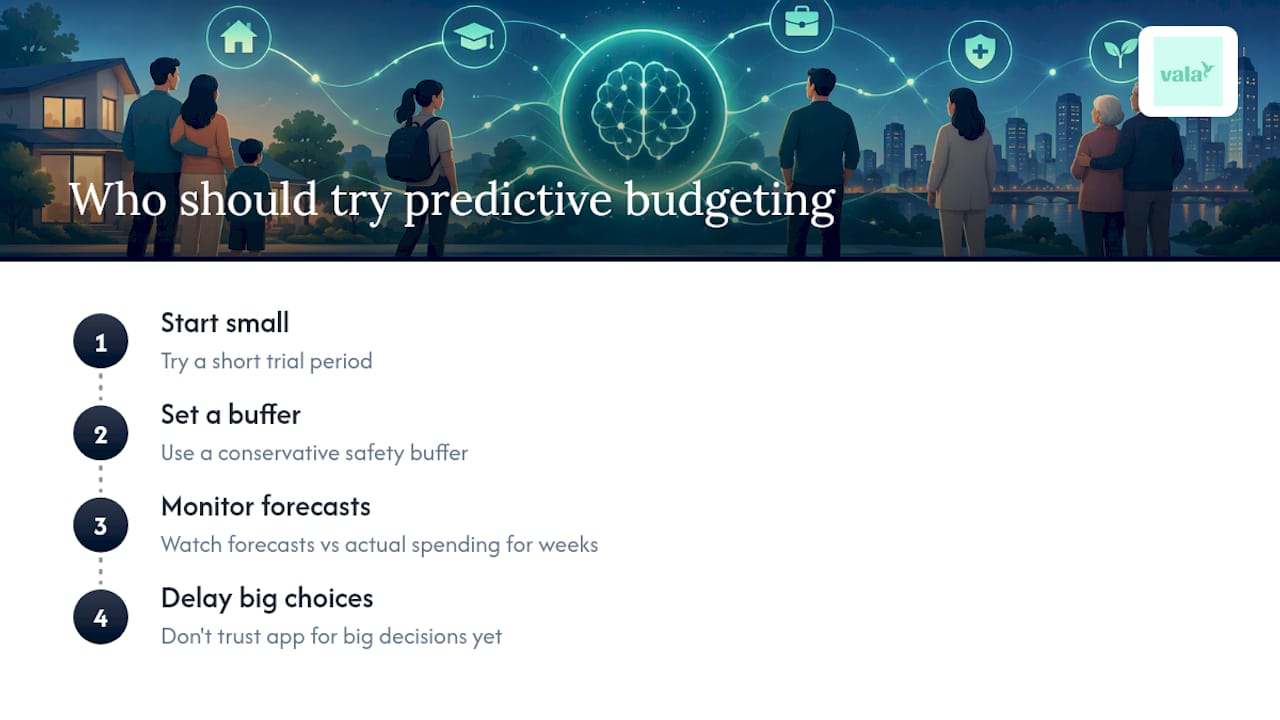
Predictive budgeting fits best if you have steady income, split bills with a partner or roommates, or simply want less manual tracking in your week. It’s less useful, at least at first, if your income swings widely month to month or if you’re not comfortable sharing account access yet.
If you’re on the fence, start small: try a short trial, set a conservative safety buffer, and watch how closely the forecasts match your actual spending over a few weeks before trusting the app with bigger decisions.
— SaverStride
Try Vala’s predictive budgeting for yourself
Everything covered here, secure connections, recurring-charge detection, group expense splitting, and forecasts that adjust to your habits, is what Vala is built around.
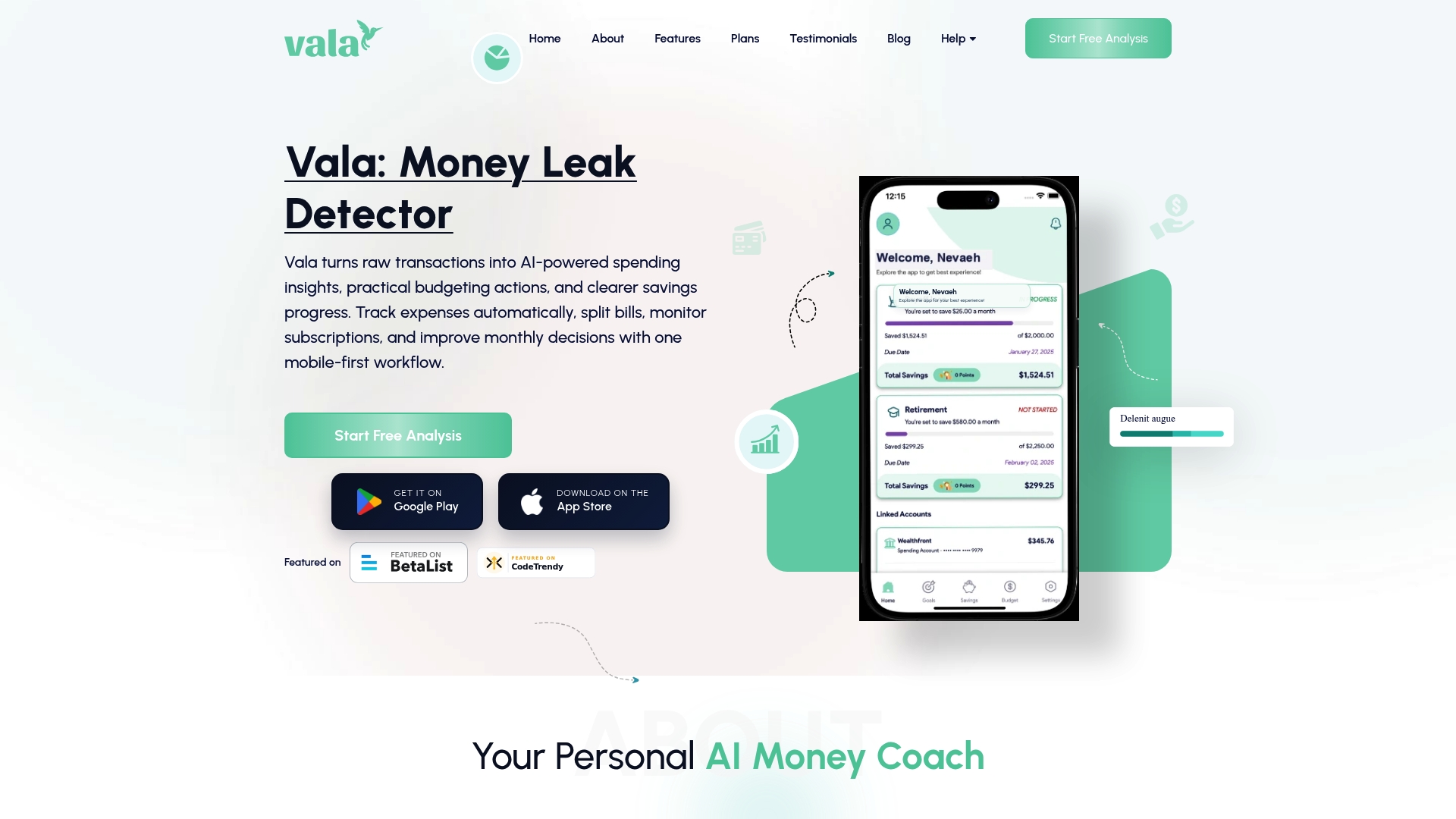
The Money Leak Check reviews your accounts for subscriptions and recurring charges you may have forgotten, and a premium plan can unlock the full predictive budgeting toolkit, including group splits and advanced forecasting.
- Run a free Money Leak Check to see what’s quietly draining your budget.
- Upgrade to SaverPro for deeper forecasts and group-splitting tools.
- Explore the full feature set on the Vala budgeting app page.
Start with the free Money Leak Check on Valapoint and see what predictive budgeting looks like with your own numbers.
This article is general information, not a substitute for advice from a qualified financial advisor. Consult a qualified financial professional about your own circumstances before acting on anything here.
Sources
- AI Financial Advice: Supply, Demand, and Life Cycle Implications | Stanford Graduate School of Business
- CFPB finalizes personal financial data rights rule to boost competition, protect privacy, and give families more choice in financial services
- Know before you share: Be mindful of data aggregation risks | FINRA
- How and why households adjust spending, saving, and borrowing in response to income shocks | NBER
FAQ
What does predictive budgeting with AI actually predict?
It forecasts your near-term spending based on past transactions, flags recurring charges, and suggests budget adjustments before problems show up in your balance. Accuracy depends on clean categorization and consistent, up-to-date bank data.
Is it safe to link my bank account to a budgeting app?
Under the CFPB’s personal financial data rights rule, you have the right to share your financial data with authorized apps, but you should still confirm the app uses secure connections and clear data policies. Checking the app’s aggregation method before linking an account is a reasonable precaution.
Why do budgeting predictions vary so much between people?
Household spending behavior is highly varied, and NBER research shows machine learning can classify households into distinct behavioral types that respond differently to the same suggestions. That is why a forecast that works well for one person may need adjustment for another.
Can AI budgeting apps split bills for couples or roommates?
Yes, many apps use the same categorization engine that tracks personal spending to automatically calculate and split shared expenses like rent or utilities. Vala’s group-splitting tools work this way, tagging shared charges and dividing them based on your setup.
What should I check before trusting an app’s forecast?
Confirm the app uses secure API connections rather than older screen-scraping methods, review how it categorizes your transactions, and keep a small safety buffer in your account in case a forecast is off. These habits reduce the chance of an unexpected overdraft while the model learns your patterns.