To save for a car, pick a total goal that covers more than the sticker price, divide it by the months you have, move that amount into a separate account every payday, and free up the cash by cutting spending you don’t notice. That last part is where most plans stall, and it’s where Vala helps: our Money Leak Check looks for forgotten subscriptions, recurring charges and bill spikes, so the money for your car fund is already in your budget.
TL;DR
- Your goal is the down payment (or full price if paying cash) plus taxes, title, registration and fees, not just the sticker price.
- Divide the goal by the months until you buy. A $4,750 goal takes about $396 a month over 12 months or just under $200 over 24.
- Keep total car costs (payment, insurance, fuel, maintenance) to roughly 15% to 20% of your take-home pay.
- Use a separate high-yield savings account and automate the transfer on payday.
- Find the monthly amount by reviewing subscriptions and recurring bills first, before cutting things you enjoy.
Table of Contents
- Step 1: Decide what kind of car you are saving for
- Step 2: Add up the real cost
- Step 3: Turn the goal into a monthly number
- Step 4: Find the money in your budget
- Step 5: Keep the money in the right place
- Step 6: Automate it and track progress
- Splitting costs with a partner or friends
- What about saving for a house down payment?
- Start with your own numbers
- Our view: the plan fails at the budget, not the math
- FAQ
- Sources
Step 1: Decide what kind of car you are saving for
Your number depends on one choice: how you will pay. There are two routes.
- Cash. You save the full price plus taxes and fees. There is no loan payment and no interest, but the goal is larger.
- Financing. You save a down payment, which is the cash you pay up front so you borrow less. A bigger down payment lowers your monthly payment and the total interest you pay.
Both routes start the same way. Investopedia explains that your goal is the full sales price including taxes and fees if you pay cash, or a down payment if you finance. Pick the route first, then the car’s price range. A used car, especially one a few years old, usually makes the goal much smaller than new.
Step 2: Add up the real cost
The sticker price is only the start. The Consumer Financial Protection Bureau (CFPB), the federal agency that oversees consumer lending, tells car buyers to add up-front costs (the price, add-ons, taxes, title and dealer fees) and monthly costs (interest, insurance and maintenance), then subtract your down payment and trade-in value.
Here are two examples from AAA:
| Car | Price | Down payment | Taxes, title, fees | Savings goal |
|---|---|---|---|---|
| New | $50,000 | 20% ($10,000) | about $1,500 | about $11,500 |
| Used | $25,000 | 15% ($3,750) | about $1,000 | about $4,750 |
Add the costs that show up after you drive off. AAA reports that owning a car cost an average of $11,577 a year in 2025, and that insurance, gas and maintenance alone can add $400 to $600 a month on top of the payment. Many dealers also want proof of insurance before the car leaves the lot, so budget the first insurance payment too.
If you want to compare cars by what they cost over years rather than on day one, this guide to total cost of ownership shows how to add it all up.
A simple formula
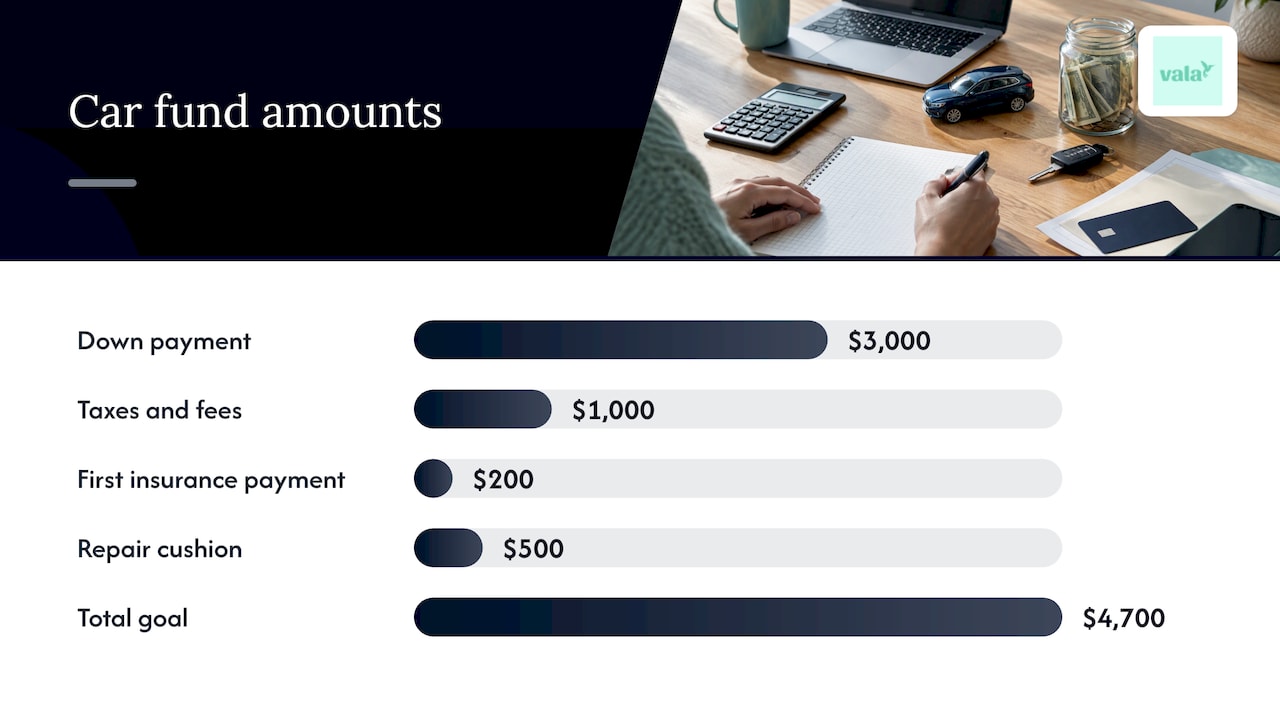
Down payment + taxes and fees + first insurance payment + a repair cushion = your goal. Using a $3,000 down payment, $1,000 in taxes and fees, $200 for insurance and a $500 repair cushion, the goal is $4,700.
Step 3: Turn the goal into a monthly number
Divide the goal by the months until you want to buy. AAA’s math on a $4,750 used-car goal:
| Timeline | Monthly savings |
|---|---|
| 12 months | about $396 |
| 18 months | about $264 |
| 24 months | just under $200 |
For a bigger goal, PNC’s example is a $40,000 vehicle: a 20% down payment is $8,000, which takes $2,000 a month for four months.
If your number looks too high, change one of three things: the timeline, the car’s price or the monthly amount. Stretching from 12 to 24 months nearly halves the monthly cost. If you want help setting a target you will actually hit, our guide to realistic savings targets that stick walks through it.
Check it against your income
A car you can save for is not always a car you can afford to run. SmartAsset suggests keeping total transportation costs (payment, insurance, fuel and maintenance) under 15% to 20% of take-home pay. On $4,000 a month, that is $600 to $800. It also calls a 10% to 20% down payment the sweet spot, as long as you don’t drain your emergency fund to get there.
AAA describes a tighter benchmark, the 20/4/10 rule: 20% down, a loan of under four years and total car costs under 10% of monthly take-home pay.
Step 4: Find the money in your budget
Most people don’t have an extra $250 sitting around. They have it scattered across small charges: a streaming service you stopped using, a free trial that rolled into a paid plan, a phone or insurance bill that crept up.
Start there, before you cut anything you enjoy:
- Pull up the last three months of statements.
- List every recurring charge, including annual ones.
- Mark what you no longer use.
- Check bills that rose without you noticing.
- Send the savings straight to your car fund.
Doing this by hand works, but it is easy to miss a charge that hits once a quarter. Vala connects to your bank through Plaid and reviews recurring charges and bill spikes for you, so you see the leaks in one list. You can also try the free Money Leak Calculator to see how much small recurring costs add up to over a year.
Other moves AAA lists for a tight month: pause other goals for a while, take on a side gig, or drop windfalls like a tax refund straight into the fund.
Small daily choices add up too. Our penny saver habits page has everyday moves that build savings without a big lifestyle change.
Step 5: Keep the money in the right place
Put your car fund in its own account, apart from your emergency fund and everyday spending. AAA recommends a separate high-yield savings account so progress is easy to see and harder to dip into. A high-yield savings account is an online savings account that pays much more interest than a standard one.
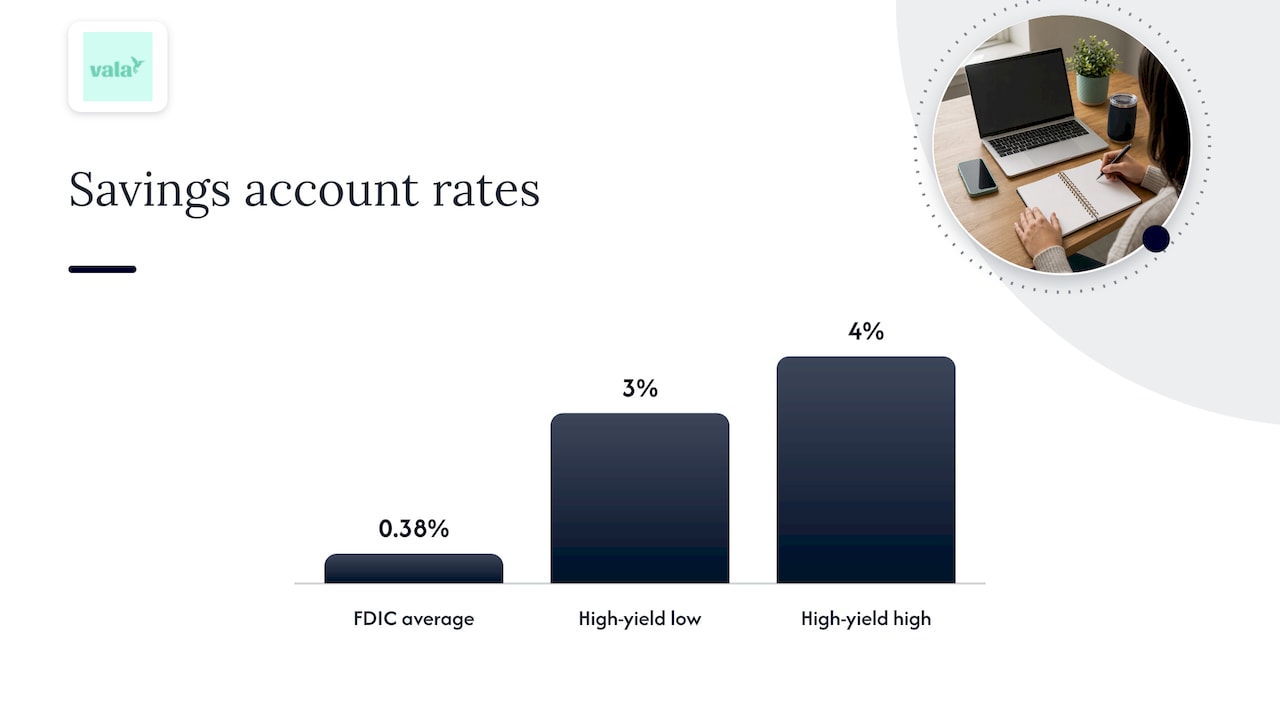
Rates move. U.S. News reported that the FDIC’s average savings account rate was 0.38% as of June 15, 2026, while high-yield savings accounts offered 3% to 4%. The FDIC publishes its national rates on a regular schedule, and banks change their own rates with the Federal Reserve’s decisions, so compare live rates when you open an account.
A few rules of thumb:
- Buying in under two or three years: keep the money out of stocks. Morningstar’s Christine Benz told CNBC that money needed within a couple of years, like a car or down payment, shouldn’t be in stocks because a market dip can arrive just when you need to spend. She called high-yield savings the safest short-term option.
- Fixed purchase date: a certificate of deposit (CD), which locks your money for a set term at a fixed rate, can reduce the temptation to spend. U.S. News notes that CDs may charge early-withdrawal penalties.
Choose an FDIC- or NCUA-insured institution so your deposits are protected.
Step 6: Automate it and track progress
The Florida Department of Financial Services advises treating your savings contribution like a must-pay expense such as rent or groceries. The easiest way is to schedule a transfer for payday, so the money moves before you can spend it. Our guide to automating personal savings goals covers how to set that up.
Then check in once a month. Compare what you saved with what you planned, and adjust the timeline if you fell behind. In Vala you can set a savings goal for your car, use future cash flow simulations to see how your balance looks in the coming weeks, and get reminders for upcoming bills so a surprise charge doesn’t raid the fund. The goal tracker for savings milestones shows how to break a big goal into smaller checkpoints.
Splitting costs with a partner or friends
If you share a car with a partner, or you are pooling money with friends for a road trip or event, keep shared and personal money separate. Agree on who contributes what, and track it in one place. Vala’s shared expense splitting is built for this, so a group cost doesn’t sit in your head or in a messy chat thread.
What about saving for a house down payment?
The method is the same: set a total, divide by months, automate. The difference is the order. Charles Schwab suggests funding retirement and high-interest debt first, then a three to six month emergency fund, then goals like a home down payment. It also sorts goals by time: money needed within two years belongs in cash-like accounts, while 3 to 10 year goals can use a mix of bonds and stocks. A car in the next year or two fits the first group.
Start with your own numbers
Our Money Leak Check scans your recurring charges and shows what you could redirect toward your car fund. You can start with the Money Leak Check. The SaverLite plan is $2.99 per month if you want goal tracking and ongoing insights.

You can see more on the automatic savings app page, or begin on valapoint.com.
Our view: the plan fails at the budget, not the math
Saving for a car is simple arithmetic. Divide the goal by the months, and you have a number. Where people struggle is finding that number in a budget that already feels full.
We built Vala around that gap. Many budgeting tools list what you spent. We think the more useful question is what you are paying for that you no longer want. Reviewing subscriptions, recurring charges and bill spikes first means your car fund is paid for by money that was leaking anyway, not by skipping the things you value.
We also think the plan should stay visible. A goal, a clear monthly target, reminders before bills hit and a simulation of your cash flow keep you confident that the next transfer won’t cause an overdraft. That is how a 12 or 24 month plan becomes a habit instead of a good intention.
SaverStride
FAQ
How much should I save for a car?
Save the down payment (or full price for a cash purchase) plus taxes, title, registration and fees. AAA’s examples come to about $4,750 for a $25,000 used car and about $11,500 for a $50,000 new car. Add a repair cushion and your first insurance payment.
How much of my income should go to a car?
A common guide is to keep total car costs, including payment, insurance, fuel and maintenance, under 15% to 20% of take-home pay. On $4,000 a month, that is $600 to $800. Stricter rules aim for 10%.
Is it better to pay cash or finance?
Paying cash avoids interest but means saving the whole price. Financing lets you save less up front, and a larger down payment lowers your payments. The CFPB also notes that shopping among lenders to compare rates and terms can save thousands over the life of a loan.
How fast can I save for a car?
It depends on your goal and income. A $4,750 goal takes about 12 months at $396 a month or about 24 months at just under $200. If you need it sooner, lower the car’s price, add income or free up cash by cancelling unused subscriptions.
Sources
- How Do I Save for Buying a Car? (AAA)
- How much can I afford to borrow for a car or auto loan? (CFPB)
- How to Save for a Car: Savings Plan and Example (SmartAsset)
- Save for a Car: Tips and Strategies (Investopedia)
- How To Save for a Car (PNC Insights)
- How to Build an Emergency Fund in 2026 (U.S. News)
- Where to put savings you’ll need in the next 5 years (CNBC)
- Saving (Florida Department of Financial Services)
- How to Achieve Multiple Financial Goals (Charles Schwab)
- Total Cost of Ownership: How to Calculate It (FactRated)