
A shared budget is a collective financial plan where two or more people pool income and manage expenses together toward common goals. Couples, roommates, families, and project groups all use shared budgets to coordinate spending, reduce financial conflict, and build toward shared milestones like paying off debt or saving for a vacation. The core idea is simple: instead of each person managing money in isolation, everyone involved agrees on how money comes in, where it goes, and what gets saved. Tools like YNAB, Rocket Money, and Valapoint make this process easier by automating tracking and keeping everyone on the same page.
What is a shared budget and how does it work?
A shared budget, also called collaborative budgeting, is a structured agreement between two or more people to jointly track income, divide expenses, and work toward financial goals together. It goes beyond simply splitting a dinner bill. It covers rent, groceries, utilities, savings targets, and discretionary spending, all within one agreed framework.
The shared budget definition centers on three core activities: pooling resources, allocating expenses, and reviewing progress together. Pooling does not always mean combining every dollar into one account. It means agreeing on which expenses are shared and how each person contributes. Allocation sets the rules for who pays what and when. Regular reviews keep everyone honest and aligned.

Common use cases include married couples managing household finances, roommates splitting rent and utilities, families coordinating monthly bills, and even small teams managing project costs. Each group has different needs, but the underlying structure is the same. You define what is shared, agree on contributions, and track together.
The benefits of shared budgeting are concrete. Shared budgets reduce financial surprises, create accountability, and make it easier to reach goals that require sustained effort over time. When both people can see the same numbers, there is less room for misunderstanding and more room for progress.
How to create a shared budget: three proven methods
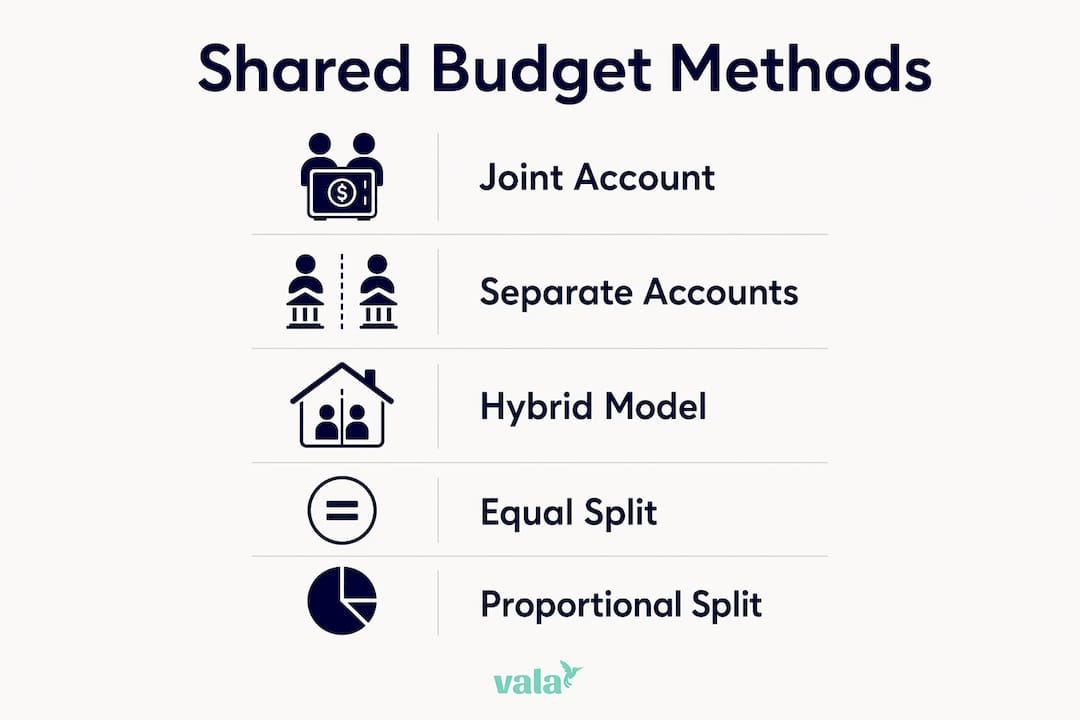
Three common shared budgeting methods exist: fully joint accounts, fully separate accounts, and a hybrid model. Each suits different income levels, relationship dynamics, and personal preferences.
| Method | How it works | Best for | Drawback |
|---|---|---|---|
| Fully joint | All income goes into one account; all expenses paid from it | Couples with similar incomes and full financial transparency | Less individual autonomy |
| Fully separate | Each person keeps their own account and splits bills by agreement | Roommates or couples who prefer independence | Requires constant coordination |
| Hybrid | Joint account for shared expenses; personal accounts for individual spending | Couples with different incomes or spending styles | Requires clear rules upfront |
The hybrid model is the most widely adopted, particularly when partners earn different amounts. You open one joint account specifically for shared expenses like rent, groceries, and utilities. Each person also keeps a personal account for individual purchases. This structure gives you joint visibility where it matters without turning every coffee purchase into a group decision.
When deciding how much each person contributes to the joint account, two approaches apply. Equal dollar splits work when incomes are similar. Proportional contribution works better when incomes differ significantly. Each person contributes the same percentage of their take-home pay rather than the same dollar amount. If one partner earns $4,000 per month and the other earns $6,000, and shared expenses total $3,000, a 30% contribution rate means each pays $1,200 and $1,800 respectively. The financial burden stays fair even when incomes are not equal.
Pro Tip: Before opening a joint account, write down your shared expense categories and estimate monthly costs. This one step prevents the most common source of early disagreements: undefined expectations.
How to fairly split expenses in a shared budget
Fair expense splitting is the part of shared budgeting that causes the most friction, and the solution is almost always more structure, not more trust. Giving each partner a no-questions-asked personal spending allowance is one of the most effective ways to preserve both fairness and individual freedom. Each person gets a set amount each month to spend however they choose, with no reporting required. This prevents shared finances from feeling like surveillance.
A practical starting framework for couples is the 50/30/20 allocation: roughly 50% of combined income to needs, 30% to wants, and 20% to savings and debt. This is a starting point, not a fixed rule. Your actual numbers will depend on your city, income level, and goals.
Here are the most effective strategies for splitting shared expenses fairly:
- Use proportional contributions when incomes differ by more than 20%. Each person pays a percentage of their income rather than a flat dollar amount.
- Assign category ownership for recurring bills. One person handles the electric bill; the other handles the internet. This reduces the mental load of constant negotiation.
- Set a personal spending threshold. Any individual purchase above a set amount, say $100, gets discussed before it happens. Below that threshold, no explanation needed.
- Review and rebalance quarterly. Income changes, expenses shift, and goals evolve. A quarterly check keeps the split accurate.
- Separate shared goals from personal goals. Saving for a joint vacation is a shared expense. Saving for a personal hobby is not. Keep these buckets distinct.
Pro Tip: Track shared expenses in a dedicated budget tracking app rather than a shared spreadsheet. Real-time syncing removes the “I thought you paid that” problem entirely.
Why communication is the real foundation of shared budgeting
Shared budgets require transparent communication, mutual respect, and agreed boundaries to work long term. The numbers are the easy part. Getting two people to talk openly about money, including fears, habits, and priorities, is where most shared budgets succeed or fail.
Framing budget discussions using “we-language” instead of “you-language” is one of the most practical shifts you can make. “Our grocery budget is over this month” lands very differently than “you spent too much on groceries.” The first invites collaboration. The second invites defensiveness. This is not just soft advice. It changes the outcome of the conversation.
Here is a simple structure for running a monthly budget meeting that actually works:
- Review last month’s spending against the agreed budget. Note categories that went over or under without assigning blame.
- Identify any upcoming expenses for the next 30 to 60 days, such as car registration, annual subscriptions, or travel.
- Check progress on shared goals. Are you on track for the emergency fund, vacation savings, or debt payoff target?
- Adjust allocations if needed. If one category consistently runs over, either increase its budget or discuss behavior changes.
- Each person shares one financial concern or priority for the coming month. This keeps both people feeling heard.
Regular financial check-ins prevent misunderstandings and keep both people aligned on goals. Monthly meetings work well for most groups. Weekly check-ins suit couples who are actively paying down debt or saving aggressively. The format matters less than the consistency.
Successful shared budgeting depends on emotional intelligence and the willingness to discuss fears and preferences openly. One partner may be a natural saver; the other may be more comfortable spending. Neither approach is wrong. A shared budget works when both people feel their values are represented in the plan.
What tools and apps make shared budgeting easier?
Apps like Valapoint, YNAB, and Rocket Money offer features specifically designed for shared expense tracking, bill splitting, and goal monitoring. The right app removes the friction of manual tracking and keeps everyone informed without requiring constant check-ins.
When choosing a tool for collaborative budgeting, look for these features:
- Real-time syncing so both users see the same data at the same time, not yesterday’s version
- Expense categorization that lets you separate shared costs from personal spending automatically
- Bill splitting tools that calculate each person’s share and track who has paid
- Goal tracking so you can monitor progress on shared savings targets like a home down payment or emergency fund
- Spending alerts that notify both users when a shared category is approaching its limit
Valapoint’s AI budgeting app goes further by identifying hidden spending patterns that drain shared budgets over time. Instead of just showing you what you spent, it surfaces the patterns behind the spending. That distinction matters when you are trying to make lasting changes rather than just monitor the status quo.
For groups managing shared expenses across multiple people, such as roommates or travel groups, a dedicated split bills app simplifies the math and keeps a clear record of who owes what. This removes the awkward “I think I paid more last month” conversations entirely.
Pro Tip: When evaluating free budgeting tools, prioritize apps that support multiple users natively rather than workarounds like shared logins. Native multi-user support means cleaner data and fewer sync errors.
Key takeaways
A shared budget works when you combine a clear structure for contributions, a fair method for splitting expenses, and consistent communication to keep both people aligned.
| Point | Details |
|---|---|
| Shared budget definition | A joint financial plan where two or more people manage pooled income and expenses toward common goals. |
| Best method for most people | The hybrid model combines a joint account for shared expenses with personal accounts for individual spending. |
| Fairest way to split costs | Proportional contribution, where each person pays a percentage of their income, balances the burden when incomes differ. |
| Communication is non-negotiable | Monthly budget meetings using “we-language” prevent conflict and keep both people working toward the same goals. |
| Use the right tools | Apps like Valapoint, YNAB, and Rocket Money automate tracking and reduce the friction of managing shared finances manually. |
Shared budgeting is a relationship skill, not just a math problem
I have seen a lot of people approach shared budgeting as a spreadsheet problem. They build detailed trackers, color-code categories, and set up automatic transfers. Then it falls apart within three months because nobody talked about what the numbers actually meant to them.
The couples and roommates I have seen make shared budgeting work long term are not the ones with the most sophisticated systems. They are the ones who treat the monthly budget meeting as a normal, low-stakes conversation rather than a performance review. They use proportional contributions not because it is mathematically elegant, but because it removes the underlying resentment that builds when one person feels they are carrying more than their share.
The hybrid model deserves more credit than it gets. It solves the autonomy problem that kills most fully joint budgets. When you have your own spending account with no reporting requirements, you stop feeling monitored. That feeling of financial independence, even within a shared system, is what makes people stick with the plan.
My honest observation: most shared budget failures are communication failures that show up as math problems. The numbers are just the symptom. If you fix the conversation, the budget tends to fix itself.
— SaverStride
Manage your shared budget with Valapoint
Valapoint is built for exactly this kind of financial collaboration. Whether you are splitting expenses with a roommate, managing household finances as a couple, or coordinating group costs, Vala gives you the tools to track, split, and plan with confidence.

With Valapoint’s personal finance app, you can set up shared expense categories, track contributions from multiple users, and monitor progress on joint savings goals in real time. The AI-powered insights surface spending patterns you would not catch manually, so you can make smarter decisions together. Start managing your shared budget clearly and confidently with Valapoint today.
FAQ
What is a shared budget in simple terms?
A shared budget is a financial plan where two or more people agree on how to manage joint income and expenses together. It covers shared costs like rent and groceries while allowing each person to retain some individual spending freedom.
How do you split expenses fairly in a shared budget?
Proportional contribution is the fairest method when incomes differ. Each person contributes the same percentage of their take-home pay to shared expenses rather than an equal dollar amount, balancing the financial burden relative to earnings.
What is the best app for managing a shared budget?
Apps like Valapoint, YNAB, and Rocket Money are designed for shared expense tracking, bill splitting, and goal monitoring. Look for real-time syncing, multi-user support, and expense categorization when choosing a tool.
How often should you review a shared budget?
Monthly budget meetings are the standard recommendation for most couples and groups. Regular check-ins prevent misunderstandings, catch overspending early, and keep both people aligned on shared financial goals.
What is the hybrid budgeting model?
The hybrid model combines a joint account for shared expenses with separate personal accounts for individual spending. It is the most widely used approach, particularly for couples with different income levels or spending habits.