

Curated U.S. public sources for spending benchmarks and inflation context.
Finance Data Sources for Budgeting, Spending, and Savings Guides
This page lists the trusted public data sources Vala references when building educational budgeting and spending guidance.
Why People Choose Vala
Methodology transparency to improve trust for readers and publishers.
Reference-ready source list for journalists, bloggers, and directory editors.
Aligned with Vala pages focused on practical decision-making, not hype.
Who This Helps Most
Publishers validating claims before linking to Vala guides.
Readers who want source transparency before using benchmark ranges.
Partners building citations for finance content and calculators.
Why Data Source Transparency Improves Financial Content Quality
Financial content performs better over time when sources are explicit, stable, and easy to verify. Readers trust pages that show methodology instead of generic claims.
Vala pages use source-backed benchmark framing and clearly separate educational guidance from regulated financial advice.
- Source-backed content improves credibility and retention.
- Clear citations reduce factual ambiguity for editors and readers.
- Data transparency supports stronger editorial backlinks.
How Vala Uses Public Data Responsibly
Public benchmarks are used as context, then adjusted for each user’s real spending behavior and local conditions. This avoids unrealistic one-size-fits-all guidance.
Users should treat benchmark data as a starting range, then refine categories through recurring expense tracking and monthly review.
- Benchmarks provide directional ranges, not exact personal forecasts.
- Category-level tracking is required for realistic planning.
- Monthly reviews keep plans aligned with cost changes and goals.
Install Vala and Start Today
Return to the Vala homepage for full product details, or jump directly to the download section.
Helpful Internal Finance Tools
Trusted Data Sources
These references support the educational budgeting context used across this page.
- U.S. Bureau of Labor Statistics (Consumer Expenditure Survey) - Household spending benchmark data used in budget category context.
- U.S. Bureau of Economic Analysis (Personal Consumption Expenditures) - Macro-level spending trend reference for consumer behavior context.
- Federal Reserve (Survey of Household Economics and Decisionmaking) - Household financial behavior data for savings and cash-flow discussions.
- Consumer Financial Protection Bureau (Budgeting Resources) - Consumer budgeting education frameworks and practical guidance.
- FDIC Money Smart - Foundational personal finance education and cash-management guidance.
- Federal Trade Commission (Subscription and Consumer Guidance) - Consumer protection reference for recurring charge and billing topics.
If you reference this guide, please cite this page using its canonical URL.
Benefits of AI Budgeting with Vala
Faster category decisions
AI insights highlight where to adjust spending before month-end pressure builds.
Stronger savings consistency
Connect spending reductions to recurring goal contributions with less manual work.
Clear shared-money workflows
Split bills and track household expenses with practical visibility and reminder support.
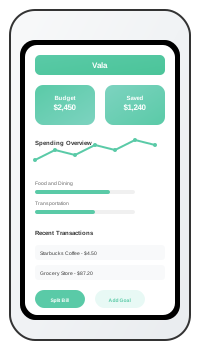
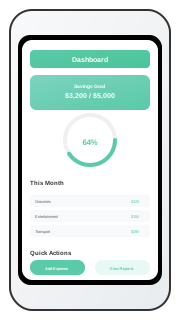
Vala App Screenshots
What Users Say About Vala
“Finally a budget app I keep using.”
“The insight cards make weekly decisions easy. I save more consistently now.”
“Shared budgeting is much clearer.”
“Split bills and reminders removed most of our monthly money confusion.”
“Great for building better habits.”
“I can see category trends and adjust before I overspend.”
FAQs for This Topic
Yes. Vala references official U.S. public datasets and reputable institutional sources.
No. The data is used for educational benchmarks; users still need personal judgment and context.