
Personal finance automation is defined as the practice of scheduling recurring money transfers, bill payments, and investment contributions so your financial system runs without manual input. The personal finance automation benefits are direct: you save time, prevent costly errors, and build wealth consistently without relying on willpower. Research shows that automated savers save 2.4x more annually and report lower financial stress than those managing money manually. Tools like Fidelity Investments, 401(k) auto-escalation programs, and apps like Valapoint make this accessible at any income level. The standard industry term for this practice is “automated financial planning,” and it applies whether you are managing rent, retirement, or a shared household budget.
1. Personal finance automation benefits start with time savings
Manual money management costs more time than most people realize. Tracking every transaction, scheduling bill payments, and reviewing account balances can consume several hours each month. Initial automation setup takes roughly 1 to 2 hours, and ongoing maintenance drops to about 15 minutes per month. That is a significant reduction compared to the weekly effort most manual budgeters put in.
The time savings compound over a year. Instead of logging into multiple accounts, cross-referencing statements, and manually moving money, your system handles transfers on a fixed schedule. You free up mental energy for decisions that actually require your attention.
- Set up direct deposit splits so a percentage of your paycheck goes straight to savings before you see it
- Schedule bill autopay for fixed expenses like rent, utilities, and insurance
- Use apps that link bank accounts and categorize spending automatically
Pro Tip: Schedule a 15-minute monthly review to catch any errors, subscription creep, or account changes. Automation handles execution; your monthly check handles oversight.
2. How automation prevents late fees and credit score damage

Payment history accounts for 35% of your FICO credit score. A single missed payment can drop your score by 50 to 100 points depending on your credit profile. That kind of damage takes months to repair and can affect your ability to qualify for loans, apartments, or favorable interest rates.
Automation removes the human error factor entirely. When your mortgage, car payment, and credit card minimum are all on autopay, you cannot forget them. A 2021 Consumer Financial Protection Bureau study found that missed payments caused by forgetfulness, not financial hardship, are a leading driver of credit score damage. Automation closes that gap directly.
Beyond credit protection, autopay eliminates late fees. Most credit cards charge $25 to $40 per late payment. On a utility bill, late fees typically run 1.5% to 2% of the outstanding balance per month. Those amounts are small individually but add up to hundreds of dollars annually if you are managing multiple accounts manually.
3. How automation improves saving habits through psychology
Automation does not just move money. It works with how your brain is wired. Financial automation removes emotional interference by creating default behaviors that run without requiring a conscious decision each time. This matters because willpower is a limited resource. Every time you manually decide whether to transfer money to savings, you are competing against impulse spending, stress, and distraction.
Loss aversion is the psychological principle at work here. Stopping an automated transfer feels like losing money, which makes you far less likely to cancel it. This is the same reason gym memberships get paid even when people skip workouts. Automation uses that same psychological pull in your favor.
“Automation is about protecting yourself from your own lapses in attention rather than laziness or irresponsibility.” — BrokeToBanking
The data backs this up clearly. People who automate their savings save 2.4 times more annually than those who transfer money manually. They also report measurably lower financial anxiety. When saving happens automatically, you stop second-guessing every purchase because your goals are already funded.
4. Dollar-cost averaging through automated investing
Automated investing is one of the most powerful advantages of finance automation for long-term wealth building. Dollar-cost averaging means investing a fixed amount on a regular schedule regardless of market conditions. You buy more shares when prices are low and fewer when prices are high, which reduces the average cost per share over time.
Fidelity Investments recommends automating investments specifically to avoid panic selling and performance chasing, two behaviors that consistently reduce long-term returns. When you automate a monthly contribution to a Roth IRA or index fund, you remove the temptation to time the market. Most retail investors who try to time the market underperform a simple automated monthly contribution strategy.
Practical examples include setting up automatic 401(k) contributions with employer matching, scheduling monthly transfers to a Roth IRA, and using brokerage platforms that support recurring investment purchases. Even $50 per month invested automatically at age 22 compounds to a significantly larger amount by retirement than the same $50 invested manually and inconsistently. For readers new to automated investing, reviewing a trading platform checklist before selecting a brokerage helps you choose a platform that supports recurring contributions.
5. Budgeting automation and the reverse budget approach
Budgeting automation organizes your spending without requiring you to track every dollar manually. Apps that link directly to your bank accounts categorize transactions in real time, flag unusual charges, and show you exactly where your money goes each month. This replaces the spreadsheet approach that most people abandon within two weeks.
The reverse budget method is the most effective framework for automating budgeting. You automate your savings goals and fixed expenses first, immediately after each paycheck arrives. Whatever remains is yours to spend without guilt or tracking. This approach reduces budgeting burnout because you are not monitoring every coffee purchase. Your priorities are already funded.
| Budgeting method | How it works | Best for |
|---|---|---|
| Traditional budget | Track every expense category manually | Detail-oriented planners |
| Reverse budget | Automate goals first, spend the rest freely | People who hate tracking |
| Envelope method | Allocate cash to physical or digital envelopes | Overspenders needing hard limits |
| Zero-based budget | Assign every dollar a job each month | High earners with variable expenses |
Multiple savings buckets add another layer of clarity. Instead of one general savings account, you create separate accounts labeled “Emergency Fund,” “Vacation,” and “Car Repair.” Automated transfers feed each bucket on payday. Seeing progress toward specific goals is more motivating than watching a single savings balance grow slowly.
Pro Tip: Use AI-personalized budgeting tools to automatically adjust your budget categories based on your actual spending patterns rather than estimates.
6. How automation reduces financial anxiety and decision fatigue
Automation promotes emotional wellbeing by removing the constant low-level stress of financial decision-making. When you manage money manually, every purchase carries a mental tax. You are always calculating whether you can afford something, whether you remembered to pay a bill, or whether your savings are on track. Automation eliminates most of that background noise.
Decision fatigue is a real cognitive phenomenon. The more financial decisions you make in a day, the worse your judgment becomes on subsequent ones. Automating recurring transactions removes dozens of micro-decisions from your week. Manual budgeting mistakes, emotional spending, and missed deadlines all stem from cognitive overload. Automation addresses the root cause rather than the symptoms.
Users who automate their finances consistently report feeling more confident and in control, even when their income has not changed. The system creates a sense of order that manual management rarely achieves.
7. Common misconceptions about automating personal finances
Several myths prevent people from starting financial automation. Addressing them directly removes the barriers.
- “Set it and forget it forever.” Automation is “set it and review it.” A monthly 15-minute check catches errors, expired cards linked to autopay, and subscriptions you no longer use. The system runs itself; you just verify it periodically.
- “You need a high income to automate.” Automation works especially well on tight budgets because loss aversion psychology enforces consistency. Even automating $25 per paycheck builds a habit and a balance. The Save More Tomorrow principle shows that small, incremental automation beats waiting for the “right time” to start.
- “Automation locks up your money.” Every automated transfer is reversible. You can pause, cancel, or redirect funds at any time. Automation creates structure, not restriction.
- “I need to get my finances in order first.” Starting with imperfect automation is better than waiting for perfect conditions. Delay consistently leads to never starting at all.
- “Apps are not secure enough for my accounts.” Reputable personal finance tools use bank-level encryption and read-only account access for tracking. Your money stays in your bank; the app only reads the data.
Key takeaways
Personal finance automation works because it removes human error, leverages loss aversion psychology, and creates consistent financial behavior that compounds over time.
| Point | Details |
|---|---|
| Time savings are immediate | Setup takes 1 to 2 hours; ongoing maintenance is just 15 minutes per month. |
| Credit protection is automatic | Autopay prevents the missed payments that account for 35% of your FICO score. |
| Automated savers save more | People who automate savings save 2.4 times more annually and report less financial stress. |
| Reverse budgeting reduces burnout | Automate goals first, then spend the remainder freely without tracking every purchase. |
| Small starts beat perfect timing | Incremental automation using the Save More Tomorrow principle outperforms waiting to begin. |
Why I think most people overcomplicate the starting point
Most articles about automating personal finances spend too much time on advanced strategies and not enough on the first 48 hours. In my experience, the biggest obstacle is not knowledge. It is the false belief that you need a perfectly organized financial life before automation can help you.
The truth is the opposite. Automation is most valuable precisely when your finances feel chaotic. The first time I set up a direct deposit split and watched savings land in a separate account without any effort on my part, the relief was immediate. Not because the amount was large, but because the decision was made once and then never had to be made again.
The emotional payoff of removing recurring financial decisions is underrated in most personal finance writing. You stop dreading payday logistics. You stop the mental math before every discretionary purchase. That cognitive space gets redirected toward things that actually matter.
My honest recommendation: start with one automation this week. One autopay. One savings transfer. Build from there. The personal finance tools available today make the setup faster than ever. The compounding effect of consistent, automated behavior over 12 months will outperform any manual budgeting system you have tried and abandoned.
— SaverStride
Take control of your finances with Valapoint
Valapoint’s personal finance app is built for exactly this kind of setup. You can track expenses, set savings goals, and connect your accounts to see where every dollar goes in real time.
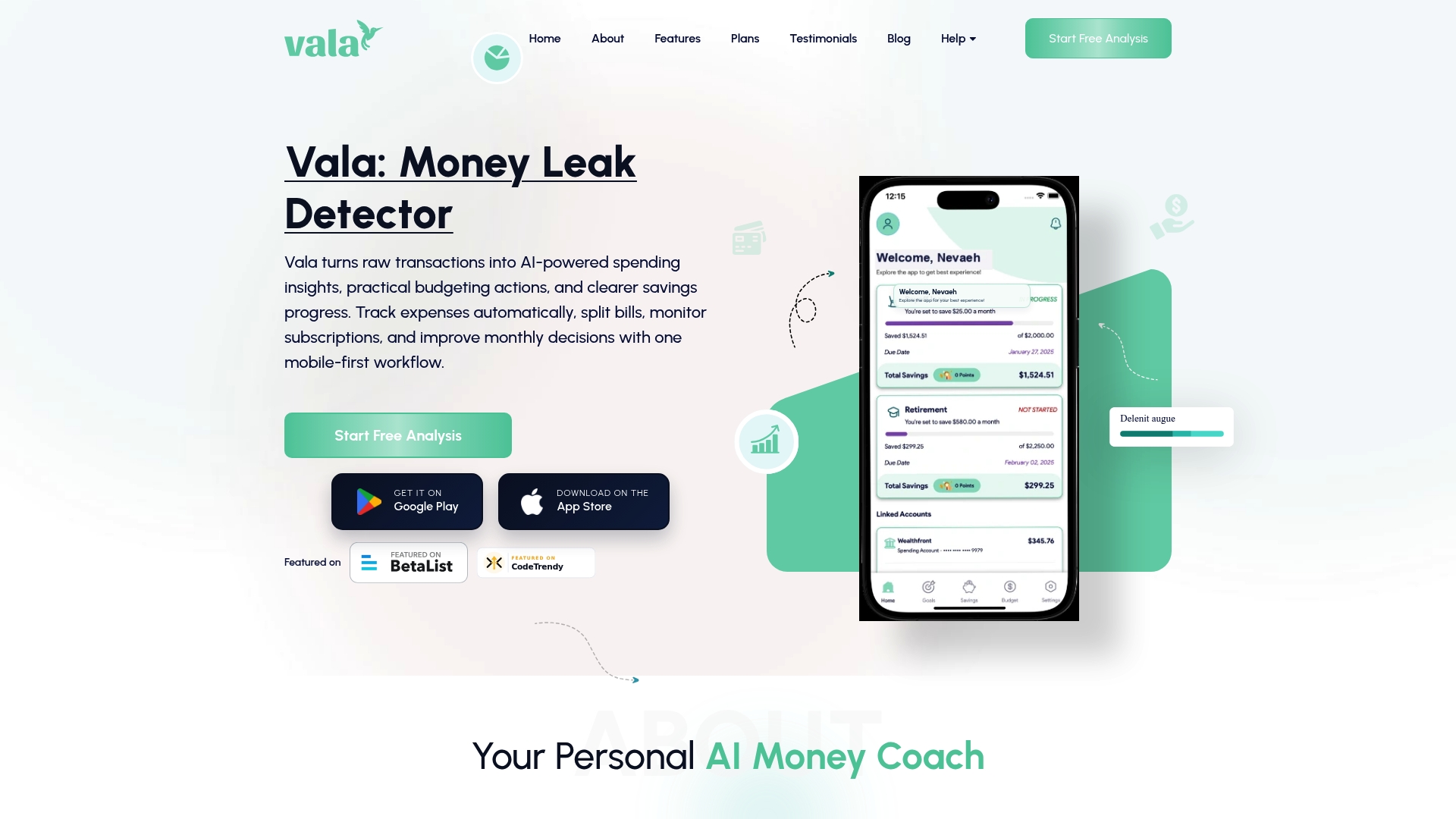
The app’s automation features handle the recurring work so you focus on the big picture. Whether you are building an emergency fund, paying down debt, or saving for a specific goal, Valapoint gives you the structure to make it happen without overhauling your lifestyle. Start with the Vala personal finance app and have your first automation running within the hour. You can also explore the budget goal tracker to monitor progress toward every financial target you set.
FAQ
What are the main personal finance automation benefits?
The core benefits are time savings, error prevention, improved saving consistency, and reduced financial stress. Automated savers save 2.4 times more annually than those managing money manually.
How does financial automation save money?
Automation prevents late fees, protects your credit score by ensuring on-time payments, and removes emotional spending decisions that lead to overspending. Payment history accounts for 35% of your FICO score, making autopay one of the highest-impact financial habits you can build.
Do you need a high income to start automating your finances?
No. Automation is effective at any income level. The Save More Tomorrow principle shows that small, incremental automated transfers build stronger habits than waiting until you earn more.
How much time does it take to set up financial automation?
Initial setup takes 1 to 2 hours. After that, a 15-minute monthly review is all you need to keep your automated system running correctly and catch any issues like expired payment methods or unwanted subscriptions.
What is the reverse budget method in personal finance automation?
The reverse budget automates your savings goals and fixed expenses immediately after each paycheck, then lets you spend whatever remains freely. It reduces tracking fatigue and works well for people who find traditional category-based budgeting unsustainable.