Why Student Budgeting Is Different: A 2026 Guide

Student budgeting is defined as a distinct subset of personal financial planning that requires strategies built around irregular income, high living costs, and variable educational expenses. Most general budgeting advice assumes a steady paycheck and predictable bills. Students rarely have either. Over 51% of college students identify daily living costs like food and housing as their main financial stressor, ranking above student loan debt. That single fact explains why student budgeting is different from anything a standard finance guide covers. Your income arrives in chunks, your expenses shift every semester, and the rules most adults follow simply do not fit your situation.

Why student budgeting is different from regular financial planning

Student financial planning operates under conditions that most budgeting frameworks were never designed to handle. Your income does not arrive on the first and fifteenth of every month. It comes from part-time jobs with variable hours, semester-based financial aid disbursements, scholarships paid in lump sums, and occasional family support. Each source follows its own schedule. That combination creates a cash flow pattern that looks nothing like a salaried worker’s.

Standard budgeting advice, including the widely cited 50/30/20 rule, assumes that 50% of income covers needs, 30% covers wants, and 20% goes to savings. That split works when rent is a manageable fraction of a steady salary. For most students, housing and food alone consume far more than half of available funds. Experts recommend a 60/25/15 split for students, allocating 60% to essentials like housing, food, and transportation, 25% to lifestyle spending, and 15% to savings and debt repayment. The reallocation reflects a real difference in expense structure, not just a tweak.

Hands using student finance app on smartphone

The proportional weight of fixed costs also differs. A working adult might spend 25% of income on rent. A student in a college town might spend 50% or more. That leaves far less room for error in every other category. Irregular, multi-source income undermines financial self-efficacy and contributes to ongoing financial strain, particularly when institutional advice fails to reflect actual student income patterns.

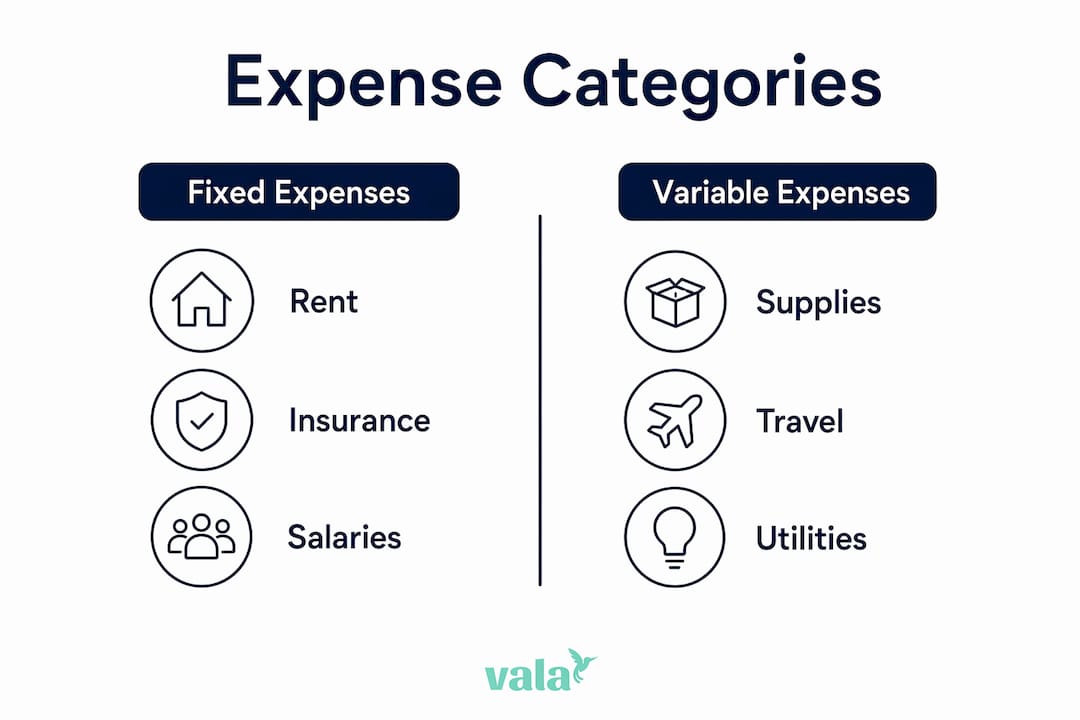
Fixed vs. variable costs for students

Students carry a mix of fixed costs (rent, phone, subscriptions) and highly variable costs (textbooks, lab fees, social events, travel home). The variable side is where most budgets break down. Textbook costs alone illustrate this well. Over 55% of students spend $600 or less per year on textbooks, yet institutional budget estimates often assume $1,300 or more. That gap means students who rely on school-provided budget templates may be planning around numbers that do not match their actual spending.

Pro Tip: Build a separate “semester startup” fund each term to cover one-time costs like textbooks, lab supplies, and course fees. Treat it as a fixed expense, not a surprise.

How do students track spending and build realistic budgets?

Practical budgeting for students starts with one non-negotiable step: track your actual spending for at least one full term before making major changes. Tracking spending for one full term gives you real data on habits you would otherwise underestimate. Most students discover they spend more on food and less on textbooks than they assumed. That data becomes the foundation of a budget that actually holds.

Three budgeting methods work particularly well for students:

  1. Zero-based budgeting. Zero-based budgeting assigns every dollar a job before the month begins. You list all expected income, then allocate every dollar to a category until the balance reaches zero. This method works well with variable income because it forces you to plan around what you actually have, not what you hope to have.

  2. The envelope method. This approach sets hard spending limits for each category. You allocate a fixed amount to eating out, groceries, and entertainment at the start of the month. When the envelope is empty, spending stops. Students who overspend tend to do so in flexible categories like dining and socializing, and hard category limits address that directly.

  3. The 60/25/15 adapted split. Apply the student-adjusted percentage framework to each income source as it arrives. When a financial aid disbursement hits your account, immediately allocate 60% to essential bills, 25% to a spending account, and 15% to savings or debt. This prevents the common mistake of treating a large disbursement as free money.

One underused tool worth knowing: a 0% interest student overdraft. A student overdraft acts as an interest-free buffer between income disbursements and regular expenses. Used responsibly, it prevents late fees and missed payments during cash flow gaps. It is not a spending tool. It is a timing tool.

Pro Tip: Use a student finance management app to log every transaction the day it happens. Weekly reviews take less than five minutes and catch problems before they compound.

What financial challenges do students face most often?

The unique challenges of student budgeting go beyond math. They involve psychology, social pressure, and the unpredictable nature of academic life.

  • Housing and food costs dominate. The majority of students experience financial stress not from large debts but from immediate costs like monthly rent and groceries. Long-term debt feels abstract. This month’s rent does not.
  • Textbook costs are unpredictable. Costs vary by major, semester, and professor. One course might require a $200 textbook. Another might use free PDFs. You cannot plan accurately until you know your course list.
  • Social spending creates pressure. Eating out, concerts, trips, and group activities feel like small decisions in the moment. They add up faster than any other category for most students.
  • Semester transitions create gaps. Income often drops or disappears between semesters while fixed costs continue. Summer months are particularly difficult for students who rely on campus-based jobs.

“Students’ financial strain often arises from mismatches between institutional budgeting advice and real-life income and expense patterns. Spending tracking reveals hidden leakages and irrational expenditure that guessing budgets miss, enabling better planning.”
— University of Illinois Chicago research, 2026

The psychological impact of irregular spending needs is real. When you do not know exactly what next month looks like financially, anxiety increases and impulsive spending often follows. Building a small emergency buffer, even $200 to $500, reduces that anxiety and protects the rest of your budget from one bad week.

How can students adapt general budgeting frameworks?

General budgeting rules need adjustment before they work for students. The table below compares three common frameworks and their student-adapted versions.
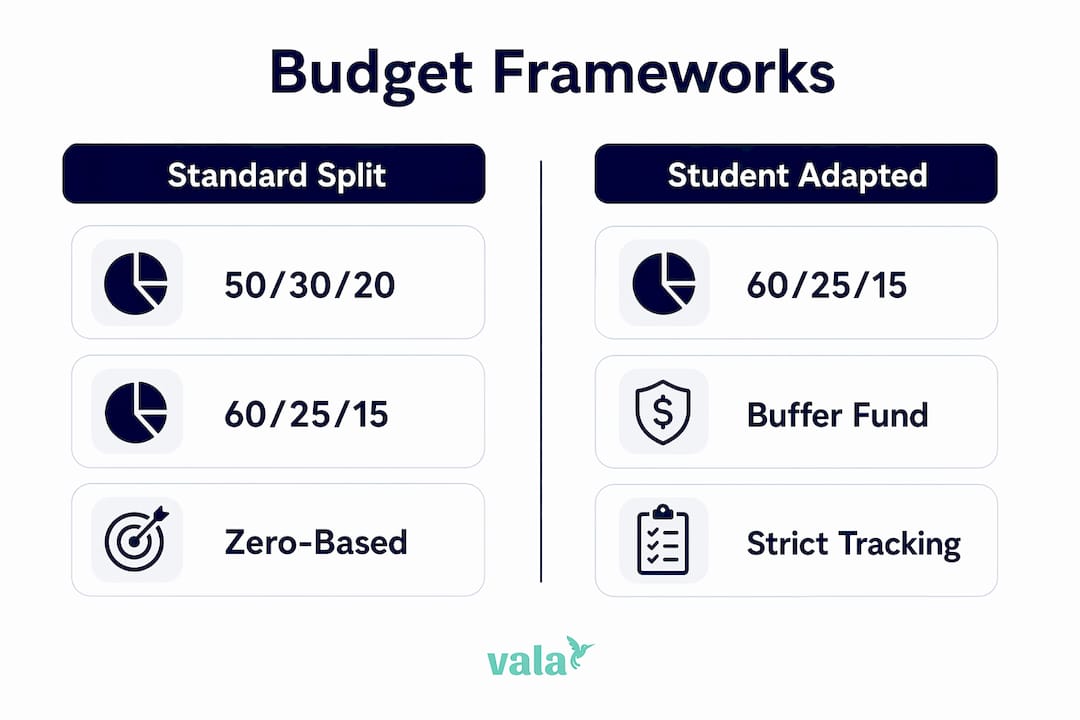
Infographic comparing standard versus student budgeting splits

Framework Standard split Student-adapted split Why it changes
50/30/20 rule 50% needs, 30% wants, 20% savings 60% needs, 25% wants, 15% savings Higher housing and food costs as a share of income
70/20/10 rule 70% living, 20% savings, 10% debt 70% living, 15% savings, 15% debt Student loan repayment often starts during school
Zero-based Every dollar assigned Every dollar assigned per disbursement Aligns with lump-sum income patterns

The 60/25/15 framework is the most practical starting point for most students. It acknowledges that essentials take priority, gives you a real lifestyle budget, and still builds the savings habit. The 70/20/10 adaptation suits students carrying active loan balances who need to prioritize debt alongside savings.

A mental model that assigns every income dollar a purpose before spending builds discipline and awareness. This is especially useful when income arrives irregularly. Instead of asking “how much do I have left?” you ask “where does this dollar go?” That shift in thinking changes spending behavior over time.

A student budget checklist helps you apply these frameworks consistently each semester. Reviewing your allocations at the start of each term, when your course list and income picture are clearer, keeps your budget grounded in current reality rather than last semester’s assumptions.

Key Takeaways

Student budgeting requires a tailored approach because irregular income, high living costs, and variable educational expenses make standard financial frameworks unreliable without adjustment.

Point Details
Income is irregular Students draw from multiple sources with different schedules, requiring flexible allocation strategies.
Essentials take a larger share The 60/25/15 split reflects that housing and food consume more than 50% of most student budgets.
Track before you plan Spending one full term tracking actual expenses builds a budget grounded in real habits, not guesses.
Social and variable costs derail budgets Hard category limits using the envelope method prevent overspending in flexible categories.
Adapt frameworks, not just adopt them General rules like 50/30/20 need recalibration to fit student income and expense realities.

The habit matters more than the method

Most students I have observed struggle not because they lack a budget, but because they chose a framework designed for someone else’s life. The 50/30/20 rule is taught everywhere. It works beautifully for a 35-year-old with a salary and stable rent. For a student juggling a part-time job, a financial aid disbursement, and a semester that just added a $180 lab fee, it falls apart by week two.

The students who manage money well are not necessarily the ones with the most income. They are the ones who track consistently, adjust quickly, and do not treat a large disbursement as a windfall. I have seen students with modest budgets build real savings by simply assigning every dollar a purpose the day their aid arrived. That discipline, not the specific method, is what creates financial stability.

Technology helps, but only if it fits your actual behavior. A budgeting app for students that shows you real-time category balances changes how you make decisions at the point of spending. Seeing that your food budget has $18 left on a Wednesday changes your Thursday lunch choice. That is the kind of feedback loop that builds lasting habits.

Start with one term of honest tracking. Pick a framework that fits your income pattern. Adjust it every semester as your situation changes. Progress matters more than perfection.

— SaverStride

How Valapoint helps students manage their unique budgets

Student budgets do not fit neatly into generic finance apps built for salaried adults. Valapoint’s personal finance app is built for exactly the kind of financial complexity students face: multiple income sources, irregular timing, and spending categories that shift every semester.

https://valapoint.com

With Valapoint, you can track every income source separately, set category limits that reset each month, and get real-time alerts when spending approaches your limits. The app’s AI-powered insights surface hidden spending patterns you would not catch by reviewing a bank statement once a month. You can also use Valapoint’s financial planning tools to model different budget splits and find the framework that fits your actual income. Set it up once, adjust each semester, and let the app do the tracking.

FAQ

Why is student budgeting different from regular budgeting?

Student budgeting differs because income arrives irregularly from multiple sources and living costs consume a higher proportion of that income. Standard frameworks like 50/30/20 require significant adjustment to reflect student financial realities.

What is the best budgeting method for college students?

Zero-based budgeting works well for students because it assigns every dollar a purpose before spending begins, which suits irregular, lump-sum income patterns like financial aid disbursements.

How much should students spend on essentials?

Experts recommend allocating 60% of income to essentials like housing, food, and transportation. This is higher than the 50% suggested by standard budgeting rules, reflecting the proportionally larger cost of living for students.

How do students handle unexpected expenses?

Building an emergency buffer of $200 to $500 covers most unexpected costs without disrupting the rest of the budget. A 0% interest student overdraft can also serve as a short-term cash flow tool between income disbursements.

How long does it take to build an accurate student budget?

Tracking spending for one full academic term gives you enough real data to build a budget that reflects your actual habits. Adjust your allocations at the start of each new semester as your course load and income change.


Benefits of Digital Expense Splitting Apps for Groups

Digital expense splitting apps are defined as mobile and web tools that automate cost-sharing calculations, track group debts in real time, and settle balances with minimal transactions. The benefits of digital expense splitting apps go far beyond simple math. They remove the social awkwardness of asking friends for money, prevent forgotten expenses, and give every person in a group a clear, auditable record of what they owe. Whether you share rent with roommates, split a road trip with friends, or manage a group gift, these tools turn a stressful process into a straightforward one.

Woman viewing payment request on smartphone

1. Benefits of digital expense splitting apps: eliminating social friction

Shared money is one of the fastest ways to create tension in a friendship. Digital expense splitting apps remove that tension by turning payment requests into objective, automated notifications rather than personal asks.

“Digital splitting apps eliminate awkward conversations and math anxiety by automating calculations and sending objective payment requests. Payment becomes a system event, not a social confrontation.”

The psychological shift is real. When an app sends a payment request, it carries no emotional charge. Nobody feels accused or embarrassed. The group expense tracking process becomes a shared system everyone agreed to, not a favor someone has to chase.

Proportional splitting adds another layer of fairness. A 2004 study found that diners order 37% more food when costs are split equally versus proportionally. That statistic reveals something important: equal splits create hidden incentives to overspend, while proportional splits keep everyone accountable for their own choices.

Key social benefits include:

  • Payment requests feel neutral, not confrontational
  • Every person sees the same numbers, removing “he said, she said” disputes
  • Proportional splits prevent resentment from unequal consumption
  • Groups build trust faster when finances are transparent

2. Real-time logging speeds up settlements

Forgetting an expense between the moment you pay and the moment you log it is the biggest failure point in shared finances. Digital apps solve this by letting you log costs the second they happen, directly from your phone.

Users who log expenses immediately report up to twice as fast resolution times compared to manual methods. That speed matters when you have five people waiting to settle up after a weekend trip.

Pro Tip: Log every expense the moment you pay, not at the end of the day. Even a 30-minute delay increases the chance of forgetting details like exact amounts or who was included.

Real-time logging also keeps the underlying debt calculations clean. Immediate expense entry simplifies the debt graph the app maintains, which means fewer errors and faster final settlements. Think of it like keeping a running grocery list versus trying to remember everything at the checkout.

Habits that make real-time logging work:

  • Open the app before you put your wallet away
  • Use shared group links or chat integrations so everyone can add expenses
  • Set a group rule: log within five minutes of paying
  • Review the group balance at the end of each day on a trip

3. How debt optimization algorithms minimize your transactions

Most people think of expense apps as simple IOU trackers. The reality is more powerful. These apps function as debt optimization engines that use graph algorithms to minimize the total number of payment transactions in a group.

Here is how it works in practice. Imagine four friends on a trip. Alex owes Ben $20, Ben owes Cara $30, and Cara owes Alex $15. Without an algorithm, that is three separate payments. The app collapses those into a net flow problem and may determine that Alex simply pays Cara $5, settling everything in one transaction.

  1. The app maps every expense as a directed debt between two people.
  2. It calculates each person’s net balance across all transactions.
  3. It finds the minimum number of payments that clears all balances.
  4. It sends each person a single, clear payment request.

One important detail surprises many users: debt simplification algorithms sometimes route payments between people who never directly transacted with each other. You might pay someone you never bought anything with. That is not an error. It is the algorithm working correctly to minimize total transfers. Understanding this builds trust in the system rather than confusion.

Settlement method Transactions needed (5-person group) Error risk
Manual cash rounds 8–10 High
Spreadsheet tracking 5–7 Medium
App with debt optimization 2–4 Very low

4. Financial accuracy and transparent record-keeping

Automated calculations remove the human errors that are common in spreadsheets or paper tracking. When you type numbers manually, you round, misplace decimals, or forget who was present for a specific expense. Apps handle all of that without mistakes.

Digital apps maintain detailed transaction logs that show who paid what, when, and how much each person owes. That audit trail is useful long after the trip ends. You can review it to understand your spending patterns, confirm a disputed amount, or simply feel confident that the final balance is correct.

Spreadsheets break down quickly when group composition changes. Someone joins the trip late, or one person leaves early. A spreadsheet requires manual restructuring. A dedicated app with a relational design handles group changes automatically, keeping every calculation accurate.

Common use cases where accurate records matter most:

  • Shared rent and utilities: Monthly recurring costs need a permanent, reviewable record
  • Group travel: Multiple payers across several days create complex webs of debt
  • Shared subscriptions: Recurring splits that change when members join or leave
  • Group gifts: One-time collections where every dollar needs to be accounted for

The automated calculation advantage also supports personal budgeting. When you can see exactly what you spent on a group trip versus what you owe others, you get a clearer picture of your actual monthly outflows.

5. How apps support your personal budgeting goals

Expense splitting apps do not just settle group debts. They generate spending data you can use to budget better on your own. Every logged expense is a data point that reveals patterns over time.

If you consistently spend more than your share on group dinners, the app’s history shows that clearly. You can then decide whether to adjust your habits or set a personal cap for social spending. That kind of real-time tracking turns group expense data into personal financial insight.

The best digital expense apps also integrate with broader budgeting tools. When your group spending feeds into a single financial dashboard, you stop treating shared costs as a separate mental category. They become part of your full monthly picture, which makes budgeting more accurate and less stressful.

Key Takeaways

Digital expense splitting apps reduce social friction, speed up settlements, and produce accurate financial records that manual methods cannot match.

Point Details
Social friction drops immediately Automated payment requests remove the emotional weight of asking friends for money.
Real-time logging doubles settlement speed Users report up to 2x faster resolution when expenses are logged at the point of purchase.
Debt algorithms cut transaction count Graph-based optimization reduces a 5-person group’s payments from 8–10 down to 2–4.
Transparent records prevent disputes Full transaction histories give every group member the same auditable view of costs.
Group data improves personal budgeting Logged shared expenses feed into personal spending patterns, making monthly budgets more accurate.

My honest take on expense apps after years of group travel

I have used digital expense splitting tools across roommate situations, international trips, and recurring friend group dinners. The single biggest shift I noticed was not in the math. It was in the conversations.

Before using an app, someone always felt like they were nagging. After switching to a digital system, nobody was nagging anymore. The app sent the request. The request was just a fact. That change alone was worth every other feature combined.

The advice I give everyone starting out is simple: pick one app, get the whole group to agree on it before the trip starts, and log expenses immediately. The app only works as well as the group’s commitment to using it consistently. One person logging everything while others forget defeats the purpose entirely.

I have also seen people resist these tools because they do not understand why the app sometimes asks them to pay someone they never bought anything with. Once you explain the debt optimization logic, that resistance disappears. The algorithm is doing you a favor. Fewer payments means less friction and faster closure.

The expense tracking practices that work best are the boring ones: log immediately, review balances daily on trips, and settle at the end of each event rather than letting balances carry over for weeks. Consistency beats any clever feature the app offers.

— SaverStride

Valapoint makes group and personal finance work together

Splitting costs with a group is only half the picture. The other half is understanding how those shared expenses fit into your personal financial life.

https://valapoint.com

Valapoint’s personal finance app combines expense splitting with full budget tracking, real-time spending insights, and AI-powered analysis of your money habits. You can log group costs, see your share instantly, and watch those numbers flow directly into your personal budget dashboard. Valapoint also surfaces hidden spending patterns that most people never notice until they check their bank statement at month’s end. If you want group expense management and personal budgeting in one place, Valapoint is built for exactly that.

FAQ

What are the main benefits of digital expense splitting apps?

Digital expense splitting apps automate calculations, eliminate math errors, and send objective payment requests that remove social awkwardness. They also maintain full transaction records and speed up group settlements by up to 2x compared to manual methods.

How do expense splitting apps work with debt optimization?

These apps use graph algorithms to calculate each person’s net balance and find the minimum number of payments needed to clear all debts. This means a group of five people might settle everything with just two or three transactions instead of ten.

Why does real-time logging matter for shared expenses?

Forgetting an expense between payment and logging is the most common failure in group finance tracking. Logging immediately keeps the debt graph accurate and prevents disputes over amounts that no one can remember clearly.

Can expense splitting apps help with personal budgeting?

Yes. Every logged group expense becomes spending data you can review to understand your social and travel costs. Apps like Valapoint connect group expense data to personal budget dashboards for a complete financial picture.

Are digital expense apps better than spreadsheets for group costs?

Spreadsheets break down when group membership changes or when multiple people edit the same file. Dedicated apps handle group changes automatically, eliminate version conflicts, and apply debt optimization that no spreadsheet formula replicates.

What Is a Shared Financial Goal? Your Clear Guide

A shared financial goal is a mutually agreed objective that two or more people work toward together to improve their financial health and reach common aspirations. In personal finance, the formal term is “joint financial planning,” and shared financial goals are its building blocks. Whether you’re a couple saving for a home, roommates splitting rent costs, or a family building an emergency fund, these goals give your money a clear direction. The SMART framework (Specific, Measurable, Achievable, Relevant, and Time-bound) is the industry standard for turning vague intentions into real plans. Approximately 1 in 5 people would struggle to access even $1,000 in an emergency, which shows exactly why building shared financial objectives together matters so much.

What is a shared financial goal and what types exist?

A shared financial goal is any money-related target that two or more people commit to pursuing together. The goal must be agreed upon, tracked jointly, and funded through coordinated effort. That last part separates a shared goal from a personal one: both parties contribute time, money, or decisions to reach it.

Shared goals fall into four broad categories:

  • Emergency funds. A foundational shared financial goal is building a reserve that covers 3–6 months of living expenses. This protects the group from job loss, medical bills, or unexpected repairs.
  • Major purchases. Saving for a home down payment, a car, or a family vacation are classic examples. These goals have a fixed target amount and a natural deadline.
  • Debt repayment. Couples or households often tackle student loans, credit card balances, or personal loans together. Paying down shared debt frees up cash for other goals.
  • Lifestyle and investment goals. These include funding a child’s education, building a retirement portfolio, or saving for a business. Aligning shared goals enables partners to create a unified risk management and investment approach that supports long-term stability.

The right goal category depends on your relationship type. Couples typically merge more finances and pursue longer timelines. Roommates usually focus on short-term shared expenses. Families often balance immediate needs with multi-year goals like college savings.

Goal category Typical timeline Common budgeting approach
Emergency fund 6–18 months Fixed monthly contribution
Major purchase 1–5 years Dedicated savings account
Debt repayment 1–7 years Avalanche or snowball method
Investment or retirement 10+ years Automated recurring transfers

Hands marking financial planning documents on home desk

How to set effective shared financial goals

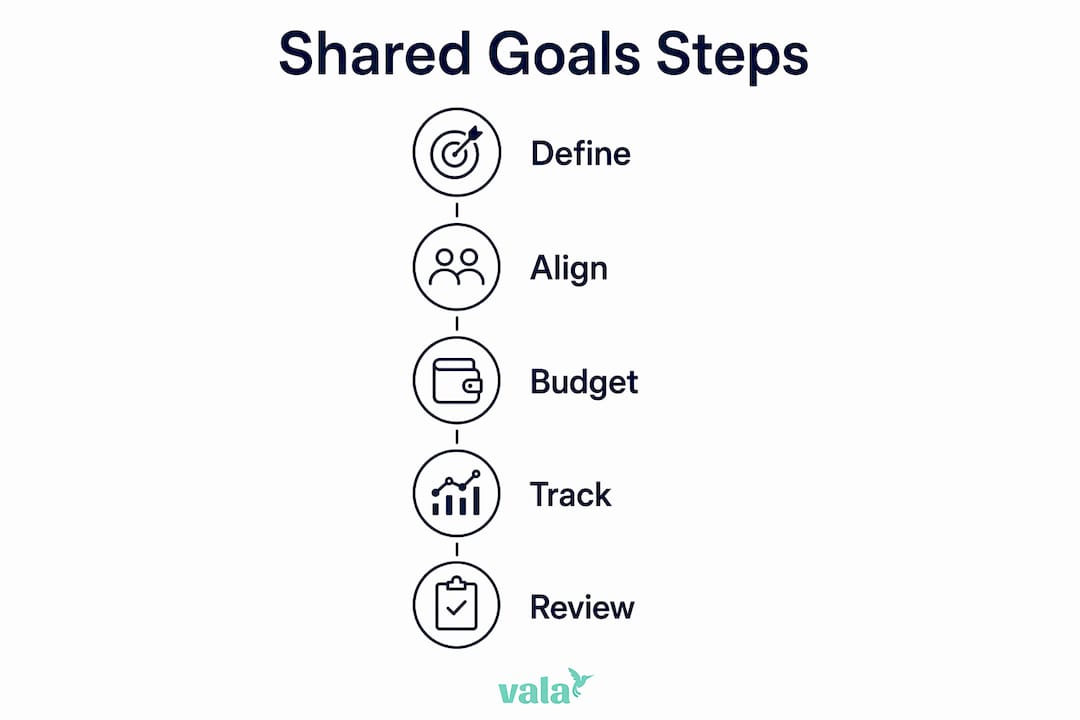
Infographic showing steps to set shared financial goals

The SMART framework is the industry standard for setting financial goals that actually get reached. SMART stands for Specific, Measurable, Achievable, Relevant, and Time-bound. Applied to shared goals, it turns “we want to save more” into “we will save $2,000 in 6 months by setting aside $330 each month.”

Follow these steps to build your first shared goal together:

  1. Name the goal clearly. Write down exactly what you are saving for and why it matters to both of you. Vague goals lose momentum fast.
  2. Set a dollar amount. Attach a specific number to the goal. “Save for a vacation” becomes “save $3,000 for a trip to Costa Rica.”
  3. Agree on a deadline. A target date creates urgency and makes it easy to calculate monthly contributions.
  4. Divide contributions fairly. Decide how much each person contributes based on income, expenses, and capacity. Fair does not always mean equal.
  5. Open a dedicated account. Keeping goal money separate from daily spending reduces the temptation to dip into it.
  6. Schedule a monthly check-in. Review progress together and adjust contributions if circumstances change.

Aligning goals with shared values is what keeps motivation high over time. If one partner values travel and the other prioritizes home ownership, both goals deserve a place in the plan. Ignoring one person’s priorities creates resentment and kills cooperation.

Pro Tip: Use the AI budgeting tools available through apps like Valapoint to automate your monthly goal contributions. Automation removes the friction of manual transfers and keeps you on track without constant effort.

Joint budgeting strategies that support shared goals

Budgeting is the engine behind every shared financial objective. Without a clear spending plan, even well-defined goals stall. The 50/30/20 rule is widely recommended for managing cash flow: 50% of income goes to needs, 30% to wants, and 20% to savings and debt repayment. Applied to shared finances, the 20% savings slice funds your joint goals directly.

Defining financial roles prevents confusion and conflict. Assign one person to track daily spending and another to manage the monthly budget review. Rotating these roles every few months keeps both partners informed and prevents one person from carrying all the mental load.

Practical steps to avoid common budgeting pitfalls:

  • Use a shared tracking tool. A joint budget tracker gives both partners real-time visibility into spending. Hidden purchases are the fastest way to erode trust.
  • Separate goal money immediately. Transfer your agreed contribution to the goal account on payday, before spending anything else.
  • Build in a buffer. Incorporating a buffer category for unexpected expenses prevents stress and blame when plans are disrupted. Think of it as emotional padding for your budget.
  • Review subscriptions and recurring costs. Shared households often accumulate duplicate subscriptions. Auditing these quarterly frees up money for goals.
  • Avoid the “all or nothing” trap. If you miss a contribution one month, adjust the next month’s amount rather than abandoning the goal entirely.

Pro Tip: Valapoint’s expense tracking features automatically categorize your spending, so you can see at a glance whether your 50/30/20 split is on track. No manual spreadsheets required.

Shared bank accounts work well for couples with fully merged finances. Roommates and family members often prefer a hybrid model: individual accounts for personal spending and one shared account for joint goals and household expenses. The structure matters less than the transparency. Both parties need to see the same numbers.

How do you communicate about shared financial goals?

Communication is where most shared financial plans succeed or fail. Financial discussions are most effective in relaxed, neutral environments, which reduces defensiveness and builds openness. A coffee shop or a quiet dinner at home works better than a tense kitchen-table confrontation.

Framing budgeting as a shared vision rather than a restrictive task increases cooperation and motivation. The language you use matters. “We are building toward our dream home” lands differently than “we need to cut spending.” Both statements can be true, but one creates energy and the other creates resistance.

Practices that keep communication healthy over time:

  • Schedule regular money talks. Couples who schedule regular financial update meetings maintain clearer alignment and adapt better to changing circumstances. Monthly is a good baseline; quarterly deep reviews work well for longer-term goals.
  • Lead with curiosity, not criticism. Ask “what felt hard about our budget this month?” before pointing out what went wrong.
  • Revisit goals when life changes. A job change, a new baby, or a medical expense all require a goal adjustment. Treating the plan as flexible keeps both partners engaged.
  • Acknowledge progress out loud. Celebrating milestones, even small ones, reinforces the habit of working together.

Unexpected expenses are the most common reason shared goals fall apart. Including a budget category for surprises is critical to avoid derailing shared financial plans due to life’s unpredictability. A $200 car repair should not wipe out three months of savings progress.

Key Takeaways

Shared financial goals work because they combine clear targets, coordinated effort, and regular communication into a plan both partners own equally.

Point Details
Define goals jointly A shared goal requires a specific amount, a deadline, and agreed contributions from all parties.
Use the SMART framework Specific, Measurable, Achievable, Relevant, and Time-bound goals are far more likely to be reached.
Apply the 50/30/20 rule Directing 20% of shared income to savings and debt repayment funds goals without sacrificing daily needs.
Communicate in neutral settings Regular money talks in relaxed environments reduce conflict and keep both partners aligned.
Build in a buffer A dedicated category for unexpected expenses protects goal progress when life gets unpredictable.

Why shared goals changed how I think about money

The conventional advice on joint financial planning focuses almost entirely on the mechanics: open a shared account, set a budget, track your spending. That advice is not wrong. It just misses the part that actually determines whether you succeed.

The real work is emotional. Most financial disagreements are not about money. They are about values, priorities, and the fear of losing control. When I started treating budget conversations as a way to understand what my partner cared about most, the whole dynamic shifted. The numbers became easier to agree on because we understood the “why” behind them.

The insight I rarely see discussed: your first shared goal should be small and winnable. Save $500 for a weekend trip. Pay off one small credit card together. The goal itself matters less than the experience of succeeding together. That first win builds the trust and the habit that makes every future goal easier.

Flexibility is not a sign of failure. Revising a goal because circumstances changed is exactly what good planning looks like. The couples and groups I have seen struggle most are the ones who treat their original plan as sacred. Life does not cooperate with rigid budgets. Build in room to adjust, and you will stay in the game long enough to actually win.

— SaverStride

How Valapoint helps you track shared financial goals

Reaching a shared financial objective is much easier when you can see your progress in real time.

https://valapoint.com

Valapoint’s personal finance app is built for exactly this kind of collaborative planning. You can track expenses by category, set savings goals with target amounts and deadlines, and get AI-powered insights that flag spending patterns before they become problems. The app works for individuals, couples, and groups, so whether you are splitting costs with a roommate or building a retirement fund with a partner, the tools fit your situation. Valapoint also offers a goal tracking module that shows your progress toward each shared goal at a glance. Clear numbers, no guesswork, and no spreadsheets.

FAQ

What is a shared financial goal?

A shared financial goal is a mutually agreed money target that two or more people work toward together, such as building an emergency fund, paying off debt, or saving for a home.

How do you set financial goals as a couple or group?

Use the SMART framework to define a specific amount, a deadline, and fair contribution amounts, then track progress with a shared budgeting tool and review monthly.

What is the 50/30/20 rule in joint financial planning?

The 50/30/20 rule allocates 50% of income to needs, 30% to wants, and 20% to savings and debt repayment, making it a practical structure for funding shared goals.

How often should partners review shared financial goals?

Monthly check-ins work well for short-term goals, while quarterly deep reviews are better suited to long-term objectives like retirement or home savings.

Why do shared financial goals fail?

Most shared goals fail due to poor communication, no buffer for unexpected expenses, or misaligned priorities. Regular neutral-setting money talks and a dedicated surprise fund address all three causes.

Annual Savings Milestones: Examples for Ages 18–45

Annual savings milestones are defined as yearly financial benchmarks that mark measurable progress toward specific money goals. They work differently from vague resolutions because they give you a concrete number to hit by a set date. Examples of annual savings milestones range from saving your first $1,000 emergency fund to reaching 4x your salary in retirement accounts by age 45. Americans under 35 hold a median savings balance of around $13,000, while those aged 35–44 average $43,000. That gap shows exactly why setting clear yearly targets early matters.

1. Examples of annual savings milestones for your emergency fund

Emergency fund milestones follow a tiered structure based on your life stage and income type. The first target is simple: save $1,000 within your first six months of focused effort. That amount covers most minor emergencies without touching a credit card.

From there, the standard benchmark shifts to 3–6 months of essential expenses. If your monthly essentials total $3,000, your annual goal becomes saving $9,000–$18,000 over one to two years. That is a real, trackable number you can break into monthly contributions.

Overhead view of man organizing finances at home desk

Self-employed workers and anyone with variable income should target 9–12 months of expenses. The higher cushion protects against income gaps that salaried workers rarely face. A $20,000 emergency fund takes 10 months at $2,000 per month, or just over three years at $500 per month with a 4.5% interest rate.

Keep your emergency fund in a high-yield savings account, not a checking account. Liquidity matters, but so does earning interest while you wait.

Pro Tip: Name your emergency fund account something specific, like “Peace of Mind Fund.” Research shows that naming savings accounts boosts motivation and long-term consistency.

2. How the 50/30/20 rule creates clear yearly savings targets

The 50/30/20 budgeting rule is the most widely used framework for setting annual savings goals. It directs 50% of take-home pay to needs, 30% to wants, and 20% to savings and debt repayment. That 20% becomes your annual savings milestone baseline.

44% of Americans save at least 20% of their take-home pay, and 66% of employed Americans save something every month. Hitting 20% is achievable, but it requires a plan rather than good intentions.

Here is how the 50/30/20 rule translates into yearly savings targets:

  • $40,000 annual take-home pay: 20% equals $8,000 saved per year, or $667 per month
  • $60,000 annual take-home pay: 20% equals $12,000 saved per year, or $1,000 per month
  • $80,000 annual take-home pay: 20% equals $16,000 saved per year, or $1,333 per month

Categorize your 20% into short-term, medium-term, and long-term buckets. Short-term goals cover 1–2 years, medium-term covers 3–7 years, and long-term covers 10 or more years. Splitting the 20% across these buckets prevents you from raiding retirement savings for a vacation.

Pro Tip: Automate your 20% transfer on payday. Treating savings as a fixed expense removes the monthly decision and dramatically reduces missed goals.

3. Retirement savings milestones by age: the salary multiple method

Retirement savings milestones use salary multiples as annual benchmarks. These multiples give you a single number to compare against your current balance each year.

Age Savings milestone Annual savings rate
30 1x your salary 18% of gross income
35 2x your salary 23% of gross income
40 3x your salary 23% of gross income
45 4x your salary 23% of gross income
50 6x your salary 23% + catch-up contributions
67 10x your salary Retirement target

Saving 15% starting at age 25, 18% at 30, and 23% at 35 puts you on track to reach 10x your salary by retirement at 67. Each percentage point matters more the later you start.

Compound interest is the engine behind these milestones. Small savings in your 20s can quadruple by retirement due to decades of compounding. A 25-year-old who saves $200 per month at a 7% average annual return will have roughly $525,000 by age 67. A 35-year-old starting the same habit reaches only about $243,000.

After age 50, the IRS allows catch-up contributions to 401(k) and IRA accounts. In 2026, the standard 401(k) contribution limit is $23,500, with an additional $7,500 catch-up for those 50 and older. Use this window aggressively if you started late.

If you are behind on these milestones, adjust rather than abandon. Financial milestones should adapt to career changes or family size. Falling behind is a signal to recalibrate, not a reason to stop.

4. Yearly savings targets for goals beyond retirement

Retirement and emergency funds are not the only savings milestones worth tracking annually. Specific goals like a home down payment, a vacation, or education costs each deserve their own yearly target.

Here are concrete saving milestones examples for common goals:

  • Home down payment: Save $5,000–$10,000 per year toward a 10–20% down payment. On a $300,000 home, a 10% down payment of $30,000 takes three to six years at this rate.
  • Annual vacation fund: Set a yearly milestone of $2,000–$4,000. Divide by 12 and automate a monthly transfer to a dedicated account.
  • Education savings (529 plan): Contribute $2,000–$5,000 per year per child. Starting at birth gives 18 years of compounding before college begins.
  • Debt repayment milestone: Target paying off one specific debt per year. Eliminating a $5,000 credit card balance annually frees up cash for other milestones the following year.
  • Car replacement fund: Save $1,500–$3,000 per year so you can pay cash or make a large down payment when your current vehicle needs replacing.

The key is to give each goal its own named account. Visual progress tracking and named accounts reinforce psychological engagement and keep you connected to the purpose of each dollar.

Pro Tip: Increase your savings rate by 1% each year. Starting at 5% and adding 1% annually until you reach 15–20% builds the habit without a lifestyle shock. Most people never notice a 1% shift.

You can also use financial planning tools for young professionals to map out multiple goal timelines side by side and spot conflicts before they happen.

Key Takeaways

Annual savings milestones work best when they are specific, named, automated, and tied to a clear timeline rather than a vague intention.

Point Details
Emergency fund tiers Build $1,000 first, then target 3–6 months of expenses, or 9–12 months if self-employed.
50/30/20 baseline Allocate 20% of take-home pay to savings and split it across short, medium, and long-term goals.
Retirement salary multiples Aim for 1x salary by 30, 4x by 45, and 10x by retirement at 67 using age-based savings rates.
Automate every milestone Set automatic transfers on payday to remove willpower from the equation and hit goals consistently.
Incremental rate increases Add 1% to your savings rate each year to grow contributions without disrupting your lifestyle.

Why I think most people set savings milestones the wrong way

Most people treat savings milestones as a single annual number, like “save $10,000 this year.” That is not a milestone. That is a wish. A real milestone has a purpose, a deadline, and an account attached to it.

The behavioral research is clear. Naming a savings account after its goal, like “2027 Italy Trip” or “House Down Payment,” makes you far less likely to raid it for unrelated expenses. The name creates a psychological contract with yourself. Generic labels like “Savings Account 2” create no such barrier.

Automation is the other piece most people underestimate. Making transfers automatic means the milestone gets funded before you have a chance to spend the money elsewhere. I have seen people with modest incomes consistently outperform higher earners simply because they automated everything and never had to rely on monthly discipline.

The hardest part of setting yearly savings achievements is not the math. It is accepting that your milestones will look different from someone else’s. A 28-year-old paying off student loans has different annual budget milestones than a 28-year-old with no debt. Use the benchmarks as a compass, not a report card. Steady progress in the right direction beats a perfect plan you abandon after three months.

— SaverStride

Valapoint makes annual milestone tracking clear and automatic

Tracking multiple savings milestones at once gets complicated fast. Valapoint’s personal finance app is built to handle exactly that.

https://valapoint.com

With Valapoint, you can name individual savings goals, set annual targets, and automate monthly contributions to each one. The app supports the 50/30/20 budgeting framework and lets you track your emergency fund, retirement contributions, and short-term goals in one place. Real-time progress tracking shows you exactly where each milestone stands, so you are never guessing. You can also set realistic savings targets and adjust them as your income or goals change. Try the Valapoint personal finance app and put your annual savings milestones on autopilot.

FAQ

What are good examples of annual savings milestones?

Strong yearly savings achievements include saving $1,000 as a starter emergency fund, contributing 15–20% of income to retirement accounts, and setting aside $2,000–$5,000 per year for a specific goal like a home down payment or education fund.

How do I set savings milestones that are realistic?

Start with your take-home pay and apply the 50/30/20 rule, directing 20% to savings. Break that 20% into named buckets for each goal, then automate monthly transfers so the milestone funds itself.

What retirement savings milestone should I hit by age 30?

The standard benchmark is 1x your annual salary saved by age 30. Reaching that target requires saving roughly 18% of your gross income starting in your mid-20s, according to retirement planning benchmarks.

How does automation help with annual savings goals?

Automating transfers on payday treats savings as a fixed expense rather than an optional one. This approach removes monthly decision-making and consistently outperforms relying on willpower alone.

What if I am behind on my savings milestones?

Falling behind is a cue to adjust your plan, not abandon it. Increase your savings rate by 1% immediately, redirect any raise or bonus to savings, and recalibrate your timeline based on your current income and expenses.

Financial Planning for Young Professionals: 2026 Guide

Financial planning for young professionals is the process of organizing your income, expenses, savings, and investments into a coordinated plan that builds wealth and meets your future goals. The ages of 22–35 represent the most valuable window you have. Time compounds money faster than any salary increase ever will. The 50/30/20 rule remains the most widely used budgeting framework in 2026, and financial planners recommend saving and repaying debt at a combined rate of 15–20% of gross income. Getting these fundamentals right early sets the trajectory for everything that follows.

How to create a budget that actually works

A budget is not a restriction. It is a map of where your money goes so you can decide where it should go. Most young professionals skip this step and wonder why they feel financially stuck despite earning decent salaries.

The 50/30/20 framework divides your take-home pay into three categories:

  • 50% for needs: rent, utilities, groceries, transportation, and minimum debt payments
  • 30% for wants: dining out, subscriptions, travel, and entertainment
  • 20% for savings and debt repayment: emergency fund, retirement accounts, and extra debt payments

The most common budgeting mistake is tracking only big expenses. A $12 streaming service, a $6 coffee habit, and a $15 gym you never visit add up to over $400 a year in spending you barely notice. These are the financial leaks that quietly drain your progress.

Automation fixes this problem. When you set up automatic transfers to savings on payday, you remove the decision entirely. You spend what remains, not what you intended to save. Budgeting apps that categorize transactions automatically give you a real picture of your spending without manual effort.

Hands setting up budget automation on smartphone

Pro Tip: Set your savings transfer to hit your account the same day your paycheck lands. You will never miss money you never see.

How to build an emergency fund and manage debt

An emergency fund is your financial defense system. Without one, a single car repair or medical bill forces you into high-interest debt, which sets back every other financial goal.

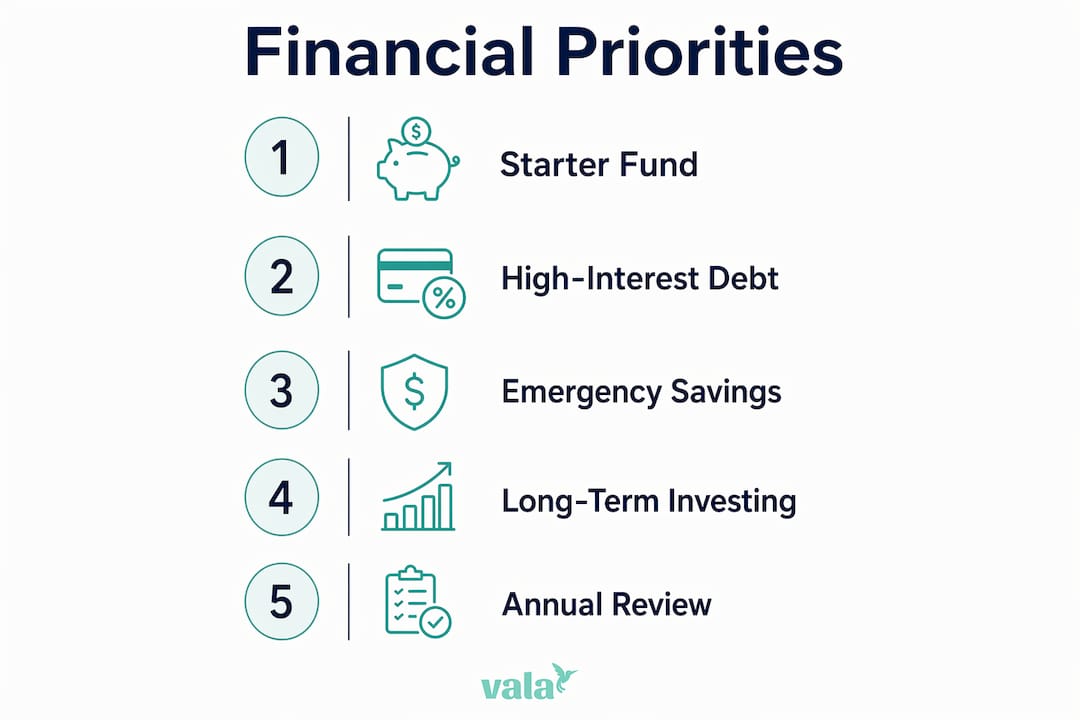
The fastest path to financial stability follows a clear priority order:

  1. Build a $1,000 starter emergency fund as quickly as possible
  2. Capture your full employer 401(k) match before doing anything else
  3. Pay down high-interest debt above 6–7% interest rate aggressively
  4. Expand your emergency fund to cover 3–6 months of essential expenses
  5. Contribute to tax-advantaged accounts like a Roth IRA or HSA
  6. Invest additional funds in a taxable brokerage account

The logic behind this ladder matters. A $1,000 starter fund prevents you from reaching for a credit card every time something unexpected happens. That single buffer stops the debt cycle before it starts.

High-interest debt above 6–7% is a guaranteed negative return on your money. Paying off a credit card charging 22% interest is equivalent to earning a 22% return on an investment. No index fund reliably beats that. Pay it down before investing beyond your employer match.

Infographic on financial priority steps

Pro Tip: While paying down debt, freeze your credit card use. Even one new high-interest charge slows your payoff timeline significantly.

Why starting to invest early changes everything

Compound interest is the single most powerful force in personal finance. A dollar invested at age 25 is worth roughly five times as much at age 65 as a dollar invested at age 45. That gap is not about skill or market timing. It is purely about time.

Delaying retirement contributions by even a few years creates a significant long-term cost. Each year of delay can cost tens of thousands in portfolio value over a lifetime, and catching up later often requires saving at 2–3 times the original rate. Starting small now beats starting big later.

Key accounts to prioritize as a young professional:

  • 401(k) with employer match: Employer match contributions offer a near-instant 100% return on investment. Capture every dollar of it.
  • Roth IRA: Contributions grow tax-free. At your current income level, you likely qualify, and the tax benefit compounds over decades.
  • HSA (Health Savings Account): Triple tax advantage. Contributions are pre-tax, growth is tax-free, and withdrawals for medical expenses are tax-free.
  • Taxable brokerage account: Use this after maxing tax-advantaged options. Dollar-cost averaging, meaning investing a fixed amount on a regular schedule, removes the pressure of timing the market.

Tax planning is a year-round process, not a once-a-year event. Using 401(k)s, HSAs, and FSAs throughout the year reduces your taxable income and increases the amount you keep.

Pro Tip: Always contribute enough to your 401(k) to get the full employer match before paying extra on low-interest debt or opening a taxable account. The match is free money with no strings attached.

Why integrated financial planning beats managing things separately

Most young professionals manage their budget in one place, their investments in another, and their debt in a third. This siloed approach creates blind spots. Managing financial elements separately leads to inefficiency and lost opportunities that an integrated plan eliminates.

A unified financial plan treats every dollar as part of a single system. Your budget feeds your savings rate. Your savings rate determines how fast you eliminate debt. Your debt payoff timeline determines when you can increase retirement contributions. Each decision affects the others, and sequencing them correctly maximizes every dollar’s impact.

The difference between siloed and integrated planning looks like this:

Approach What happens
Siloed You invest in a brokerage while carrying 24% credit card debt
Integrated You clear high-interest debt first, then redirect that payment to investments
Siloed You save cash in a checking account earning 0.01%
Integrated You route savings to an HSA or Roth IRA for tax-free growth

A written financial plan reviewed annually, or after major life changes like a new job or marriage, keeps you accountable and adapts to your real situation. Working with a fee-only fiduciary advisor once a year gives you an outside perspective and a single source of truth for all your financial decisions.

Pro Tip: Schedule a 30-minute financial review every january. Update your income, expenses, and goals. A plan you never revisit is just a wish list.

How AI budgeting tools help young professionals save more

Automation removes the biggest obstacle to consistent financial progress: human inconsistency. AI-driven tools track spending, identify saving opportunities, and automate transfers to investments and savings without requiring you to log in and make decisions every week.

The right financial planning tools for young professionals share a few key features:

  • Automatic expense categorization: Transactions sort themselves so you see exactly where money goes
  • Spending pattern alerts: The app flags when a category spikes above your normal range
  • Goal-based goal planning: You set a target, the app moves money toward it on schedule
  • Real-time balance visibility: You always know your actual available balance, not just your bank balance

Personal finance automation reduces the mental load of budgeting. When saving is automatic, you do not need willpower. The system does the work. This is especially valuable for young professionals managing student loans, rent, and career expenses simultaneously.

Pro Tip: Automate your Roth IRA contribution on the first of each month. Treating it like a fixed bill makes consistent investing the default, not the exception.

Key Takeaways

Effective financial planning for young professionals depends on starting early, sequencing decisions correctly, and using automation to stay consistent without relying on discipline alone.

Point Details
Start with a budget framework The 50/30/20 rule gives you a clear starting structure for income, spending, and saving.
Build your emergency fund first A $1,000 starter fund stops unexpected expenses from creating new high-interest debt.
Capture the employer match immediately Employer 401(k) matching is a near-instant 100% return. Never leave it uncaptured.
Invest early, not perfectly A dollar invested at 25 is worth five times more at 65 than one invested at 45.
Integrate all financial decisions Managing budgeting, debt, and investing as one system eliminates costly blind spots.

What I’ve learned about financial planning that most articles won’t tell you

The biggest mistake I see young professionals make is not starting too late. It is starting without a sequence. They open a brokerage account before paying off a 22% credit card. They build a six-month emergency fund before capturing their employer match. Good intentions, wrong order.

The priority ladder exists for a reason. Every dollar has an optimal next destination, and skipping steps costs real money. I have watched people invest $500 a month in index funds while carrying $8,000 in credit card debt at 24% interest. The math on that is brutal. The debt wins every time.

The second thing most articles skip is the psychological side of a written plan. Knowing your numbers is not the same as writing them down and reviewing them. A plan you carry in your head shifts every time your mood shifts. A written plan reviewed annually holds you to your past self’s better judgment.

Technology genuinely helps here. Apps that automate savings and surface spending patterns remove the friction that causes most people to abandon their budgets by february. The best financial habit is the one that runs without you having to think about it. Automate the right behaviors, and the results follow.

Start where you are. Contribute $50 a month to a Roth IRA if that is all you can manage. Build the $1,000 buffer before anything else. The sequence matters more than the amount, especially in the first few years.

— SaverStride

Valapoint makes your financial plan work in real life

Building a financial plan is one thing. Sticking to it is another. Valapoint’s Vala app brings your budget, savings goals, and spending habits into one clear view so you always know where you stand.

https://valapoint.com

Vala tracks your expenses automatically, flags spending patterns before they become problems, and helps you set savings goals with real timelines. Whether you are building your first emergency fund or tracking progress toward a Roth IRA contribution, the Vala personal finance app keeps every piece of your plan connected. You can also use Valapoint’s financial planning tools to calculate savings targets, model debt payoff timelines, and build a budget that fits your actual income. No spreadsheets required.

FAQ

What is the 50/30/20 rule for budgeting?

The 50/30/20 rule allocates 50% of take-home pay to needs, 30% to wants, and 20% to savings and debt repayment. It is the most widely used budgeting framework for young professionals starting their financial plan.

How much should I have in an emergency fund?

Start with a $1,000 buffer to cover small emergencies, then build toward 3–6 months of essential expenses. Reach the starter amount before expanding so unexpected costs do not push you into high-interest debt.

Should I pay off debt or invest first?

Capture your full employer 401(k) match first, then pay down debt above 6–7% interest before investing further. The match offers a near-instant 100% return that no debt payoff or investment reliably beats.

When should I start contributing to a Roth IRA?

Start as early as possible, ideally in your mid-20s when your income and tax rate are lower. Roth IRA contributions grow tax-free, and decades of compounding make early contributions significantly more valuable than later ones.

How often should I review my financial plan?

Review your plan at least once a year and after major life changes like a new job, a raise, or a move. A written plan reviewed annually keeps your goals current and your priorities correctly sequenced.

What Is a Budget Category Limit? A Guide for Young Adults

A budget category limit is the maximum dollar amount you assign to a specific spending area within your budget, giving you a clear cap that keeps your expenses in check. Think of it as a personal spending rule for each part of your financial life, from rent to groceries to entertainment. This concept sits at the heart of effective personal finance management, and frameworks like the 50/30/20 rule are built entirely around it. Understanding what is a budget category limit, and how to set one, is the first step toward spending with confidence and saving without stress.

What is a budget category limit and why does it matter?

A budget category limit is a defined spending cap for one area of your budget, such as $400 for food or $150 for entertainment each month. The formal term in personal finance is a “spending limit by category,” though most budgeting guides and apps simply call it a category limit or category cap. Budget categories help organize spending and set clear boundaries that make it easier to follow any budgeting method you choose.

Without category limits, money tends to disappear into vague, untracked spending. You might know you spent “a lot” on food last month, but without a set limit, you have no reference point for whether that amount was reasonable or excessive. Category limits turn abstract intentions into concrete numbers, which makes accountability possible.

Hands writing budget limits in cafe

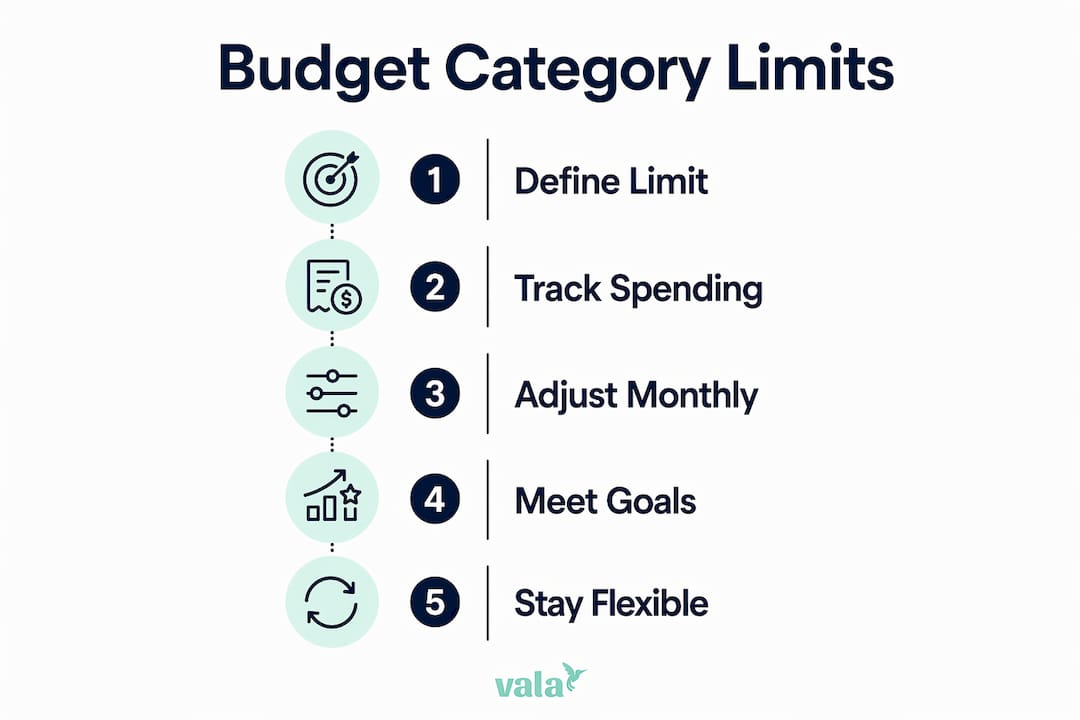
Category limits also connect directly to your financial goals. If you want to save $200 a month, you need to cap your discretionary spending tightly enough to make that happen. The limit is not a punishment. It is a plan.

Every major budgeting method uses category limits in some form. Understanding how each method assigns those limits helps you pick the approach that fits your life.

The 50/30/20 rule is one of the most widely used frameworks. It allocates 50% of your after-tax income to needs, 30% to wants, and 20% to savings and debt repayment. Needs include housing, utilities, minimum loan payments, and childcare. Wants cover dining out, entertainment, and gifts. Each of those broad buckets then breaks down into individual category limits.

Infographic illustrating budget category limit steps

The envelope budgeting system takes a more hands-on approach. The envelope system enforces strict spending limits by assigning a fixed amount of money to each category, either in a physical envelope or a digital equivalent. Once the envelope is empty, spending in that category stops for the month. This method works especially well for controlling discretionary spending because the limit is physical and immediate.

Zero-based budgeting assigns every dollar of income a specific job until your income minus your expenses equals zero. Each category gets a limit, and the total of all limits must equal your total income. This method requires more upfront work but gives you complete visibility into where every dollar goes.

Common budget categories across all three methods include:

  • Housing: rent or mortgage payments
  • Food: groceries and dining out
  • Transportation: car payments, gas, or transit passes
  • Utilities: electricity, water, and internet
  • Savings: emergency fund, retirement contributions
  • Insurance: health, auto, and renters insurance
  • Entertainment: streaming services, events, and hobbies
  • Debt repayment: credit card minimums and student loans

Your category limits reflect your income and your priorities. A student with a $1,500 monthly income will set very different limits than a young professional earning $4,000. The categories stay the same. The numbers change.

What are the benefits of setting budget category limits?

Setting category limits gives you control over your money before you spend it, rather than regret after. Budget category limits reduce overspending and increase financial confidence, two outcomes that matter whether you are managing $800 a month or $8,000.

The core benefits include:

  • Reduced financial stress. Knowing exactly how much you can spend in each area removes the anxiety of wondering whether you can afford something.
  • Better spending awareness. Limits force you to notice where your money actually goes, not where you think it goes.
  • Faster savings progress. When discretionary spending has a cap, the money you do not spend stays in your account and builds toward your goals.
  • Easier debt repayment. A dedicated debt repayment category with a firm limit keeps you consistent, even when other expenses compete for attention.
  • Flexibility over time. Limits are not permanent. You can adjust them as your income grows or your priorities shift.

Pro Tip: If a category limit causes consistent frustration or feels impossible to stick to, that is a signal to adjust the limit, not abandon budgeting altogether. Adjusting limits improves sustainability and reduces the chance of giving up entirely.

The biggest misconception about category limits is that they feel restrictive. The opposite is true. When you know your food budget is $350 and you have $200 left with two weeks to go, you feel in control. Without a limit, you have no idea where you stand until the month is over.

How to set effective budget category limits for your lifestyle

Setting limits that actually work requires a few deliberate steps. Guessing at numbers leads to limits that are either too tight to follow or too loose to matter.

  1. List all your expenses. Write down every recurring cost you pay each month. Fixed expenses like rent and insurance stay constant, so they are easy to assign. Variable expenses like groceries and gas fluctuate, so you need to average two to three months of past spending to get a realistic number.

  2. Separate fixed from variable costs. Fixed costs go directly into your budget at their exact amount. Variable costs need a limit based on your average spending, with a small buffer built in.

  3. Apply a percentage framework. Housing typically consumes 25–30% of take-home pay. Food runs 10–15%. Transportation lands around 10–15%. These ranges give you a starting point, not a final answer.

  4. Prioritize savings as a category. Treat savings like a bill. Assign it a limit and pay it first. The 50/30/20 rule recommends 20% of after-tax income for savings and debt repayment.

  5. Add a miscellaneous category. Life produces unexpected costs. A small miscellaneous limit, around 3–5% of income, prevents those surprises from breaking your entire budget.

  6. Track and adjust monthly. Monitoring actual spending against your limits is what makes the system work. Use an app or a spreadsheet to compare what you planned against what you actually spent, then adjust limits that are consistently off.

Pro Tip: Use automated expense tracking to remove the manual work of comparing your spending to your limits. Automation catches overspending in real time, before it becomes a problem.

The goal is limits that reflect your real life, not an idealized version of it. A limit you can follow 90% of the time beats a perfect limit you abandon after two weeks.

Common budget categories and example limits for beginners

A practical starting point for budgeting categories explained with percentage ranges gives you a concrete framework to build from. The table below uses the recommended percentage ranges from widely cited personal finance guidelines.

Budget category Recommended range Example limit ($3,000/month)
Housing 25–30% $750–$900
Food 10–15% $300–$450
Transportation 10–15% $300–$450
Utilities 5–10% $150–$300
Insurance 5–10% $150–$300
Savings 15–20% $450–$600
Entertainment 5–10% $150–$300
Miscellaneous 3–5% $90–$150

These ranges are starting points. Your actual limits depend on your city, income, and lifestyle. Someone living in New York City will spend a larger share on housing than someone in a smaller city, which means other categories need to shrink to compensate.

A miscellaneous category deserves special attention. Most beginner budgets skip it, then blow up their entire plan the first time an unexpected cost appears. A small buffer category absorbs those costs without forcing you to raid your savings.

The best budgeting apps let you set these category limits digitally and alert you when you approach or exceed them. That real-time feedback is what turns a static spreadsheet into an active financial tool.

Key Takeaways

A budget category limit is the single most practical tool for controlling spending, because it converts financial intentions into specific, trackable numbers.

Point Details
Budget category limit defined It is the maximum dollar amount you assign to one spending area each month.
Popular frameworks use limits The 50/30/20 rule, envelope system, and zero-based budgeting all rely on category caps.
Limits reduce financial stress Clear spending caps give you confidence and prevent end-of-month surprises.
Fixed vs. variable expenses Fixed costs are easy to cap; variable costs need a two-to-three-month average to set accurately.
Adjust limits, do not quit If a limit feels impossible, revise it. Sustainable limits outperform perfect ones you abandon.

Budget limits should guide you, not cage you

Budgeting advice often presents category limits as rigid rules you must follow perfectly or fail. I disagree with that framing entirely. After working through my own budgets across different income levels and life stages, the limits that actually stuck were the ones I treated as guides, not laws.

The first time I set a food budget, I made it too tight. I hit the limit by the third week every single month and felt like I was failing. The fix was not more discipline. It was raising the food limit by $50 and cutting entertainment instead. The total budget stayed the same. The stress disappeared.

Your category limits should reflect the life you actually live, not the one you think you should live. If you love cooking at home and hate going out, your food limit can be generous and your dining-out limit can be tiny. That is not cheating. That is expense tracking best practices in action.

The readers who succeed with budgeting long-term are not the ones with the most disciplined limits. They are the ones who revisit their limits regularly and adjust without guilt. Treat your budget like a living document, and it will serve you for years.

— SaverStride

Valapoint makes budget category limits easy to set and track

Setting category limits is straightforward once you know the numbers. Keeping track of them every day is where most people struggle.

https://valapoint.com

Valapoint is built for exactly that challenge. The Vala personal finance app lets you set spending limits for every category, then tracks your expenses in real time so you always know where you stand. You get instant alerts when you are close to a limit, clear visuals of your spending by category, and AI-powered insights that flag patterns you might miss on your own. Whether you are a student building your first budget or a young professional managing multiple financial goals, Valapoint gives you the clarity to spend confidently and save consistently.

FAQ

What is a budget category limit in simple terms?

A budget category limit is the maximum amount you allow yourself to spend in one area, such as $200 for groceries or $100 for entertainment, within a set time period like a month.

How many budget categories should a beginner use?

Most beginners do well with six to eight categories: housing, food, transportation, utilities, savings, and entertainment, plus a small miscellaneous buffer. Starting simple makes the system easier to follow.

What happens if I go over a budget category limit?

Going over a limit means you need to pull money from another category or adjust the limit for next month. Tracking spending against limits regularly helps you catch overages early before they compound.

Is the 50/30/20 rule a good starting point for category limits?

Yes. The 50/30/20 rule gives you a clear percentage-based structure for needs, wants, and savings that works well as a first framework, especially for people new to budgeting for expenses.

Can I change my budget category limits over time?

Absolutely. Limits should change as your income, expenses, and goals evolve. Reviewing and adjusting your limits every one to three months keeps your budget accurate and realistic.

What Is a Spending Audit? A Guide for Ages 18–45

A spending audit is defined as a backward-looking review of your actual financial transactions over a recent period, typically 30–90 days, to uncover where your money truly goes. Unlike budgeting, which plans future spending, an audit diagnoses what already happened. Behavioral economics research shows people underestimate their discretionary spending by 20–30% from memory alone. That gap between what you think you spend and what you actually spend is exactly what a spending audit closes. Valapoint’s tracking tools are built to make that gap visible fast.


What is a spending audit, and why does it matter?

A spending audit is a systematic review of every dollar you spent over the past one to three months. The goal is simple: see the full picture of your spending, not the version your memory constructed. 10–25% of monthly spending often goes to unallocated or forgotten categories. That means a real audit can surface $200–$500 in monthly savings for the average person.

Man conducting a spending audit using laptop and notes

The formal term used in personal finance is “expenditure review” or “personal spending analysis,” but “spending audit” has become the widely accepted everyday label. Both terms describe the same process. You pull your statements, categorize every transaction, and compare the results against your actual financial goals.

The audit matters because your memory is not a reliable financial record. You might recall the big purchases but forget the $14.99 subscription, the three delivery fees, and the two ATM charges that quietly added up. A spending audit replaces guesswork with data.


How does the spending audit process work?

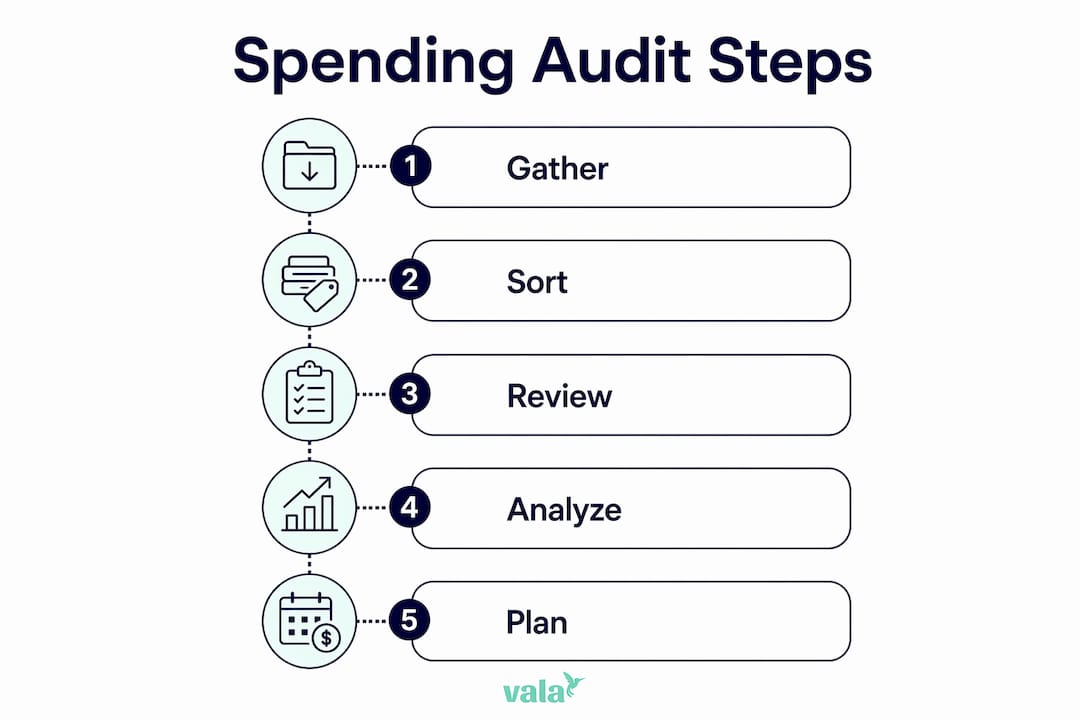
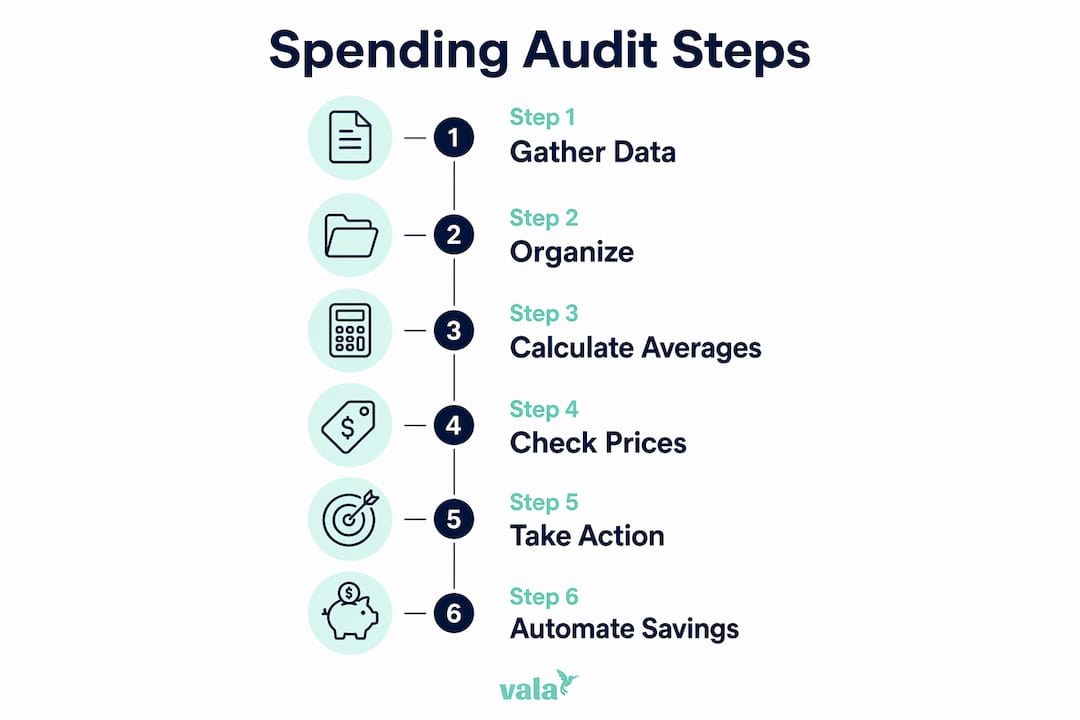
The spending audit process follows a clear sequence. Here is how to work through it step by step.

  1. Gather your statements. Pull bank statements, credit card statements, and any digital payment records (Venmo, PayPal, Cash App) for the past 30–90 days. Include an honest estimate of cash spending. Collecting 1–3 months of statements gives you enough data to spot patterns without drowning in detail.

  2. List every transaction. Copy every charge into a spreadsheet or notebook. Do not skip small amounts. A $3.49 charge repeated 20 times is $69.80 you may have never noticed.

  3. Categorize each transaction. Group spending into categories: housing, groceries, dining out, transportation, subscriptions, entertainment, personal care, and miscellaneous. Be specific. “Dining out” and “coffee shops” are different categories with different solutions.

  4. Flag recurring charges. Mark every charge that repeats monthly or annually. These are your highest-priority review items because they compound over time.

  5. Total each category. Add up what you spent in each group. Compare the totals to what you expected to spend. The surprises are your audit findings.

  6. Identify the leaks. Note any category where actual spending exceeded your mental estimate by more than 15%. These are the areas that need attention first.

A quick scan takes about one hour. A deep review that catches every cash purchase and recurring charge takes 2–3 hours. The deeper review pays off more.

Pro Tip: Never rely solely on your bank app’s auto-categorization. Automated categorization frequently misclassifies transactions and misses cash spending entirely. Always verify each category manually.

Infographic illustrating five steps of spending audit process


How does a spending audit differ from a budget?

A budget is a forward-looking plan. A spending audit is a backward-looking diagnostic. They serve different purposes, and confusing them is one of the most common financial mistakes people make.

Here is how the two tools differ in practice:

  • A budget sets targets. It tells you how much you plan to spend in each category next month.
  • An audit reveals reality. It tells you how much you actually spent last month, with no assumptions.
  • A budget can be built on false assumptions. If you have never audited your spending, your budget categories are based on guesses.
  • An audit makes your budget accurate. Once you know your real spending patterns, you can set budget targets that reflect your actual life.
  • Audits expose category creep. Category creep is the gradual, unnoticed rise in small expenses within a category. A budget rarely catches it. An audit always does.

The psychological dimension matters here. People tend to remember their intentional purchases and forget their impulse ones. A spending audit removes that bias. It shows you the full picture, including the purchases you made on autopilot. That objectivity is what makes audit data so much more useful than a budget built from memory.


What hidden expenses does an audit typically uncover?

Hidden expenses are the charges you pay but rarely think about. They are the leading reason people feel financially tight despite a steady income.

Forgotten subscriptions top the list. Streaming services, app subscriptions, cloud storage plans, and gym memberships you signed up for and stopped using all continue billing until you cancel them. Silent recurring costs and subscription fatigue are leading causes of unnoticed monthly leakage, often totaling around $500 per month for the average household.

Small daily convenience purchases add up faster than most people expect. A $6 coffee five days a week is $120 a month. A $4.99 delivery fee three times a week is $60 a month. Neither feels significant in the moment. Together, they represent $180 a month, or $2,160 a year.

Cash spending and ATM fees are the most commonly omitted items in any audit. Recurring charges, convenience fees, and ATM fees quietly drain hundreds monthly. Cash withdrawals show up as a single lump sum on your statement, with no detail about where the money went.

Category creep is the subtlest leak of all. Your grocery bill was $350 six months ago. Now it is $430. Nothing changed dramatically. Prices crept up, habits shifted slightly, and the total grew without a single conscious decision. Spending audits uniquely reveal these leaks by examining detailed transactions over time, something a monthly budget review rarely does.


How to apply audit findings to improve your financial habits

Finding the leaks is only half the work. The other half is deciding what to do about them.

  1. Pick three changes, not ten. Limiting initial actions to three changes avoids overwhelm and improves the chance you will actually follow through. Choose the three categories with the biggest gap between expected and actual spending.

  2. Cancel or renegotiate recurring charges. Go through every flagged subscription. Cancel anything you have not used in the past 30 days. For services you want to keep, check if a lower-tier plan meets your needs.

  3. Set category budgets based on real data. Use your audit totals as the baseline. If you spent $430 on groceries, set your grocery budget at $400 and work down from there. Starting from your actual behavior is more realistic than starting from an ideal number.

  4. Align spending with your stated priorities. An audit creates a spending map that you can compare against your actual goals. If you say travel is a priority but your audit shows you spent nothing on savings and $200 on impulse dining, the data tells you something your budget never would.

  5. Schedule your next audit. A quarterly review keeps your spending map current. Set a calendar reminder for 90 days out. The second audit takes less time because you already know the process.

Pro Tip: Use expense tracking best practices to maintain the accuracy you built during your audit. Consistent tracking between audits makes each subsequent review faster and more useful.


What tools support an effective spending audit?

The right tool depends on how detailed you want to get and how much time you want to invest.

Method Best for Key limitation
Pen and paper Simple, one-time audits Slow; easy to miss digital transactions
Spreadsheet (Excel, Google Sheets) Detailed, customizable reviews Requires manual data entry
Expense tracking apps Ongoing tracking with auto-import Auto-categorization errors require manual correction
Personal finance platforms Full financial picture with goal tracking Setup time; learning curve

No special software is required for an accurate audit. Accuracy depends more on consistent tracking and manual review than on the technology you use. A spreadsheet with honest data beats an app with sloppy categorization every time.

That said, apps that auto-import transactions save significant time during data collection. The key is to treat auto-categorization as a starting point, not a finished product. Always review each category manually before drawing conclusions. For readers who want a structured comparison of available tools, the best expense tracking apps guide covers what to evaluate before you install anything.

Downloadable spending audit templates are available from personal finance sites like Money Instructor and Phroogal. These give you a pre-built category structure so you are not starting from a blank page.


Key Takeaways

A spending audit gives you an accurate, data-based picture of your real spending habits, which no budget built from memory can match.

Point Details
Audits are backward-looking They review past transactions, not future plans, making them a diagnostic tool rather than a planning tool.
Memory underestimates spending Behavioral economics research shows people underestimate discretionary spending by 20–30%, making manual review essential.
Hidden costs add up fast Forgotten subscriptions and small daily purchases can quietly drain hundreds of dollars each month.
Start with three changes Focusing on three high-impact adjustments after an audit improves follow-through and builds lasting habits.
Quarterly audits maintain clarity Reviewing your spending every 90 days keeps your financial picture current and catches new leaks early.

Why I think most people skip the most valuable financial tool they have

Most personal finance advice jumps straight to budgeting. Set a budget, track your categories, stick to the plan. The problem is that a budget built without an audit is built on fiction. You are planning with numbers you made up, not numbers you measured.

The first time I worked through a full spending review, the results were uncomfortable. I thought I spent about $80 a month on subscriptions. The actual number was $214. I thought I rarely ordered delivery. My statement showed 11 delivery charges in one month. None of those purchases felt significant at the time. Together, they told a story I did not recognize.

That discomfort is the point. A spending audit is not a judgment. It is a measurement. You would not skip a health checkup because you were afraid of the results. The same logic applies here. Viewing an audit as a neutral health checkup rather than a verdict shifts your reaction from defensive to curious.

The readers who get the most from this process are the ones who stay curious. They do not try to fix everything at once. They pick the two or three findings that surprise them most and address those first. That focused approach builds confidence, and confidence builds the habit of regular review.

If you have never done a spending audit, your first one will likely be the most revealing financial exercise you have ever done. That is not a warning. It is a reason to start.

— SaverStride


How Valapoint makes your spending audit easier

Running a spending audit manually is entirely possible, and the process above works. But tracking every transaction, correcting miscategorized charges, and spotting recurring leaks takes real time.

https://valapoint.com

Valapoint’s personal finance app auto-imports transactions, flags recurring charges, and surfaces spending patterns you might otherwise miss. You still review and confirm categories manually, which keeps your audit accurate. The difference is that Valapoint handles the data collection so you can focus on the analysis. For readers ready to build on their audit findings, Valapoint’s budget tracking tools let you set category limits based on your real spending data and monitor progress in real time.


FAQ

What is a spending audit in simple terms?

A spending audit is a detailed review of your actual transactions over the past 30–90 days to see exactly where your money went. It replaces memory-based estimates with real data.

How long does a spending audit take?

A quick scan takes about one hour. A thorough review that catches recurring charges and cash spending takes 2–3 hours. The deeper review produces more useful findings.

How is a spending audit different from a financial audit?

A financial audit is a formal, often legally required review of an organization’s financial records conducted by an external party. A spending audit is an informal personal review you conduct yourself to understand your own spending habits.

How often should you do a spending audit?

A quarterly review, every 90 days, keeps your spending picture current and catches new leaks before they compound. Annual reviews are better than nothing but miss the gradual category creep that builds month by month.

What are the biggest benefits of a spending audit?

The main benefits are identifying forgotten subscriptions, uncovering category creep, and building a realistic baseline for budgeting. Most people find monthly savings of $200–$500 after completing their first full audit.

How to Find Hidden Monthly Spending Leaks Fast

Hidden monthly spending leaks are recurring or irregular expenses that drain your finances without you noticing them. Most people experience a visibility problem, not a spending problem. A systematic 60–90 minute audit of your last three months of transactions can uncover $200–$500 in recoverable monthly costs. The industry term for this process is a spending audit, and it works by surfacing patterns that individual line items never reveal. This guide shows you exactly how to find hidden monthly spending leaks, fix them permanently, and keep them from coming back.

What are the common categories of hidden spending leaks?

Knowing where leaks hide is the first step toward stopping them. Most people scan their bank statements and miss the real culprits because they look at individual charges instead of categories.

The six most common leak categories are:

  • Recurring subscriptions and auto-renewals. Streaming services, gym memberships, and software trials that converted to paid plans without a reminder are the biggest offenders. Free trials billed under different names are especially easy to miss.
  • Small daily convenience expenses. Coffee runs, delivery tips, and impulse purchases feel minor individually. Across a month, they compound into a significant budget leak.
  • Bank fees, credit card interest, and overdraft charges. These are predictable and avoidable, yet they recur because most people never set up alerts to catch them.
  • Insurance and warranty policies. Policies purchased years ago rarely get re-evaluated. Rates increase quietly, and coverage often no longer matches your actual needs.
  • SaaS and digital service overages. The average SaaS tool costs 15–30% more than its advertised price due to mandatory add-ons, contact tier overages, and onboarding fees. This applies to personal tools like cloud storage and productivity apps too.
  • Annual or irregular charges. Annual memberships, domain renewals, and car maintenance costs don’t show up every month. A single-month review will miss them entirely.

Pro Tip: Search your email inbox for the word “receipt” and sort by sender. You’ll surface annual charges and forgotten subscriptions faster than any bank statement review.

What tools and preparations do you need for a spending audit?

A spending audit works best when you prepare before you start reviewing transactions. Walking in without the right materials turns a 90-minute task into a frustrating afternoon.

What to gather before you start

Pull at least 90 days of statements from every bank account and credit card you use. A 90-day transaction review captures irregular expenses and spending drift that a single month snapshot misses. Annual memberships, car maintenance, and quarterly software fees only appear when you look across multiple months.

Tools that speed up the process

Tool type What it does Time saved
Budgeting app with AI categorization Sorts transactions automatically into needs, wants, and savings 40–60 minutes per audit
Subscription register (spreadsheet or app) Tracks every subscription’s cost, renewal date, and cancellation path Prevents future leaks
Calendar reminders Flags upcoming renewals 7 days in advance Stops auto-renewals
Spending alerts Notifies you when a category exceeds a set threshold Catches drift in real time

Infographic of six step spending audit process

Budgeting apps with AI-enabled categorization reduce manual effort and miscategorization compared to traditional spreadsheet methods. They also surface patterns across months that you would never catch by reading statements line by line.

The 50/30/20 rule gives you a clear framework for evaluating what you find. Experts recommend allocating 50% of take-home pay to needs, 30% to wants, and 20% to savings. Pair this with weekly 10–15 minute check-ins to catch new leaks before they compound.

Pro Tip: Focus your audit on categories with inconsistency, not every line item. If your grocery spending varies by more than $100 month to month, that category deserves a closer look.

How to conduct a step-by-step spending audit

A spending audit follows a clear sequence. Skipping steps reduces accuracy and leaves money on the table.

Step 1: Pull and organize your transaction data

Download 90 days of statements from all accounts. Export them to a spreadsheet or import them into a budgeting app. Group transactions by category: food delivery, dining out, subscriptions, entertainment, fees, and miscellaneous.

Hands organizing financial papers at glass table

Step 2: Flag unknown or suspicious charges

Scan every recurring charge and mark any you cannot immediately identify. Subscriptions billed under different names and cancelled services that kept billing are common finds. Look specifically for:

  • Charges under $15 that appear monthly (easy to ignore, hard to justify)
  • Charges from companies you don’t recognize
  • Duplicate charges for the same service
  • Annual charges that hit without warning

Step 3: Calculate category averages

Add up each category across all three months and divide by three. This gives you a true monthly average that accounts for irregular spending. Most people are surprised by their food delivery and dining totals. The gap between what you remember spending and what you actually spent is driven by frictionless payment methods like tap-to-pay and one-click purchases that your memory under-records.

Step 4: Check for price increases and hidden add-ons

Review each subscription for price changes since you signed up. Currency conversion fees and automatic annual price increases are common overlooked costs. A streaming service that started at $9.99 may now bill at $15.99. A cloud storage plan may have added a paid feature you never requested.

Step 5: Decide and act on each leak

For every flagged item, choose one of three actions: cancel, renegotiate, or downgrade. Set a deadline of 48 hours to act. Decisions left open tend to stay open.

Step 6: Automate what you recover

Every dollar you recover from a cancelled subscription or eliminated fee should move automatically to savings or debt repayment. Set up an auto-transfer the same day you cancel. This step is what separates a one-time audit from a lasting financial improvement.

What mistakes should you avoid when plugging spending leaks?

Most people cut back on spending for a few weeks and then drift back to old habits. That is patching, not plugging. Patching spending rarely lasts. Plugging leaks requires structural and automated changes that remove the decision entirely.

The most common mistakes are:

  • Canceling nothing, just spending less. If the subscription is still active, the charge will return the moment your attention shifts.
  • Relying on willpower instead of automation. Auto-transfers to savings work because they remove the choice. Willpower does not scale.
  • Running a single audit and stopping. New leaks appear constantly. A subscription you signed up for in march will show up as a leak by june if you don’t track it.
  • Ignoring annual charges in monthly reviews. A single-month snapshot misses quarterly and annual fees. Multi-month reviews catch spending drift and irregular expenses that monthly snapshots miss entirely.

“The key to uncovering leaks is consistent, centralized visibility focused on problematic categories rather than manual line-by-line scrutiny. Systems beat willpower every time.”

Maintaining a central subscription register with each service’s actual cost, renewal date, and cancellation path is the single most effective habit for preventing future leaks. Update it every time you sign up for a new service.

Pro Tip: Set a recurring calendar event every 90 days labeled “Spending Audit.” Treat it like a bill payment. Missing it costs you money.

Key Takeaways

Finding and fixing hidden monthly spending leaks requires a 90-day transaction audit, a clear categorization framework like the 50/30/20 rule, and automated systems that remove the need for willpower.

Point Details
Audit 90 days, not 30 A single month misses annual fees, irregular charges, and spending drift.
Use the 50/30/20 rule Allocate 50% to needs, 30% to wants, and 20% to savings as your baseline.
Flag and act within 48 hours Decisions left open stay open. Cancel, renegotiate, or downgrade immediately.
Automate recovered funds Set up auto-transfers the same day you cancel a subscription.
Repeat every 90 days New leaks appear constantly. A one-time audit is not enough.

The mindset shift that actually makes this stick

I’ve looked at a lot of personal budgets over the years, and the pattern is almost always the same. People think they have a spending problem. They actually have a visibility problem. The moment you can see exactly where your money goes, the decisions become obvious. You don’t need a stricter budget. You need a clearer picture.

What surprises most people is how small the individual leaks are. A $12.99 subscription here, a $4.99 add-on there. None of it feels significant. But when you add them up across a year, you’re looking at real money. The math is not complicated. The hard part is making yourself sit down and look.

The other thing I’ve learned is that strict budgets fail because they require constant effort. Automation wins because it requires none. Once you cancel the subscriptions you don’t use and redirect that money automatically to savings, you don’t have to think about it again. The system does the work. That’s not restriction. That’s financial clarity, and it feels completely different.

The readers I’ve seen make the most progress are not the ones who cut the most aggressively. They’re the ones who set up the right systems and then check in every 90 days to catch new drift. Consistent, light-touch visibility beats intense, short-lived willpower every time.

— SaverStride

How Valapoint helps you track and stop spending leaks

Valapoint’s personal finance app handles the parts of a spending audit that most people skip because they’re tedious.

https://valapoint.com

Valapoint automatically categorizes your transactions, tracks every subscription’s renewal date, and sends alerts when a category exceeds your set limit. The app applies the 50/30/20 framework to your real spending data, so you can see at a glance where your money is going. You can also set up budget goal tracking to redirect recovered funds automatically. For a full overview of what Valapoint offers, visit the personal finance app page and see how it fits your financial habits.

FAQ

How much money can a spending audit recover?

A systematic 90-day spending audit typically uncovers $200–$500 in recoverable monthly expenses. The exact amount depends on how many active subscriptions and recurring fees you have.

How long does a spending audit take?

A thorough spending audit covering 90 days of transactions takes 60–90 minutes. Using a budgeting app with automated categorization cuts that time significantly.

What is the 50/30/20 rule in budgeting?

The 50/30/20 rule allocates 50% of take-home pay to needs, 30% to wants, and 20% to savings. It gives you a clear benchmark for identifying which spending categories are out of balance.

How do I find hidden subscription charges?

Review 90 days of bank and credit card statements and flag any recurring charge you cannot immediately identify. Search your email for “receipt” or “billing” to surface subscriptions billed under unfamiliar names.

How often should I audit my spending?

Run a full spending audit every 90 days. New subscriptions, price increases, and spending drift appear regularly, and a quarterly review catches them before they compound into significant losses.

What Is Expense Categorization? A Guide for Small Businesses

Expense categorization is defined as the process of grouping financial transactions into consistent, labeled categories to support tracking, budgeting, and tax reporting. Also called expense classification in accounting, it gives you a clear picture of where your money goes each month. Most small businesses and individuals base their categories on frameworks like IRS Schedule C, which provides 20 standard line items as a starting point. Without a consistent system, spending data becomes noise. With one, it becomes a tool you can actually use.

What is expense categorization and why does it matter?

Expense categorization is the practice of assigning every dollar you spend to a defined group, such as rent, travel, meals, or payroll. The goal is consistency. When every transaction lands in the right bucket, you can compare spending across months, prepare accurate tax returns, and spot budget problems before they grow.

Accounting standards divide business expenses into two main groups. Operating expenses cover day-to-day costs like salaries, utilities, and office supplies. Non-operating expenses cover indirect costs like interest payments or losses from asset sales. Knowing which bucket a cost belongs to affects how you read your profit and loss statement.

Hands using calculator with business expense spreadsheets

For individuals, the same logic applies. Grouping personal spending into categories like housing, groceries, transportation, and subscriptions shows you exactly where your paycheck goes. That clarity is the first step toward building a budget that actually holds.

What are the main types of expense categories?

Expenses can be classified in two ways: by function or by nature. Classification by function groups costs by their role in the business, such as Cost of Goods Sold (COGS) or Selling, General, and Administrative expenses (SG&A). Classification by nature groups costs by what they are, such as wages, rent, or utilities. Both methods are valid. The key is picking one and sticking with it.

Common expense categories for small businesses

Most small businesses work with a core set of categories that map directly to tax forms and accounting reports:

  • Housing and rent: Office space, storage units, or home office costs
  • Payroll and labor: Wages, contractor payments, and employer taxes
  • Travel: Flights, hotels, mileage, and ground transportation
  • Meals and entertainment: Business meals with clients or team events
  • Office supplies: Paper, software subscriptions, and equipment under a set dollar threshold
  • Utilities: Internet, phone, electricity, and water for business premises
  • Marketing and advertising: Paid ads, design fees, and promotional materials
  • Professional services: Accounting, legal, and consulting fees
  • Insurance: Business liability, health, and property coverage
  • Depreciation: Gradual cost recovery on major assets like equipment or vehicles

Fixed vs. variable expenses

Fixed expenses stay the same each month, like rent or a software subscription. Variable expenses change with activity, like shipping costs or raw materials. Tracking both separately helps you understand which costs you can control and which you cannot.

Infographic comparing fixed and variable expenses

Category type Examples Changes monthly?
Fixed operating Rent, insurance, salaries No
Variable operating Supplies, shipping, utilities Yes
Non-operating Loan interest, asset losses Varies
Personal fixed Mortgage, car payment No
Personal variable Groceries, dining, fuel Yes

How does categorization affect budgeting, taxes, and financial insights?

Accurate expense classification directly improves your budget. When you know exactly how much you spend on travel each quarter, you can set a realistic limit for the next one. Guessing leads to overspending. Data leads to control.

Tax filing becomes faster and more accurate when your categories align with your tax return. Aligning categories with IRS Schedule C lines means your accountant pulls the numbers directly from your records without hunting through raw transactions. That saves time and reduces errors.

Miscategorized expenses create real problems. A meal coded as office supplies skews both categories. Over time, those small errors add up to financial reports you cannot trust. Clean categories produce clean reports, and clean reports support better decisions.

Pro Tip: Review your expense categories at the end of each quarter. Catching a pattern of miscoded transactions early is far easier than correcting a full year of data before tax season.

The risks of overusing broad categories are well documented. The use of “Other” and “Miscellaneous” expense categories increased by 57% and 47% respectively among organizations. That trend signals a failure to classify spending properly, which makes financial analysis unreliable.

What are common mistakes in expense categorization?

The most common mistake is using “Miscellaneous” as a catch-all. Auditors flag excessive use of this category as a red flag. When too many transactions land in a vague bucket, your financial data loses meaning and your tax return becomes harder to defend.

Changing category definitions mid-year is the second major mistake. If you rename “Marketing” to “Advertising and Outreach” in july, your year-over-year comparison breaks. You cannot tell whether spending went up because the business grew or because the label changed.

Over-categorizing causes its own problems. Category fatigue sets in when employees or users face too many choices. They start guessing, and guessing produces messy data. The fix is to start broad and add detail only when transaction volume justifies it.

Categories that only make sense to accountants create errors at the point of entry. A practical expense system must be intuitive enough for anyone submitting an expense to classify it correctly without second-guessing. If your team consistently miscodes a category, the category definition is the problem, not the team.

Pro Tip: Apply a “two-touch” rule for any transaction that lands in Miscellaneous. Require a written note explaining why it does not fit another category, and set an automatic review trigger when Miscellaneous spending exceeds a set threshold.

How can you implement expense categorization effectively?

Start with 10–15 broad categories. That number covers most spending without overwhelming anyone who submits expenses. You can always add subcategories later as your transaction volume grows and your reporting needs become more specific.

Here is a practical setup process:

  1. List your actual spending first. Pull three months of bank and credit card statements. Group transactions by type before naming any categories. Let real data shape your structure.
  2. Align categories with your tax forms. Map each category to a line on IRS Schedule C or your personal tax return. This tax-first approach cuts preparation time significantly.
  3. Write a categorization guide. Document what belongs in each category with two or three examples. Share it with anyone who touches expense records.
  4. Connect categories to your chart of accounts. If you use accounting software, each category should map to a specific account code. This keeps your books and your expense reports in sync.
  5. Set a review date. Lock your categories at the start of each fiscal year. Schedule a review for the following january before the new year begins, not mid-cycle.

Automation makes the system easier to maintain. Apps that use AI to tag transactions automatically reduce the manual work of daily expense logging and catch miscategorizations before they pile up. The goal is a system that runs with minimal effort and produces data you can trust.

  • Keep category names short and plain. “Travel” beats “Business Travel and Transportation Costs.”
  • Avoid overlapping categories. If meals and entertainment share a boundary, define exactly where one ends and the other begins.
  • Review expense tracking practices regularly to catch patterns that suggest a category needs splitting or merging.

Key takeaways

Expense categorization works best when categories are simple, consistent, and aligned with your tax forms from the start of each fiscal year.

Point Details
Start with 10–15 categories Broad categories prevent fatigue and reduce miscoding errors.
Align with IRS Schedule C Tax-aligned categories cut preparation time and improve accuracy.
Avoid mid-year changes Changing definitions mid-year breaks year-over-year comparisons.
Limit Miscellaneous use Overuse of vague categories signals poor data quality to auditors.
Use automation to stay consistent AI-powered tools tag transactions automatically and flag outliers.

The case for keeping it simple

Most people overthink expense categorization. They build elaborate systems with dozens of subcategories, then abandon them by march because the upkeep is too much work.

The systems I have seen hold up over time share one trait: they are boring. Ten categories, clear names, and a one-page guide that anyone can follow. That is it. The goal is not a perfect taxonomy. The goal is data you can actually use twelve months from now.

Consistency matters more than precision. A category that is slightly imperfect but applied the same way every month produces useful trend data. A “perfect” category that gets applied differently each quarter produces nothing useful at all.

Automation changes the equation, but only when the underlying categories are clean. An AI tool that auto-tags transactions will amplify whatever structure you give it. Feed it a messy system and you get messy results faster. Feed it a clean, simple system and you get reliable data with almost no manual effort.

My honest advice: set your categories in january, write them down, and do not touch them until the following january. If a category feels wrong, note it for next year. Mid-year changes cost more than they save.

— SaverStride

How Valapoint makes expense categorization easier

Keeping your categories consistent is straightforward when the right tools do the heavy lifting.

https://valapoint.com

Valapoint’s personal finance app automatically tags your transactions, groups them into clear categories, and flags anything that looks out of place. You get a real-time view of your spending without manually sorting through bank statements. The app also supports budget controls tied directly to your categories, so you know the moment a category runs over. For small business owners and individuals who want clean financial data without the manual work, Valapoint’s AI expense tracker handles the categorization layer so you can focus on the decisions that matter.

FAQ

What is expense categorization in simple terms?

Expense categorization is the process of grouping every transaction you make into a labeled category, such as rent, travel, or groceries. It makes tracking, budgeting, and tax filing faster and more accurate.

What are the most common expense categories for small businesses?

Most small businesses use categories like payroll, rent, utilities, travel, meals, office supplies, marketing, professional services, and insurance. These align with the 20 standard line items on IRS Schedule C.

How many expense categories should I have?

Start with 10–15 broad categories. Adding too many categories too soon leads to confusion and data errors. Expand with subcategories only when your transaction volume makes it necessary.

Why is using “Miscellaneous” a problem?

Overusing Miscellaneous hides spending patterns and raises flags during audits. Auditors treat a high volume of Miscellaneous entries as a sign of poor financial controls.

How does expense categorization help with taxes?

Aligning your expense categories with IRS Schedule C lines means your tax data is ready to pull directly from your records. That reduces preparation time and lowers the risk of errors on your return.

What Is a Spending Trigger? Your Guide to Spending Less

A spending trigger is any emotional, situational, or environmental cue that prompts you to spend money impulsively or beyond your planned budget. Psychologists classify this behavior under the broader term emotional spending, a well-documented pattern where feelings drive financial decisions rather than need or logic. Understanding what is a spending trigger matters because awareness is the first step toward breaking the cycle. Impulse purchases offer short-lived emotional relief, followed by guilt and financial strain. Recognizing your personal triggers gives you real control over your money.

What causes spending triggers?

Spending triggers have both psychological and environmental roots. Neither is a character flaw. Emotional spending is a physiological response to stress and complex inner experiences, not a sign of weakness or poor character. Psychologist Emma Peterson notes that reducing shame around this behavior actually helps people track and change it more effectively.

Man browsing shopping tablet with coffee nearby

The brain’s role in impulse buying

Your brain’s reward system is directly involved every time you feel the urge to buy something unplanned. Anticipating a purchase releases dopamine, the same chemical linked to pleasure and motivation. That anticipatory rush feels good before you even spend a dollar. The problem is that the feeling fades quickly after the purchase, leaving you chasing the next hit.

Present bias, also called hyperbolic discounting, makes this worse. Your brain naturally overvalues immediate rewards and undervalues future consequences. That is why willpower alone rarely stops impulse spending. You are not weak. You are working against a deeply wired cognitive tendency.

How retailers exploit your triggers

Modern retail design is built to lower your resistance. Frictionless checkout tools like one-click purchasing, saved card details, and buy-now-pay-later options reduce the psychological “pain of paying.” When paying feels effortless, spending feels consequence-free. Urgency tactics like countdown timers and “only 3 left” alerts add pressure that bypasses careful thinking.

Common psychological causes of spending triggers include:

  • Emotional states: Stress, boredom, loneliness, sadness, and even celebration all activate the urge to spend.
  • Cognitive biases: Present bias and justification loops convince you the purchase is logical.
  • Retail design: Frictionless payment, limited-time offers, and personalized ads reduce resistance.
  • Social pressure: Peer influence, social media feeds, and fear of missing out (FOMO) push unplanned purchases.

Pro Tip: Notice the emotion you feel right before you open a shopping app. Naming the feeling, whether it is boredom or stress, creates a brief pause that can interrupt the impulse.

What are the common types of spending triggers?

Infographic detailing steps to manage spending triggers

Multiple studies confirm that specific feelings and environmental factors are the most common spending triggers. Recognizing which ones affect you personally is the most practical step you can take.

Four major trigger categories

  1. Emotional triggers. Sadness, stress, loneliness, boredom, and celebration are the most frequent emotional drivers. Retail therapy is a real phenomenon. Buying something new provides a brief mood lift, but the relief is temporary.
  2. Social triggers. Seeing a friend’s purchase on Instagram, attending a group outing, or feeling pressure to keep up with peers all qualify. FOMO is a powerful and underestimated financial force.
  3. Marketing triggers. Flash sales, limited-time discounts, “free shipping over $50” thresholds, and personalized email offers are designed to create urgency. They work because they attach a deadline to your desire.
  4. Environmental triggers. Location matters. Walking past a coffee shop, browsing a store while bored, or shopping late at night when your judgment is lower all increase vulnerability.

Signs you are in a trigger cycle

Justification loops are one of the clearest signs. You catch yourself thinking “it was on sale,” “I deserve it,” or “I’ll use it eventually.” These mental narratives rationalize the purchase after the emotional impulse has already fired. Another sign is feeling flat or guilty shortly after buying something you were excited about moments earlier.

Trigger type Common example Warning sign
Emotional Stress shopping after a hard day Buying things you don’t need to feel better
Social Purchasing after seeing a friend’s post Spending to match others, not your own goals
Marketing Buying during a flash sale Purchasing items not on your list
Environmental Impulse buys while bored or tired Shopping at night or in low-energy states

Pro Tip: Track your spending for two weeks and note the time, location, and emotion for each unplanned purchase. Financial experts recommend this two-week journal approach to surface your personal trigger patterns.

How do you manage and reduce spending triggers?

Effective impulse spending management requires environmental changes and behavioral strategies, not willpower alone. The goal is to create distance between the trigger and the purchase decision.

Practical strategies that work

  • Add friction deliberately. A 24-hour waiting period before any unplanned purchase over a set amount is one of the most effective tools available. Adding purchasing friction interrupts the impulse cycle and raises your awareness before you spend.
  • Remove saved payment methods. Deleting stored card details from shopping sites makes every purchase require a conscious action. That extra 30 seconds is often enough to reconsider.
  • Unsubscribe from marketing emails. If you never see the flash sale, you cannot be triggered by it. Reducing your exposure to marketing triggers is a direct environmental fix.
  • Build alternative coping habits. If stress is your primary trigger, identify a non-financial response. A short walk, a phone call to a friend, or a 10-minute break can address the emotional need without the financial cost.
  • Budget for celebration spending. Pre-planned spending buffers for birthdays, holidays, and milestones remove guilt and reduce the likelihood of overspending. When celebration spending is expected, it stops being impulsive.

Pro Tip: Set a specific “impulse budget” each month, a small, guilt-free amount for unplanned purchases. Knowing you have permission to spend a little removes the all-or-nothing pressure that often leads to bigger splurges.

Tracking emotions alongside expenses

Tracking your spending and emotional state together is more powerful than tracking dollars alone. When you log a purchase and note that you were stressed or bored at the time, patterns emerge quickly. Those patterns tell you which emotions cost you the most money each month.

Approach What it addresses
24-hour wait rule Interrupts impulse at the moment of trigger
Remove saved cards Reduces frictionless checkout vulnerability
Spending and emotion journal Reveals personal trigger patterns over time
Alternative coping habits Meets emotional needs without spending
Pre-planned celebration budget Removes guilt and controls festive overspending

How does technology help you identify spending triggers?

Apps that log expenses alongside feelings and context provide the clearest picture of your spending triggers. Manual tracking works, but technology makes the process consistent and easier to maintain over time.

What to look for in a finance app

The right app does more than record transactions. It surfaces patterns you would not notice on your own. Key features that support trigger management include:

  • Emotion and context logging. The ability to tag a purchase with a mood or situation turns raw data into behavioral insight.
  • AI-driven pattern detection. AI analyzes transaction data to flag clusters of impulsive purchases, often tied to specific times, categories, or emotional states.
  • Real-time notifications. Instant alerts when you approach a budget limit create a pause point before overspending happens.
  • Category breakdowns. Seeing that you spend significantly more on food delivery on Sunday evenings, for example, points directly to a time-based environmental trigger.
  • Automated tracking. When logging is automatic, you get a complete picture without relying on memory or discipline.

Combining technology with behavioral techniques produces the best results. An app can show you the pattern. The behavioral strategy tells you what to do about it. Neither works as well without the other.

Key Takeaways

Spending triggers are emotional, situational, and environmental cues that drive impulsive purchases, and managing them requires awareness, environmental changes, and consistent tracking rather than willpower alone.

Point Details
Definition matters A spending trigger is any cue, emotional, situational, or environmental, that drives an unplanned purchase.
Psychology is the root cause Present bias and dopamine responses make impulse spending a brain-wiring issue, not a discipline failure.
Four trigger types exist Emotional, social, marketing, and environmental triggers each require a different management strategy.
Friction is your best tool A 24-hour wait rule and removing saved cards interrupt the impulse cycle before money leaves your account.
Technology accelerates awareness Apps that log expenses with emotional context surface trigger patterns faster than manual tracking alone.

Why spending triggers deserve more respect than they get

Most personal finance advice treats impulse spending as a discipline problem. Pay off debt, stick to your budget, stop buying coffee. That framing misses the point entirely.

Spending triggers are a normal human response to emotional needs. Every person reading this has bought something to feel better, to fit in, or to reward themselves after a hard week. That is not a flaw. It is biology and social conditioning working exactly as designed.

What I have found is that the people who make the most lasting progress with their finances are not the ones with the most willpower. They are the ones who get curious about their own patterns. They ask “why did I buy that?” without judgment, and they use the answer to build a system that works with their behavior, not against it.

The two-week spending journal is genuinely underrated. Most people who try it are surprised by what they find. Not the amounts, but the timing and the feelings attached. That information is worth more than any budgeting rule.

Self-compassion is not soft advice. It is practical. Reducing shame around emotional spending makes it easier to track honestly, which makes it easier to change. Judgment shuts the process down before it starts.

— SaverStride

Valapoint helps you spot the patterns behind your spending

Knowing your triggers is one thing. Seeing them clearly in your own data is another. Valapoint’s personal finance app tracks your expenses automatically, categorizes your spending, and surfaces the patterns that point directly to your financial triggers.

https://valapoint.com

With Valapoint, you can set budgets by category, receive real-time alerts before you overspend, and use the budget goal tracker to stay aligned with your financial goals. The app is built for people who want clarity without complexity. If you are ready to see your spending patterns in full, the Vala personal finance app gives you the tools to track, plan, and save with confidence.

FAQ

What is a spending trigger in simple terms?

A spending trigger is any emotion, situation, or environment that causes you to spend money without planning to. Common examples include stress, boredom, social pressure, and marketing tactics like flash sales.

Are spending triggers the same as impulse buying?

Spending triggers are the cause. Impulse buying is the result. A trigger, such as feeling lonely or seeing a limited-time offer, activates the urge, and an impulse purchase is the action that follows.

How do I identify my personal spending triggers?

Track your spending for two weeks and note the time, location, and emotion for each unplanned purchase. Patterns in that data reveal your specific triggers.

Can spending triggers be positive emotions?

Yes. Celebration, excitement, and reward are common positive triggers. Buying something to mark an achievement or a birthday is still a spending trigger if it leads to unplanned or excessive spending.

Does willpower alone stop impulse spending?

Willpower alone is not enough. Present bias is a cognitive tendency that makes immediate rewards feel more important than future financial goals. Environmental changes, like removing saved cards and adding wait periods, are more reliable than relying on self-control.