The Role of Automatic Bill Tracking in Your Finances

Automatic bill tracking is defined as a system that uses software to monitor, organize, and pay recurring bills without requiring manual input for each transaction. The role of automatic bill tracking goes far beyond convenience. Payment history accounts for 35% of your FICO score, meaning a single missed payment can drop your credit score by 60–110 points. Late fees on credit cards and utilities typically cost $25–$40 per incident, which adds up to nearly $1,000 in wasted spending each year. Tools like Monarch Money, Empower, and Rocket Money have made personal finance automation accessible to anyone with a smartphone and a bank account.

What is the role of automatic bill tracking in personal finance?

Automatic bill tracking is the practice of using bill management software or apps to detect recurring charges, schedule payments, and alert you before due dates. The industry term for the broader category is automated billing solutions, which covers everything from simple reminder apps to full autopay systems connected directly to your bank.

The core function is replacing human memory with a consistent, rules-based process. You connect your bank accounts and credit cards to an app, and the software identifies recurring transactions automatically. From there, it builds a payment calendar, flags upcoming due dates, and either sends you a reminder or initiates the payment itself.

Hands sorting bills on wooden table

This matters because most people manage 10 or more recurring bills each month. Rent, utilities, streaming subscriptions, insurance, loan payments, and credit cards all have different due dates. Keeping track of all of them manually is where mistakes happen.

How does automatic bill tracking work?

Most bill tracking apps operate through one of two methods: read-only account syncing or direct payment authorization.
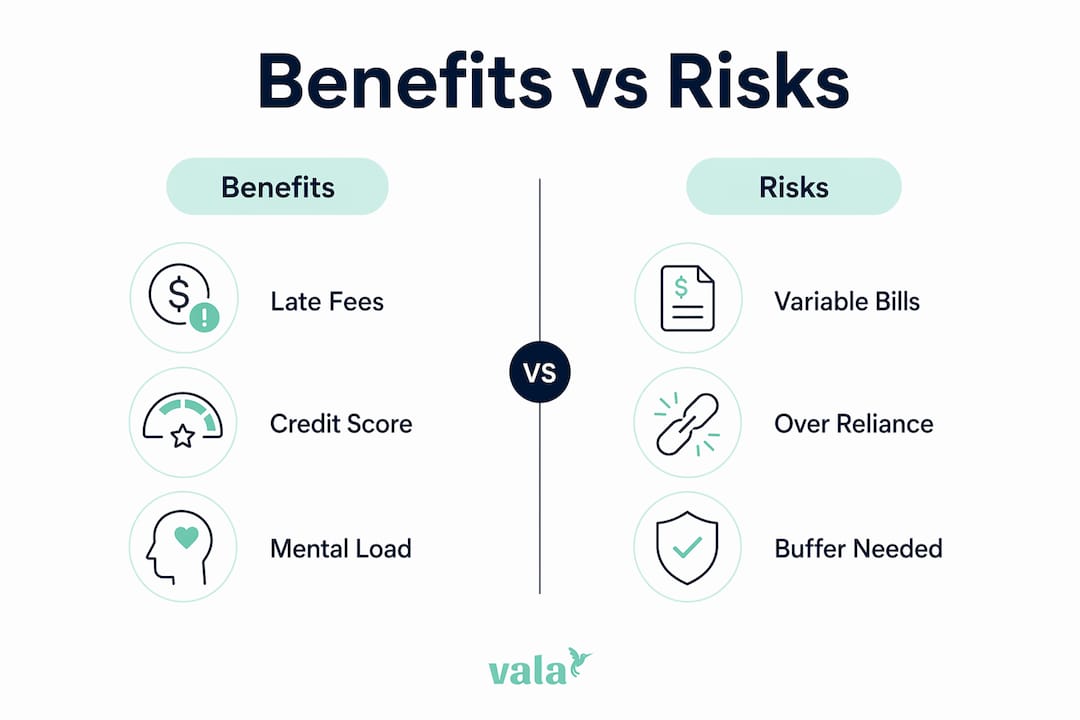
Infographic comparing benefits and risks of automatic bill tracking

Read-only syncing connects to your bank and credit card accounts through secure data aggregators. The app reads your transaction history, identifies recurring charges, and builds a bill calendar. Monarch Money and Zumfi both use this approach, offering calendar views and price alert features that flag when a subscription increases in price or a new recurring charge appears.

Direct payment authorization goes one step further. You grant the app or your bank permission to initiate payments on your behalf. This is how traditional bank autopay works, and it is also how apps like Empower and Rocket Money handle bill payments.

Here is a breakdown of the key features to look for:

  • Due date calendar: Displays all upcoming bills in one view so you can plan cash flow around paydays
  • Price increase alerts: Notifies you when a recurring charge goes up, which is common with streaming services and insurance renewals
  • Insufficient funds warnings: Checks your account balance before a payment is scheduled and alerts you if funds are low
  • Subscription detection: Scans transaction history to surface recurring charges you may have forgotten about
  • Payment scheduling: Lets you set payment dates that align with your paycheck deposits

The difference between a reminder-only system and a fully automated one is significant. Reminder apps tell you a bill is due. Automated systems pay it for you. Both have a place in a healthy financial setup, and the right choice depends on how much control you want to maintain.

What are the benefits and risks of automatic bill tracking?

The benefits of automatic bill tracking are concrete and measurable. The risks are real too, but manageable with the right setup.

Key benefits

Late fee elimination is the most immediate win. At $25–$40 per missed payment, even avoiding two or three late fees per year pays for most premium app subscriptions. Over a full year of consistent misses, the savings can reach close to $1,000.

Credit score protection is the longer-term benefit. Because payment history drives 35% of your FICO score, consistent on-time payments are one of the most reliable ways to build or maintain good credit. Automation removes the human error that causes most missed payments.

Mental load reduction is underrated. Automating bills frees mental energy that you would otherwise spend remembering due dates, logging into portals, and worrying about whether a payment went through. That freed attention can go toward budgeting, saving, or investing instead.

Risks to watch

Automating variable bills without monitoring is the most common mistake. Utility bills, phone bills, and insurance premiums can change month to month. If your balance is tight and a bill comes in higher than expected, automating variable bills without monitoring can trigger an overdraft and a fee that wipes out the savings you were trying to protect.

Over-reliance on automation is the other risk. Some users set up autopay and never check their accounts again. Subscriptions accumulate, prices increase, and billing errors go unnoticed for months.

Pro Tip: Keep at least one month’s worth of fixed expenses as a buffer in your checking account. This single habit prevents the majority of overdraft issues that come from automated payments hitting before your paycheck clears.

Financial experts recommend a hybrid automation strategy: automate fixed, predictable expenses completely, and keep variable expenses on minimum autopay or manual control. This gives you the reliability of automation without the blind spots.

How to set up automatic bill tracking effectively

Setting up a system that works requires more than downloading an app and connecting your bank. Follow these steps to build a setup that protects you from overdrafts and missed payments.

  1. List every recurring bill. Write down every monthly charge: rent or mortgage, utilities, insurance, subscriptions, loan payments, and credit card minimums. Include the amount, due date, and whether the amount is fixed or variable.

  2. Categorize bills as fixed or variable. Fixed bills like rent and loan payments are safe to automate fully. Variable bills like electricity and phone plans need monitoring before you automate them.

  3. Connect your accounts to a tracking app. Use a tool like Monarch Money, Empower, or Valapoint to sync your bank and credit card accounts. The app will detect most recurring charges automatically.

  4. Set up autopay for fixed bills. Use your bank’s autopay feature or the biller’s own portal for fixed expenses. Schedule payments two to three days after your paycheck deposits to avoid timing mismatches.

  5. Set reminders for variable bills. For bills that change month to month, use app alerts to notify you three to five days before the due date. Review the amount before it processes.

  6. Build a cash buffer. Maintain at least one month’s worth of bill payments in your checking account. This buffer method safeguards against timing mismatches with paychecks and prevents overdrafts.

  7. Schedule a monthly review. Spend 15 minutes each month checking your bill calendar. Look for price increases, new subscriptions, and any charges that look unfamiliar.

Pro Tip: Align your payment due dates with your paycheck schedule whenever possible. Most billers will let you change your due date with a single phone call or online request. This one change eliminates most cash flow timing problems.

Understanding budget and spending before relying on automation is critical. Automation enforces structure, but it cannot fix a budget that does not have enough room for all your bills. Know your numbers first.

Which automatic bill tracking tools are worth using?

The right tool depends on whether you want reminders only, full autopay, or a complete personal finance dashboard. Here is a comparison of the most widely used options.

App Cost Key features Best for
Monarch Money $14.99/month Bill calendar, subscription tracking, AI analysis Full financial dashboard users
Empower Free (investing features extra) Bill tracking, net worth, cash flow alerts Users who want free core features
Rocket Money Free or $6–$12/month Bill negotiation, cancellation, autopay Subscription management focus
Zumfi Free Price alerts, recurring charge detection Simple bill monitoring

A few factors matter beyond the feature list:

  • Bank integration: The app needs to connect reliably to your specific bank and credit card accounts. Check compatibility before committing.
  • Security: Look for apps that use bank-level 256-bit encryption and read-only access for syncing. Direct payment features require a higher level of trust.
  • Interface clarity: A bill calendar you will actually check is more valuable than a feature-rich app you find confusing.

For a deeper look at how these apps compare across budgeting and expense categories, the best budgeting and tracking apps guide covers the full landscape. You can also explore how AI detects spending patterns to understand what the smarter apps are doing behind the scenes.

The benefits of automated expense tracking extend beyond bills alone. The best tools connect bill tracking to your broader budget so you can see how fixed obligations affect what you have left for savings and discretionary spending.

Key takeaways

Automatic bill tracking works best when it combines full automation for fixed bills with active monitoring for variable ones.

Point Details
Payment history is critical 35% of your FICO score depends on on-time payments, making automation a credit protection tool.
Late fees add up fast Missing payments costs $25–$40 per incident, reaching nearly $1,000 annually without a system.
Use a hybrid approach Automate fixed bills fully and monitor variable bills manually to prevent overdrafts.
Build a cash buffer Keep one month of bill expenses in checking to protect against timing mismatches.
Review monthly Spend 15 minutes each month checking for price increases, new charges, and billing errors.

Automation is a tool, not a substitute for knowing your finances

I have worked with enough personal finance setups to say this clearly: automation is only as good as the financial foundation underneath it. People who set up autopay before they understand their cash flow often discover the problem the hard way, through an overdraft notice or a credit card balance that crept up while they were not looking.

The mental energy freed by automation is real and valuable. But that energy needs to go somewhere productive. The best users of bill automation are not the ones who forget about their finances. They are the ones who use automation to handle the routine so they can focus on the decisions that actually build wealth.

My honest recommendation: start with a read-only tracking app before you turn on any autopay. Spend one month just watching where your money goes and when bills hit. Then automate the fixed bills you fully understand, and keep your hands on the variable ones until you have seen enough months of data to trust the pattern.

Personal finance automation benefits are real across every age group, but they compound fastest for people who treat automation as a monitoring system, not a hands-off solution. The goal is confident control, not passive delegation.

— SaverStride

Take control of your bills with Valapoint

Valapoint is an AI-powered personal finance app that brings your bills, budget, and savings goals into one clear view. You can sync your bank accounts and credit cards, track recurring expenses automatically, and get alerts before payments are due.
https://valapoint.com

Valapoint goes beyond basic bill reminders. The app surfaces hidden spending patterns, flags subscriptions you may have forgotten, and connects your bill tracking to your broader budget so you always know where you stand. Whether you are managing finances solo, as a couple, or in a group, Valapoint gives you the clarity to stay ahead of every payment. Try the Vala personal finance app and see how much easier managing monthly bills can be.

FAQ

What is automatic bill tracking?

Automatic bill tracking is a system that uses software to detect recurring charges, organize due dates, and either remind you to pay or initiate payments automatically. It replaces manual bill management with a consistent, technology-driven process.

How does automatic bill tracking protect your credit score?

Payment history accounts for 35% of your FICO score. Automating bill payments removes the human error that causes missed payments, which can drop your score by 60–110 points per incident.

What is the biggest risk of automating bill payments?

The biggest risk is automating variable bills without monitoring your account balance. If a bill comes in higher than expected and your balance is low, the payment can trigger an overdraft fee.

Should I automate all my bills at once?

No. Start by automating fixed, predictable bills like rent and loan payments. Keep variable bills like utilities on manual review until you have enough monthly data to understand the typical range.

How often should I review my automated bill setup?

A monthly review of 15 minutes is enough for most people. Check for price increases, unfamiliar charges, and any bills that processed at unexpected amounts.


Trip Budget Planner: Your Complete Guide for 2026

A trip budget planner is a structured financial tool designed to estimate, organize, and track travel expenses like flights, lodging, and activities before and during a trip. In the travel finance world, the recognized term is “travel budget framework,” but “trip budget planner” is how most travelers search for and use these tools in practice. Whether you rely on a Google Sheets template, a dedicated app like YNAB or Travel Spend, or a travel expense calculator, the goal is the same: know where your money is going before it disappears.

What is a trip budget planner and why does it matter?

A trip budget planner is more than a spending record. It is a decision tool that shapes your destination choice, travel timing, and overall style before you book a single flight. That distinction matters. Most travelers treat budgeting as a post-trip accounting exercise. The ones who actually stay on budget treat it as a pre-trip planning document.

Travel strategist Michael Kovnick identifies the most common mistake travelers make: treating all travel spending as one single amount. That approach creates confusion after the trip and makes it nearly impossible to identify where money was wasted. Categorizing your spend by type gives you real visibility and real control.

The core function of any travel budget framework is simple. You set a total spending limit, break it into categories, track actual costs against those categories, and adjust as you go. Tools like Google Sheets, Excel, and apps like Tripcoin or Travel Spend each support this process in different ways.

Hands sorting travel budget category cards

What should you include in a trip budget?

A complete trip budget covers more than flights and hotels. Leaving out even one category is how travelers end up $300 over budget on a trip they thought was fully planned.

Here are the core categories every travel budget needs:

  • Transportation: Flights, trains, buses, rental cars, and local rideshares
  • Lodging: Hotels, hostels, Airbnb, or any overnight accommodation
  • Food and drink: Daily meals, coffee, snacks, and restaurant dinners
  • Activities: Tours, museum entries, national park fees, and entertainment
  • Travel insurance: Medical, trip cancellation, and baggage coverage
  • Connectivity: SIM cards or eSIM plans for international data access

Beyond those core categories, silent costs like airport transfers, baggage fees, city taxes, and mandatory eSIM costs are the most frequent causes of budget overruns. These expenses are real and predictable, yet most travelers skip them entirely when planning.

Pro Tip: Budget for a travel eSIM data plan as a fixed line item. International roaming charges or last-minute SIM purchases at airports cost significantly more than pre-purchased eSIM plans.

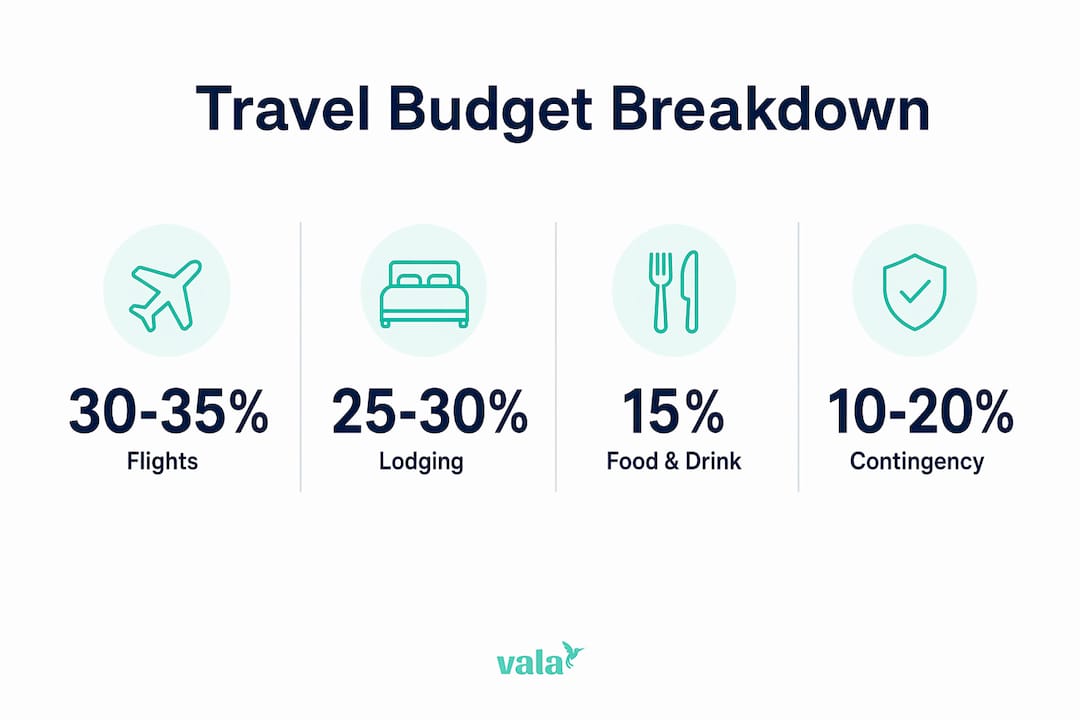
Infographic showing travel budget percentage allocations

The table below shows a sample budget breakdown for a 10-day international trip at a mid-range spending level:

Category Estimated % of Total Budget
Flights 30–35%
Lodging 25–30%
Food and drink 15–20%
Activities 10–15%
Transport (local) 5–8%
Contingency buffer 10–15%

Travel industry guidance recommends adding a contingency buffer of 10–20% to any travel budget. For complex international trips, 15% is the safest choice. That buffer covers currency fluctuations, price changes, and last-minute itinerary edits.

How do trip budget planners help with solo and group travel?

Solo travel budgeting is straightforward. You track one person’s spending across your chosen categories and adjust when needed. Group travel is a different challenge entirely. Shared expenses like accommodation, rental cars, and group dinners create confusion fast if there is no system in place.

A good travel budget planner for groups does three things:

  • Tracks shared costs separately from individual spending so everyone sees what is owed
  • Splits expenses fairly based on who paid and who benefited
  • Settles balances clearly at the end of the trip or in real time

Apps designed for group expense splitting remove the awkward money conversations that ruin trips. Instead of someone keeping a mental tally, every shared purchase is logged, split, and visible to the whole group.

For couples, the benefit is slightly different. A shared budget view creates financial transparency without requiring constant check-ins. Both people can see the running total, which reduces anxiety and prevents one person from unknowingly overspending.

Pro Tip: Assign one person in the group to log shared expenses daily. Waiting until the end of the trip to reconstruct who paid for what leads to errors and disagreements.

Individual travelers benefit most from expense tracking best practices that focus on daily logging rather than weekly summaries. Small purchases add up fast. A coffee here, a metro ticket there, and a souvenir or two can add $30 to $50 per day that never gets recorded.

What are the best tools for creating a trip budget planner?

The right tool depends on how much control you want and how much setup time you are willing to invest.

Tool Type Best For Key Limitation
Google Sheets / Excel Full customization, offline access Manual data entry, no automation
Dedicated apps (Travel Spend, Tripcoin) Real-time tracking, currency conversion Limited group features
YNAB Deep budget methodology, category rules Subscription cost, learning curve
AI-powered apps (Valapoint) Automated tracking, spending insights Requires account setup
Online calculators Quick estimates before booking No ongoing tracking

Google Sheets and Excel templates work well for travelers who want full control over their layout. You can build an overview tab for the total budget and a daily spending tab for real-time logging. Experienced travelers maintain both tabs, logging expenses in local currency daily with current exchange rates. That approach prevents missed small expenses and gives accurate totals at any point in the trip.

Dedicated apps like Travel Spend and Tripcoin handle currency conversion automatically and display running totals by category. They are faster to use on the road than a spreadsheet but offer less flexibility for custom categories.

AI-powered budgeting tools take this further. They analyze your spending patterns, flag unusual expenses, and surface insights you would not catch manually. AI-personalized budgets adapt to your actual behavior rather than forcing you into a rigid template. That is a meaningful advantage for travelers whose spending varies significantly by day or destination.

Flights typically make up 35% of an average traveler’s budget, but booking four months ahead can reduce that share to about 22% of total costs. That kind of saving gives you real room to upgrade other parts of the trip.

How to create a flexible, realistic trip budget

Building a trip budget that actually works requires a specific sequence. Here is the process that holds up in practice:

  1. Set your total spending limit first. Start with the number you are genuinely comfortable spending, not an aspirational figure. This is your hard ceiling.
  2. Assign amounts to each category. Use the percentage breakdown from the table above as a starting point, then adjust based on your destination’s cost of living.
  3. Add a 15% contingency buffer. Calculate 15% of your total and set it aside as a separate line item. Do not fold it into other categories.
  4. Research actual costs before you finalize. Check current flight prices, hotel rates, and activity fees for your specific destination and travel dates.
  5. Log expenses daily during the trip. Use a dedicated tab or app to record every purchase in local currency. Weekly logging misses too much.
  6. Reallocate savings when they appear. If your flights came in under budget, redirect that surplus to activities or a nicer dinner. Do not leave savings idle.

Food budgeting deserves special attention. Assigning spending levels by day type works better than a flat daily food budget. Plan for cheap days (street food, grocery stores), mid-range days (casual restaurants), and one or two splurge meals. That approach matches how people actually eat on trips and prevents the budget failure that comes from fatigue or hunger pushing you toward expensive options.

Pro Tip: A realistic travel budget is a living document. Review it every two to three days during your trip and adjust your remaining categories based on actual spending. This keeps you in control without requiring obsessive daily tracking.

Flexibility is the feature most travelers forget to build in. A budget that has no room to move creates anxiety. A budget with a clear contingency buffer and reallocation rules gives you confidence to spend on the things that matter most.

Key takeaways

A trip budget planner works best when it combines clear category assignments, a 15% contingency buffer, and daily expense tracking rather than a single lump-sum approach.

Point Details
Define categories upfront Assign specific amounts to flights, lodging, food, activities, and hidden costs before booking.
Add a contingency buffer Set aside 15% of your total budget for unexpected costs like fees, taxes, and price changes.
Track expenses daily Log purchases in local currency every day to catch small costs before they compound.
Reallocate savings actively Move budget surpluses from underspent categories to upgrade experiences elsewhere.
Use the right tool Match your tool to your trip: spreadsheets for control, apps for automation, AI tools for insight.

Why I think most travelers budget wrong

Most travelers I have observed make the same mistake: they set a total trip number and then spend without tracking until the money runs out. The budget exists on paper but does nothing during the trip.

The real value of a travel budget framework is not the number you set. It is the category structure underneath it. Treating all travel spending as a blob leads to confusion post-trip and zero ability to course-correct mid-journey. When you know your food category is $40 per day and you have spent $60 today, you make a different choice tomorrow. That is the mechanism that actually keeps you on budget.

The other mistake is treating the budget as a rigid contract. A budget that cannot flex is a budget you will abandon. Build in the contingency buffer, give yourself permission to reallocate savings, and check in every few days rather than obsessing daily. That balance between structure and flexibility is what separates travelers who enjoy their trips from those who spend the whole time anxious about money.

My honest recommendation: start simple. A two-tab Google Sheet with an overview and a daily log beats a complex app you will stop using by day three. Add automation and AI insights once you have the habit of tracking. The tool matters less than the discipline of using it.

— SaverStride

Take control of your travel spending with Valapoint

Planning your next trip is exciting. Watching your budget fall apart mid-trip is not.

https://valapoint.com

Valapoint is an AI-powered personal finance app built for exactly this situation. You can set a trip budget goal, track every expense by category in real time, and split shared costs with travel partners without the awkward math. Valapoint’s AI surfaces spending patterns you would miss on your own, so you know where your money is going before it is gone. Whether you are traveling solo or with a group, the Vala personal finance app gives you the visibility and control to travel confidently within your budget.

FAQ

What is a trip budget planner used for?

A trip budget planner is a financial tool used to estimate, organize, and track travel expenses like flights, lodging, food, and activities before and during a trip. Its core purpose is to keep total spending within a set limit.

How much contingency should I add to a travel budget?

Travel industry guidance recommends adding a 10–20% contingency buffer to any travel budget, with 15% being the safest choice for complex or international trips.

What expenses do most travelers forget to budget for?

Airport transfers, baggage fees, city taxes, SIM or eSIM costs, and travel insurance are the most commonly overlooked expenses. These silent costs are a leading cause of budget overruns.

Is a spreadsheet or an app better for trip budgeting?

Spreadsheets like Google Sheets offer full customization and work offline, while apps like Travel Spend and Tripcoin handle currency conversion automatically. AI-powered tools like Valapoint add automated tracking and spending insights for travelers who want more than manual logging.

How do I split travel costs fairly in a group?

Use a dedicated group expense tool that logs shared purchases, splits them by person, and tracks running balances. Assigning one person to log shared expenses daily prevents errors and disputes at the end of the trip.

What Is a Spending Category? Your 2026 Guide

A spending category is a labeled group that organizes related expenses so you can see exactly where your money goes each month. Think of it as a filing system for your finances. Without these labels, your bank statement is just a list of numbers. With them, it becomes a clear picture of your habits. Financial experts recommend starting with 8–12 core categories to keep things manageable without losing detail. Apps like Valapoint use these categories automatically, sorting your transactions the moment they hit your account. The standard industry term for this practice is expense categorization, and it sits at the heart of every effective personal budget.


What is a spending category and why does it matter?

A spending category is defined as any label that groups similar expenses for tracking and analysis. Housing, food, transportation, and entertainment are classic examples. Spending categories transform raw bank statements into readable pictures of where money actually goes, making it far easier to find waste and hit savings targets.

Woman analyzing expense categories on laptop

The value is practical, not theoretical. When you know that $600 went to “dining out” last month, you have something to act on. Without a category label, that $600 is buried across dozens of individual transactions at restaurants, coffee shops, and food delivery apps. Categorization turns noise into signal.

Expense categories also connect your daily spending to your bigger financial goals. Categories show where money goes; goals describe why it is allocated. Both are necessary for a budget that actually works. A category without a goal is just accounting. A goal without category tracking is just wishful thinking.


What are the main types of spending categories?

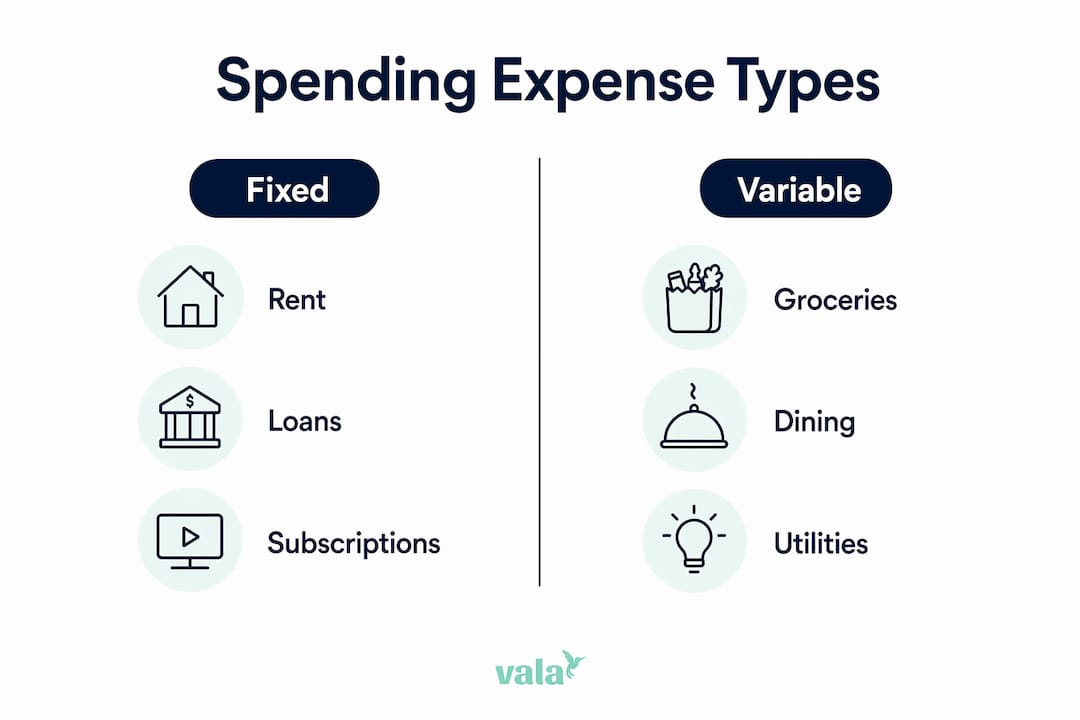
All expenses fall into two primary types: fixed and variable. Understanding the difference shapes how you budget for each one.

Fixed expenses

Fixed expenses stay the same every month. Rent, mortgage payments, car loans, and subscription services like Netflix or Spotify all qualify. These are predictable, so budgeting for them is straightforward. You know the amount in advance and can plan around it.

Infographic comparing fixed and variable expense types

Variable expenses

Variable expenses change from month to month. Groceries, gas, utilities, and dining out all fluctuate based on your behavior and circumstances. These categories require closer attention because they are where most overspending happens. A $50 grocery run can quietly become $300 if you are not tracking it.

Periodic expenses

Periodic expenses are easy to forget because they do not show up every month. Annual insurance premiums, holiday gifts, car registration fees, and back-to-school supplies all fall here. The smart move is to divide the annual cost by 12 and set that amount aside monthly so the expense never catches you off guard.

Miscellaneous expenses

A miscellaneous category handles anything that does not fit neatly elsewhere. Using a buffer category for irregular expenses prevents you from getting stuck on hard-to-classify items and keeps your tracking consistent over time.

Type Definition Examples
Fixed Same amount every period Rent, car loan, subscriptions
Variable Fluctuates month to month Groceries, gas, dining out
Periodic Irregular, often annual Gifts, insurance premiums, fees
Miscellaneous Unclassified or one-off Random repairs, unusual purchases

Pro Tip: Assign every expense to a type before you assign it to a specific category. Knowing whether a cost is fixed or variable tells you immediately how much control you have over it.


Spending category examples and how to build your own list

The ten core expense categories that cover most people’s budgets are housing, food, transportation, utilities, insurance, debt payments, savings, health, personal care, and entertainment. These ten buckets handle the vast majority of what most adults spend money on each month.

Subcategories add precision where you need it. Food, for example, splits naturally into “groceries” and “dining out.” That split matters because one is a need and the other is a want. Knowing which is which helps you make faster decisions when you need to cut back.

Here is a practical starter list you can adapt:

  • Housing: Rent or mortgage, renters or homeowners insurance, repairs
  • Food: Groceries, dining out, coffee shops, food delivery
  • Transportation: Gas, car payment, public transit, parking, rideshare
  • Utilities: Electric, water, internet, phone
  • Health: Insurance premiums, prescriptions, gym membership, copays
  • Debt: Student loans, credit card minimums, personal loans
  • Savings: Emergency fund, retirement contributions, short-term goals
  • Entertainment: Streaming services, events, hobbies
  • Personal: Clothing, haircuts, toiletries
  • Miscellaneous: Anything that does not fit above

Beginners may start with 7–8 essential categories; advanced budgeters tracking side hustles or complex goals might use 15 or more. The right number depends on your life, not a formula.

These categories also map directly onto popular budgeting frameworks. The 50/30/20 rule, for instance, groups your categories into needs (50%), wants (30%), and savings or debt (20%). Knowing your category totals makes applying that framework a five-minute exercise instead of an hour-long calculation.

Pro Tip: Organize categories by purpose, meaning where the money goes and why, rather than by merchant or payment method. Buying cleaning supplies and snacks at Target in one trip? Split the transaction by purpose: household supplies and groceries. That keeps your data clean and your insights accurate.


How to categorize spending consistently

Consistency in categorization matters more than perfect taxonomy. A system where Amazon always maps to “household supplies” is more useful than one where you reclassify it based on what you bought that day. Reliable data requires reliable rules.

Here are six best practices that make consistent categorization a habit rather than a chore:

  1. Set a rule for every recurring merchant. Decide once where Starbucks, Amazon, and your gym belong. Write it down. Never revisit it unless your spending habits genuinely change.
  2. Limit your category count. Adding more than 15 categories often causes categorization fatigue, which leads to abandoning the budget entirely. Start lean and expand only when you have a specific reason.
  3. Assign by intent, not by store. Categorize purchases by purpose rather than by merchant or payment channel. A supermarket trip that includes both groceries and a birthday card should be split between “food” and “personal.”
  4. Keep a miscellaneous category. Do not let one confusing transaction derail your whole system. Drop it in miscellaneous, move on, and review it at the end of the month.
  5. Review categories monthly. Spend 10 minutes at the end of each month checking that auto-categorized transactions landed in the right place. Catching errors early prevents compounding inaccuracies.
  6. Adjust categories annually. Your life changes. A category that made sense at 22 may not fit at 32. Review your full list once a year and retire or rename anything that no longer reflects how you actually live.

Limiting categories reduces user burden and increases budget adherence. That is not an opinion. It is a pattern observed consistently across personal finance research. Simpler systems get used. Complex ones get abandoned.


How technology makes spending category management easier

AI and machine learning in personal finance apps improve the accuracy of spending category assignments and help link expenses directly to financial goals. That means less manual work and more reliable insight into where your money actually goes.

Valapoint’s AI expense tracker reads your transactions in real time and assigns them to the correct category automatically. It also flags unusual spending patterns, so you notice a problem before it becomes a real financial setback. Apps like Valapoint also link spending categories to savings goals, so every dollar you track is connected to something you are working toward.

Key advantages of using technology for expense categorization:

  • Auto-classification removes the need to manually sort every transaction
  • Pattern detection surfaces spending trends you would not notice on your own
  • Goal linking connects your category totals to debt payoff or savings targets
  • Real-time alerts notify you when a category is approaching its limit
  • Historical data lets you compare this month’s spending to last month or last year

One caution: always review auto-categorized transactions regularly. Machine learning improves over time, but no algorithm is perfect on day one. A quick monthly review, as described in expense tracking best practices, keeps your data accurate and your budget trustworthy.


Key takeaways

Spending categories are the foundation of any budget that actually works. Without them, you are guessing. With them, you are deciding.

Point Details
Core definition A spending category is a label that groups related expenses for clear tracking and analysis.
Four main types Fixed, variable, periodic, and miscellaneous categories cover every expense you will encounter.
Right category count Start with 7–12 categories to avoid fatigue; expand only when your financial life requires it.
Consistency over perfection Assign the same merchant to the same category every time for reliable, usable data.
Technology as a partner AI tools like Valapoint auto-classify transactions and link spending data to your financial goals.

Why i think most people overcomplicate spending categories

The most common mistake I see is building a category system that looks impressive on paper but falls apart by week three. People create 20 subcategories, color-code everything, and then stop tracking entirely because it takes too long. That is not a budgeting problem. That is a design problem.

The best category system is the one you will actually use six months from now. For most people, that means starting with eight categories and resisting the urge to add more until the habit is solid. Perfection is the enemy of consistency here. A rough system you maintain beats a perfect system you abandon.

I have also noticed that people underestimate how much clarity comes from just naming things. When you label a transaction “dining out” instead of letting it sit as a raw charge from a restaurant, something shifts. You start to see patterns. You start to make different choices. The category does not change your spending automatically. But it makes your spending visible, and visibility is where change begins.

My honest recommendation: start with Valapoint’s auto-categorization, let it do the heavy lifting for the first 30 days, and then review what it found. You will learn more about your spending habits in one month of tracked data than in years of vague awareness. Then adjust your categories to match your real life, not some idealized budget template.

— SaverStride


Take control of your spending with Valapoint

Understanding expense categories is the first step. Tracking them consistently is where the real progress happens.

https://valapoint.com

Valapoint’s personal finance app automatically categorizes your transactions the moment they occur, links your spending data to your savings and debt goals, and surfaces the patterns that cost you money without you realizing it. You do not need to build a spreadsheet or manually sort receipts. Valapoint handles the classification so you can focus on the decisions. Whether you are just starting to budget or refining a system you already have, Valapoint gives you the clarity to move forward with confidence. Start tracking your spending and see exactly where your money goes.


FAQ

What is a spending category in simple terms?

A spending category is a label that groups similar expenses together, such as housing, food, or transportation, so you can see exactly where your money goes each month.

How many spending categories should i use?

Financial experts recommend 8–12 categories for most budgeters. Beginners can start with as few as 7–8, while advanced users tracking complex goals may use 15 or more.

What are the main types of expense categories?

The four main types are fixed (consistent costs like rent), variable (fluctuating costs like groceries), periodic (irregular costs like annual fees), and miscellaneous (unclassified expenses).

How do i categorize spending consistently?

Assign the same merchant to the same category every time, organize by purchase purpose rather than store name, and review your auto-categorized transactions at least once a month.

Does technology help with spending category management?

Yes. AI-powered apps like Valapoint automatically classify transactions into spending categories, detect unusual patterns, and link your expense data to savings and debt payoff goals.

Top 5 Budget-Flow.app Alternatives 2026

Tracking expenses and splitting costs with others while staying on top of savings goals takes too much time and manual effort. Most apps limit bill splitting, require manual categorization, or gate advanced forecasting and automation features behind paid plans or region restrictions. This comparison lists pricing, automation, and shared expense features across five apps so you can choose one that fits your money management needs without trial and error.

Table of Contents

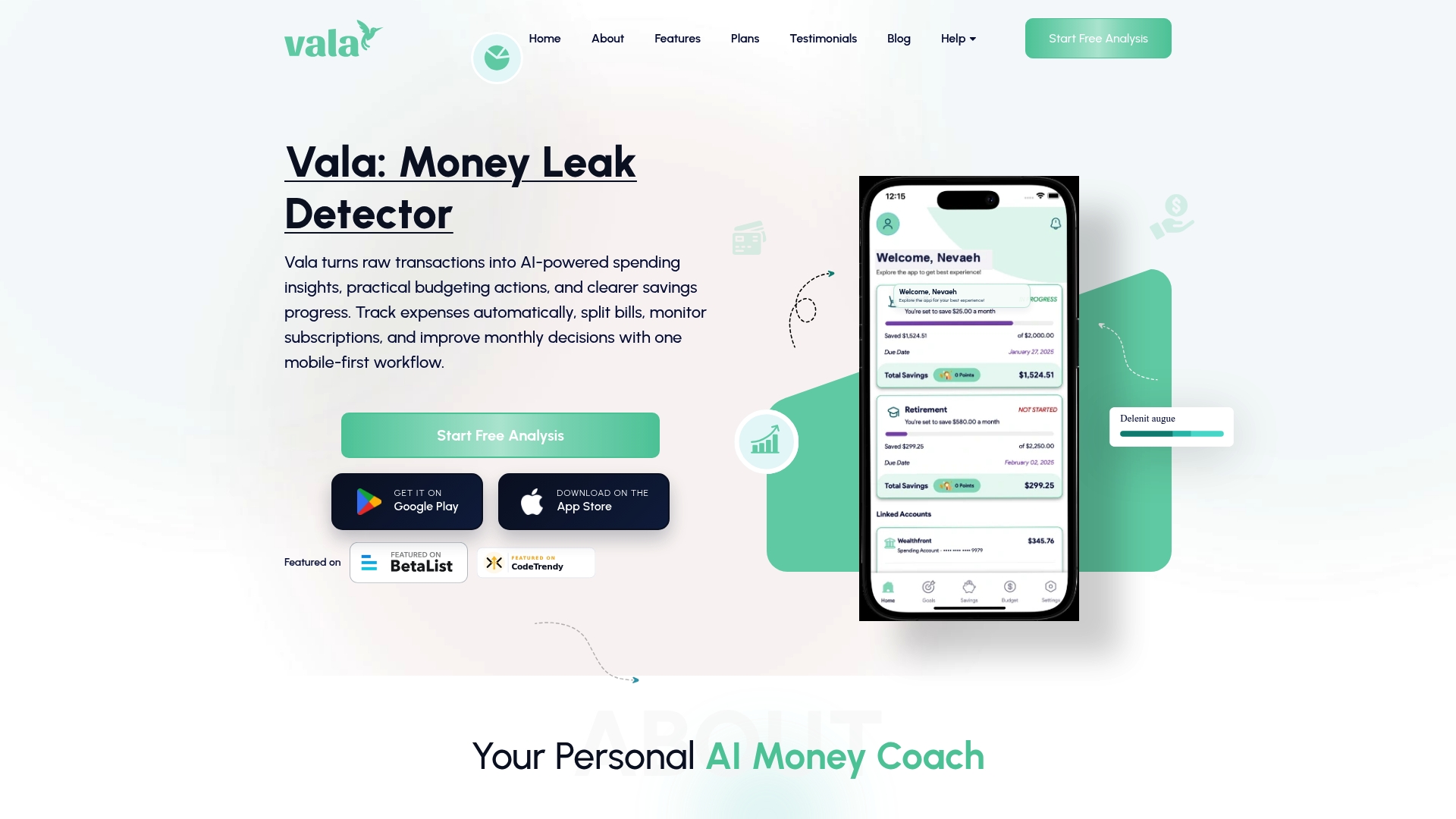
Vala

https://valapoint.com

At a Glance

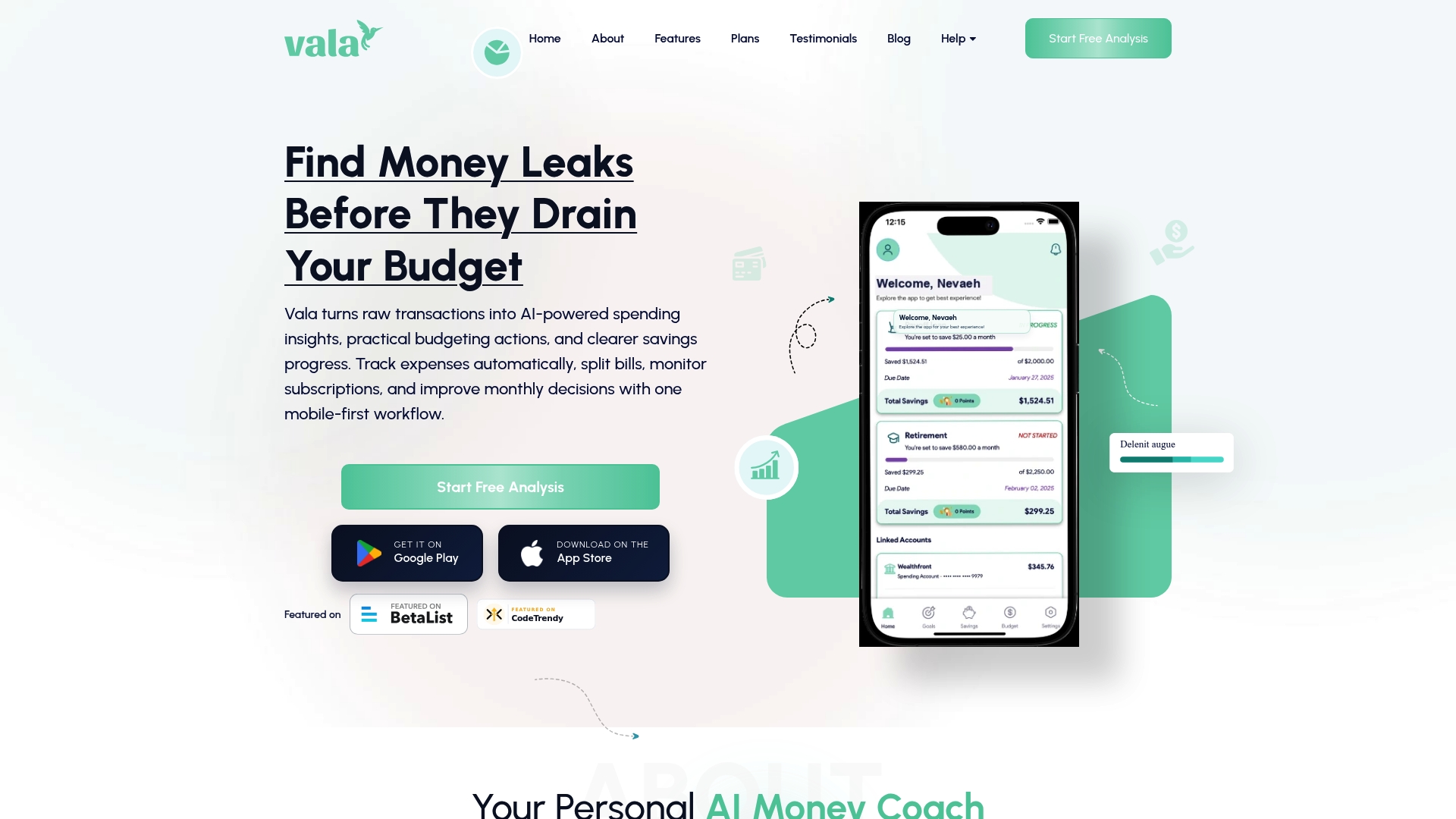
Automatic expense tracking, subscription monitoring, and built-in bill splitting work together in a single mobile first app. Vala uses AI to surface budgeting suggestions and spot spending trends. The app targets U.S. individuals, couples, and families who want clear daily money management.

Core Features

  • AI Coach App with real time budgeting suggestions that adjust to your income and habits. The coach gives short, actionable tips.

  • Automatic expense categorization and trend analysis so transactions arrive labeled and grouped for quick review. Categories update as your pattern changes.

  • Bill splitting for shared costs with partners or roommates. You can assign expenses and track who owes what.

  • Savings goal tracking with progress visualization to watch milestones and remaining amounts. Goals display clear progress and dates.

  • Secure bank account linking for transaction import so you see a full financial picture in one place.

Key Differentiator

The product pairs AI driven, actionable insights with first class support for shared expenses and goal tracking. That combination focuses on daily decisions and joint money management in a mobile first flow. For couples or families who share bills, this makes splitting and tracking routine costs straightforward.

Pros

  • Easy to use mobile first interface. The layout keeps daily tasks like categorizing and splitting fast.

  • Personalized AI insights for smarter spending. Suggestions adapt to your recent transactions and savings progress.

  • Shared budgeting features built for couples and families. You can compare individual and joint spending in one view.

  • Strong emphasis on security and privacy. Bank linking is positioned as secure and read only for transaction import.

  • Available in free and premium plans. You can start without paying and upgrade for deeper analysis.

Cons

  • Limited international support. The app is primarily tailored for U.S. users and may not handle non U.S. accounts well.

Notable Integrations

Vala supports bank account linking for transaction import so your spending and subscriptions appear automatically. That connection is the primary integration for reconciling balances and generating trends.

Who It’s For

You if you live in the U.S. and want an easy, AI powered app for daily expense tracking. Couples and families who share bills will find the split and shared views useful. You should prefer mobile first tools over manual spreadsheets or complex accounting apps.

Unique Value Proposition

The AI Coach App delivers real time budgeting suggestions tied to live transaction data. That feature trims decision time by suggesting moves you can act on immediately. For households splitting costs, the coach plus shared expense tracking reduces back and forth about who paid what. The result is clearer progress toward savings goals without extra bookkeeping.

Real World Use Case

A couple links both bank accounts to Vala, assigns shared subscriptions, and splits monthly rent and utilities. The app reminds them about upcoming bills and shows savings progress for a planned trip. They use the AI coach to trim small recurring charges and speed up reaching their goal.

Pricing

You can start for free and test core features including tracking, splitting, and basic AI suggestions. A premium upgrade unlocks deeper insights and extended goal analysis for users who want more detailed recommendations. No per seat pricing details are published in the product data.

Website: https://valapoint.com

PocketSmith

https://pocketsmith.com

At a Glance

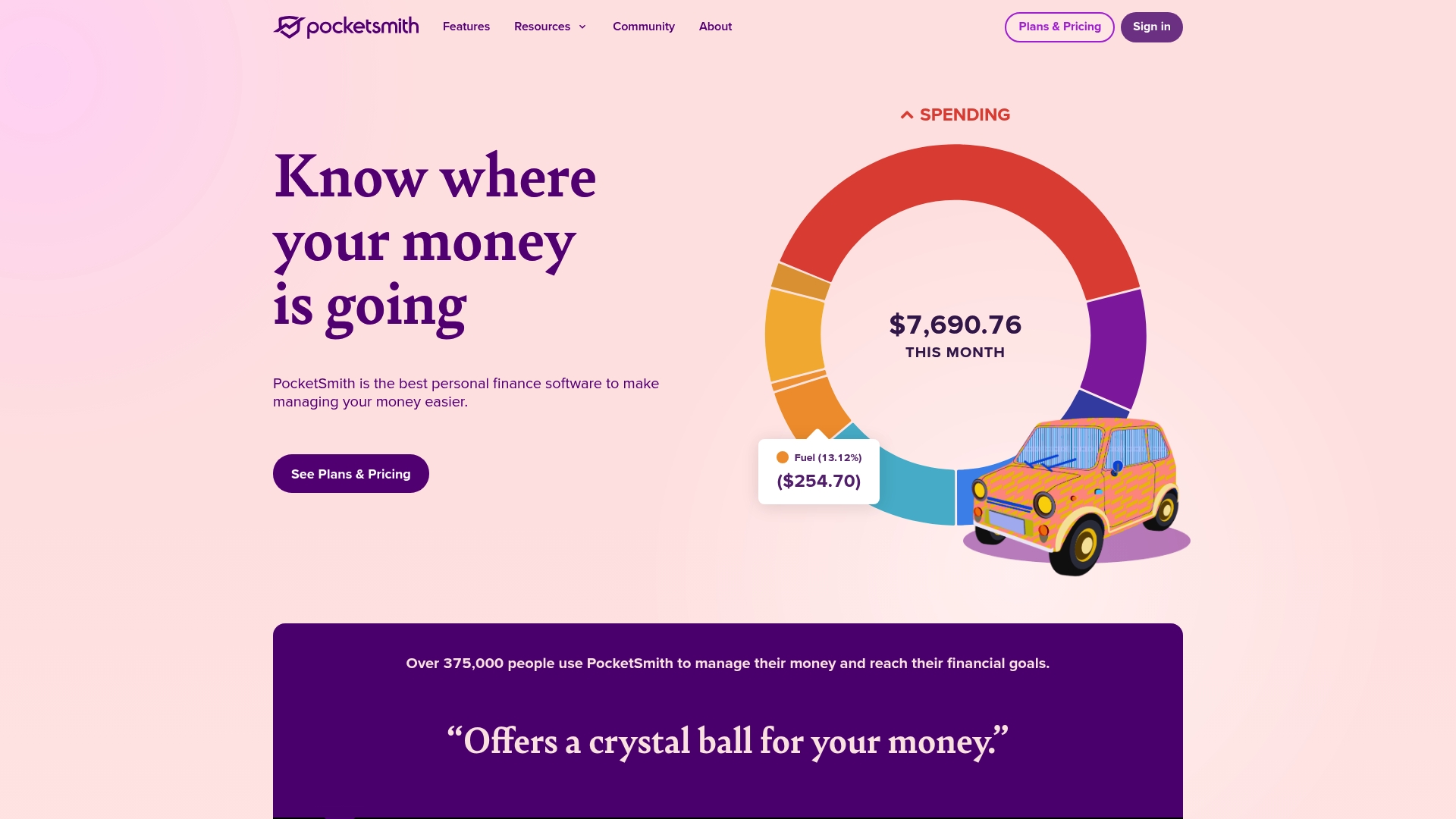
PocketSmith’s marketing materials state cash flow forecasting up to 60 years into the future. That long horizon aims to help you model retirement, big purchases, and legacy planning. The product pairs those forecasts with live account feeds and custom dashboards so you can check projected balances alongside current activity.

Core Features

PocketSmith offers automatic live bank feeds that let you pull transactions into one place. It supports multi currency accounts and global bank connections for people with finances across borders. You get transaction organization and search, plus custom dashboards and reports for income, expenses, and net worth. The platform also provides cash flow forecasting and a range of graphs that reveal future shortfalls or surpluses.

Key Differentiator

The standout claim is the extended forecasting horizon. PocketSmith emphasizes long term projection as the feature that separates it from ordinary budget trackers. That emphasis makes it useful when you want to plan decades ahead rather than only manage month to month.

Pros

  • Offers detailed forecasting and planning tools beyond basic budgeting. The forecasts help you test what if scenarios for housing, education, or retirement.
  • Supports accounts in multiple currencies and a wide range of bank connections. This matters if you hold accounts in several countries or currencies.
  • Customizable dashboards and visualizations let you focus on the numbers that matter. You can build views for cash flow, net worth, or upcoming bills.
  • Strong focus on security and data privacy. The vendor highlights active development and attention to keeping data safe.
  • The interface balances depth and usability for people who want comprehensive finance tools. You get advanced features without enterprise complexity.

Cons

  • Pricing may be a barrier for casual budgeters or those seeking entirely free tools. You can use a free plan with limits, but core features sit behind paid tiers.
  • The interface and feature set can feel complex for users who only need simple tracking. It requires time to learn and configure for your situation.
  • Integrations with non bank financial services are limited. That gap can create extra manual work for investments or third party accounts.

When It May Not Fit

If you only want a quick, no setup budget app, PocketSmith will likely feel heavy. Users who prefer one click simplicity or only occasional expense checks will find the learning curve too steep. Also, if you rely heavily on specialized investment or bill pay services, the limited non bank integrations may break your workflow.

Who It’s For

PocketSmith fits individuals and households who want forecast driven planning rather than just expense lists. It suits people preparing for long term goals, couples managing shared finances, and expatriates with accounts in multiple currencies. If you enjoy tweaking scenarios and visual reports, you will get value from this tool.

Real World Use Case

A small family uses PocketSmith to map monthly budgets, then projects savings for a home purchase over several years. They compare projected balances under different savings rates. That process gives them clear trade offs and a calendar for when their down payment target becomes realistic.

Pricing

Pricing starts at USD $9.99/month billed annually for the Foundation plan. There are higher tiers that unlock more accounts, longer forecasting options, and additional reporting. A free plan is available with limited features for casual users.

Website: https://pocketsmith.com

Era

https://era.app

At a Glance

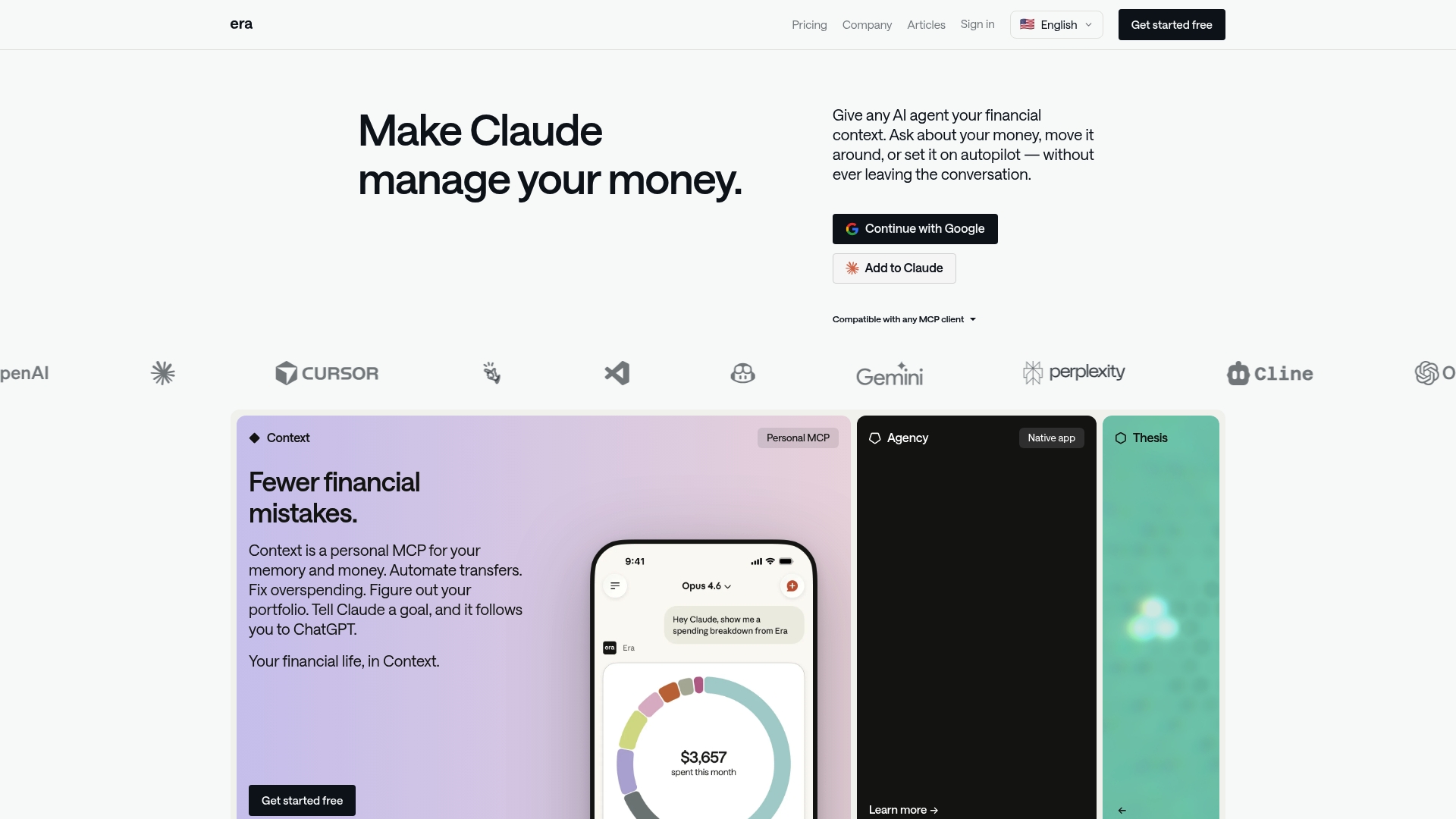
Era connects your accounts to any MCP compatible AI, letting multiple AI assistants read and act on your financial data. The platform groups that access under products named Context, Agency, and Thesis for data, proactive money management, and investment research. Era highlights privacy by stating it does not sell user data.

Core Features

  • Connects financial accounts to AI assistants that support MCP, centralizing data for third party agents.
  • Automates transfers and financial actions through AI driven rules and triggers.
  • Provides proactive account monitoring and automated management via Agency.
  • Offers investment research and trading support in Thesis.
  • Uses bank grade encryption and multi aggregator integration for broad institution coverage.

Key Differentiator

Era uses open standards to let any MCP compatible AI connect to your finances. That means you can experiment with different AI agents while keeping a single, encrypted data layer. For users who want to mix and match assistants rather than lock into one vendor, Era makes that workflow possible.

Pros

  • Flexible AI support. You are not limited to one assistant because Era supports any MCP compatible AI.

  • Time saved on routine money tasks. The automation tools handle recurring transfers and basic bill actions.

  • Unified financial view. Era consolidates accounts and presents insights so you can see balances and flows in one place.

  • Privacy focus. The vendor states it does not sell user data and prioritizes secure storage and encryption.

  • Freemium entry. You can start with a free account and test basic features before moving to paid tiers.

Cons

  • AI dependency for full value. Many advanced behaviors require a compatible assistant to be useful.

  • Technical setup. MCP integration can need extra steps that may frustrate less technical users.

  • Feature rollout. Some automation features are still coming and are not available yet.

  • Paid limits. Higher automation capacity and advanced tools live behind paid plans.

When It May Not Fit

If you prefer an app that works fully without any external AI, Era may not be a good match. Users who want simple, hands off budgeting without setup will find the MCP connection adds complexity. Also, teams or households that need plug and play features with no learning curve may prefer a more conventional personal finance app.

Who It’s For

Era fits tech savvy individuals and investors who want AI driven automation tied to their accounts. It also works for small business owners who accept an initial setup step to gain automated transfers and proactive monitoring. If you enjoy testing different AI assistants, Era lets you switch agents without moving account data.

Real World Use Case

A freelance designer links bank and payment accounts to Context to track income and expenses automatically. They use Agency to watch incoming deposits and trigger transfers to a tax savings account. For investment decisions, they run short research queries in Thesis before placing trades.

Pricing

Free access is available for basic accounts. Paid plans start at $7.99 per month and scale up to $79.20 per month for higher automation capacity and advanced features.

Website: https://era.app

Splitwise

https://splitwise.com

At a Glance

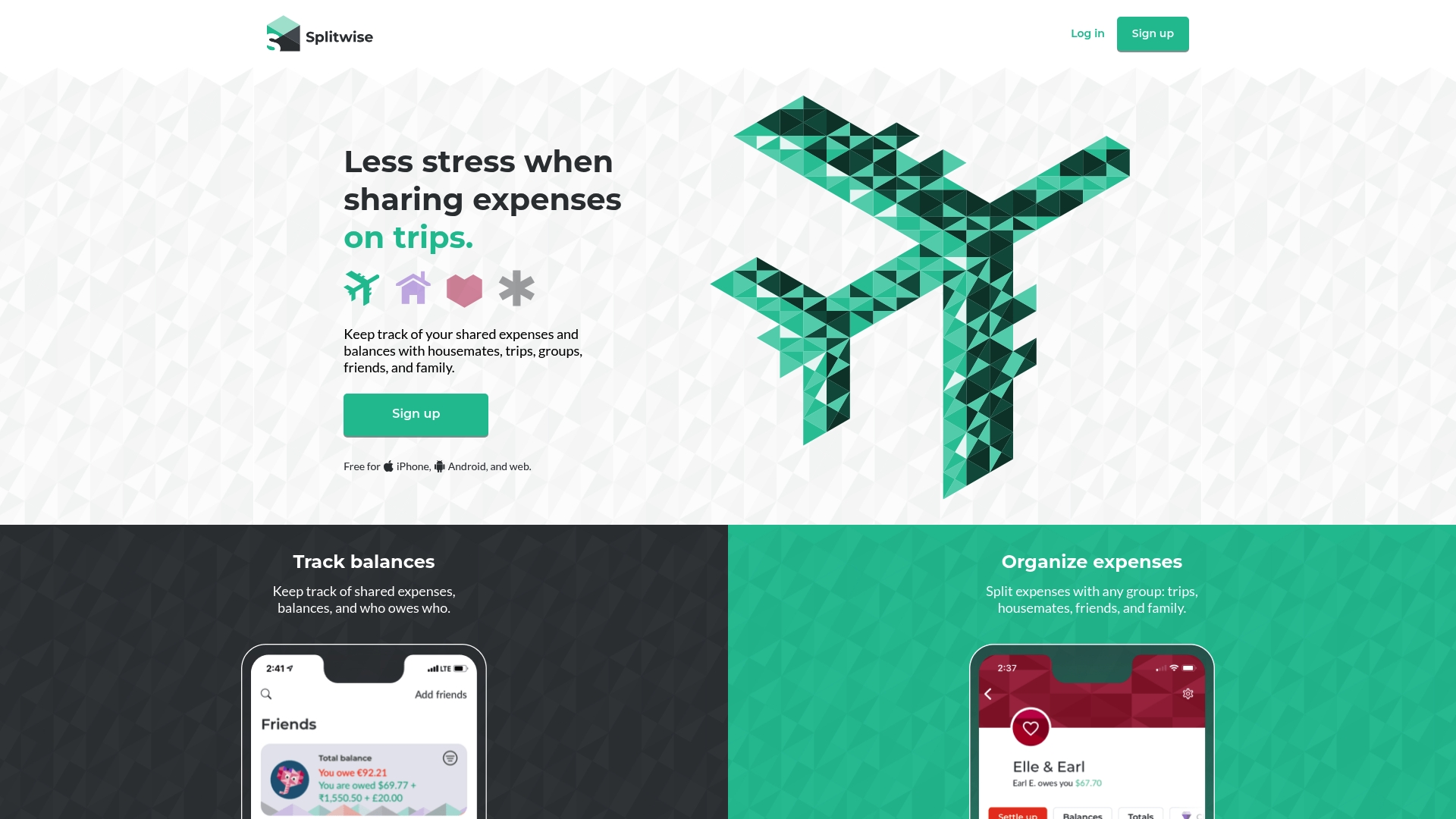
Splitwise includes built in payment options through Splitwise Pay and the Splitwise Card, which is unusual for an expense sharing app. The platform focuses on group balances and makes it simple to record who owes what. Basic split tracking is free, and optional paid features add receipt scanning and currency conversion. That mix makes it easy to use for casual groups and upgrade when needed.

Core Features

  • Track balances and who owes whom across multiple groups. This keeps long running debts clear.
  • Organize expenses by trips, housemates, friends, or family. Groups store shared history for later reference.
  • Add expenses quickly on web or mobile. You can assign items to specific people as you go.
  • Settle up via cash, online payment, or Splitwise Pay. The payment options reduce manual reimbursements.
  • Receipt scanning and itemization, currency conversion, and expense insights are available in Splitwise Pro. Those features help when bills get complex.

Key Differentiator

Splitwise pairs traditional expense tracking with built in payment features for group settlements. That combination removes the extra step of asking for reimbursements after a trip or shared bill. The payment tools are most useful for US residents with bank access. For basic group tracking the free core features remain the main draw.

Pros

  • Offers clear, focused expense tracking that makes shared balances easy to follow. The interface highlights who owes whom and reduces argument over totals.
  • Group organization fits trips, roommates, and recurring household bills. You can keep separate ledgers for each social context.
  • Receipt scanning and itemization in Pro help when bills split across items or people. That feature speeds up precise splits.
  • Splitwise Pay and the Splitwise Card let groups settle without external apps. That can remove friction when people prefer in platform payments.
  • Free core functionality covers most casual users. Tracking, adding expenses, and basic settlement do not require a subscription.

Cons

  • Payment features have geographic limits and focus on US banking. That reduces usefulness for international groups wanting in app settlement.
  • Advanced tools like transaction import and currency conversion require Pro and may not be available in all regions. Users outside supported areas will lack those features.
  • Some users report bank connection trouble and possible transaction fees. Those issues can delay settlement or add unexpected costs.
  • Pro subscription is required for several convenience features. Casual users must decide if the upgrades justify the cost.

When It May Not Fit

If most group members live outside the United States, Splitwise may not meet your payment needs. Groups that require automatic transaction imports or multi region currency support should check regional availability first. If you need built in time tracking or business billing features, this consumer focused app will feel limited.

Who It’s For

People who split costs regularly and want a lightweight, shared ledger. Roommates dividing rent and utilities will find the group tools useful. Travelers splitting trip costs get straightforward record keeping and optional in app settlement. Anyone who prefers simple, social expense tracking over accounting style tools will fit well.

Real World Use Case

A group of friends on vacation logs accommodation, rides, and meals as they spend. Each expense goes into the trip group with the payer and participants recorded. At trip end the group uses Splitwise Pay to settle remaining balances or the Splitwise Card for shared purchases, avoiding multiple bank transfers.

Pricing

Basic expense sharing is free and covers tracking, groups, and manual settling. Splitwise Pro is a paid subscription that adds receipt scanning, currency conversion, and detailed analytics. Payment processing and card use may carry separate fees depending on banks and locations.

Website: https://splitwise.com

tricount

https://tricount.com

At a Glance

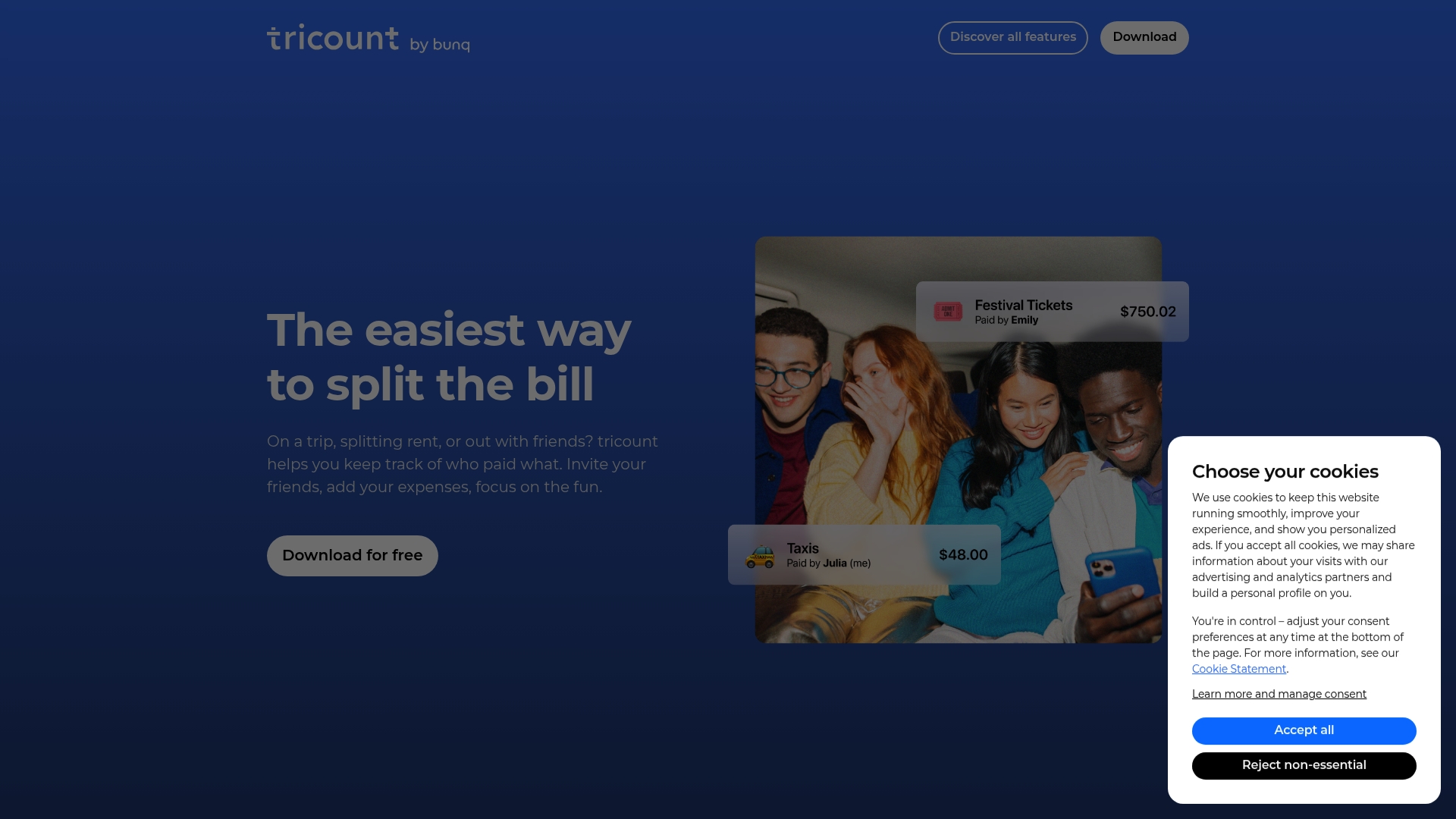
tricount reports that it is trusted by millions worldwide and that the app is 100 percent free. The standout claim here is that it handles group math for shared costs while converting currencies automatically. That mix of no cost access and built in currency conversion makes it a quick choice for travelers and mixed currency groups.

Core Features

  • Group expense tracking and splitting with automatic calculations. This shows who paid, who owes, and suggested settlements.
  • Multi currency support with automatic conversions so totals stay consistent across travelers or remote roommates. multi currency support appears throughout the app.
  • Offline expense tracking and receipt photo sharing for times without reliable mobile service.
  • Shareable expense links and real time group updates so everyone sees changes as they happen.
  • Import existing expenses from other apps like Splitwise to avoid re entering past data.

Key Differentiator

tricount stands out for its focus on fair splitting and currency handling. The app pairs automatic calculations with currency conversion so you do not manually convert receipts. Its easy import from other expense tools shortens setup for groups that already track costs elsewhere.

Pros

  • Easy math for groups. tricount does the splits and shows a clear balance table so you do not need to do manual calculations.

  • Supports uneven splits. You can split by share, exact amount, or settle who covers specific items for fair results.

  • Import capability reduces setup time. If you tracked expenses in another app you can bring them into tricount rather than re enter everything.

  • Good for travel with currency conversion. The built in conversions save time when group members pay in different currencies.

  • Clear receipts and reports. Receipt photos and group statements make it simple to check any charge later.

Cons

  • Limited information about paid upgrades. The available content mentions free use but gives little detail on optional premium features.

  • Less deep categorization than some rivals. Users who need multi level expense categories or advanced tags may find the feature set thinner than other tools.

  • No built in payment rails. The app does not provide integrated payment processing for settling balances inside the app.

When It May Not Fit

tricount may not fit groups that expect bill paying inside the app or those that need advanced accounting categories. If you require integrated payment options to collect money, this product will leave a gap. Also power users who need granular tagging or multi layer reports may prefer a different tool.

Who It’s For

tricount suits friends traveling together, roommates splitting monthly bills, couples tracking shared purchases, and small project teams managing shared costs. It works well when you want quick, fair math, clear receipts, and automatic currency conversion without paying for a service.

Real World Use Case

A group of six friends uses tricount on a weeklong trip. One person pays the hotel in euros and another buys attraction tickets in local currency. tricount converts those entries, updates the group in real time, and attaches photos of each receipt. After the trip everyone sees what they owe and can settle up outside the app.

Website: https://tricount.com

Comparison of alternatives

When selecting a personal finance management tool, users should consider the diverse features offered by alternatives like Vala, PocketSmith, Era, Splitwise, and tricount. Each platform shines in specific areas perfect for different contexts and preferences.

Customization and AI-driven insights

Vala introduces its unique AI Coach App, which interprets live transactions to provide budgeting advice. This feature helps users track and optimize daily spending intuitively. Era, by allowing integration with multiple AI systems, facilitates dynamic and automated financial behavior, presenting an opportunity for users interested in leveraging diverse technologies. Conversely, Vala simplifies financial management with its ready-to-use AI insights, favoring users who prefer a low-effort experience.

Expense sharing and group dynamics

Splitwise and tricount focus on simplifying cost splitting, and each offers functionalities like automatic settlement and multi-currency conversions, respectively. Splitwise even provides a proprietary payment system for reimbursement handling. In contrast, Vala complements its offerings with tools for financial tracking tailored for households and partnerships, bridging individual and joint expense monitoring efficiently.

Long-term financial planning

PocketSmith excels in projecting finances decades into the future. Ideal for individuals targeting retirement planning or significant purchases, the extensive forecasting tools offer depth. While Vala facilitates immediate and mid-term financial tracking, it’s important to recognize PocketSmith’s unique value in proactive future-proofing for larger financial goals.

Best fit

  • For households or families prioritizing collaborative budgeting with immediate AI-driven insights, Vala provides an intuitive and secure solution.
  • For individuals seeking detailed forecasting for retirement or other significant future milestones, PocketSmith offers tailored tools.
  • For those handling shared expenses while traveling internationally, tricount stands out with its automatic currency conversion capabilities.
  • If AI-powered financial setups appeal, especially with flexibility in assistant integration, Era fits well.
  • For users desiring a straightforward group cost-sharing solution with native payment options, Splitwise holds strong advantages.

Our pick

When emphasizing AI-driven automation with daily expense insights alongside cohesive capacity for shared financial management, Vala emerges as a compelling option. It is especially suitable when immediate recommendations based on live data are desired. However, for purely long-term planning endeavors or international group contexts, exploring PocketSmith or tricount may better align with specific needs.

When choosing a budgeting platform, consider options that combine robust features with personalized insights to best support your financial goals.

Product Core Feature Key Differentiator Pricing Notable Limitation
Valapoint AI-driven real-time financial insights Focus on shared expenses and savings tracking Free; Premium tier available Limited support for international accounts
PocketSmith Long-term cash flow forecasting 60-year financial projection capabilities Starting at $9.99/month Complex setup for casual users
Era MCP-compatible financial integration Flexibility to use multiple AI assistants Starting at $7.99/month Integration requires technical setup
Splitwise Expense sharing and reimbursement Built-in payment options like Splitwise Pay Free; Splitwise Pro available Payment features focus on U.S. banking
tricount Currency-converting shared expense tracking Automatic group math and conversions Free No built-in payment features

Discover a Smarter Way to Manage Your Money with Valapoint

Choosing the right app among budget-flow.app alternatives can feel overwhelming. If you want a tool that goes beyond basic tracking and helps you split shared bills, automatically categorize expenses, and offers AI-driven budget suggestions tailored to your habits, Valapoint is designed just for you. Whether you’re managing finances solo or with a partner, Valapoint brings clarity and control to everyday money management.

https://valapoint.com

Take control of your financial habits today. Visit Valapoint to start tracking expenses, splitting costs, and uncovering savings opportunities with the confidence that your money is working smarter. Get started with personalized insights and real-time updates that help you save more without extra effort.

FAQ

What budgeting features does Valapoint offer for daily money management?

Valapoint provides automatic expense tracking, subscription monitoring, and built-in bill splitting. These features work together to give you a clear financial overview and help you manage your daily expenses efficiently.

How does Valapoint compare to PocketSmith in terms of forecasting capabilities?

PocketSmith excels at cash flow forecasting, allowing projections up to 60 years into the future, which is beneficial for long-term planning. Valapoint, on the other hand, is better suited for individuals looking for real-time budgeting suggestions tailored to their current financial habits and income.

Which platform is easier for couples managing shared expenses, Valapoint or Splitwise?

Valapoint provides shared budgeting features that allow couples to track individual and joint spending in one view. While Splitwise focuses primarily on splitting costs, Valapoint enhances the shared experience with automated budgeting insights that adapt to each user’s financial data.

Does Valapoint support multiple currencies for users with international accounts?

Valapoint is primarily tailored for U.S. users and may not handle non-U.S. accounts effectively, making it less suitable for individuals managing finances in multiple currencies. For those needing multi-currency support, exploring other options like PocketSmith could be beneficial.

Can I track savings goals with Valapoint?

Valapoint includes savings goal tracking with clear milestones and visual progress indicators, helping you monitor your savings journey effectively. This feature ensures you stay motivated and on track to achieve your financial goals.

What Is a Spending Limit? A Personal Finance Guide

A spending limit is a maximum cap on spending for a specific category, transaction, or time period, designed to prevent overspending and build budget discipline. Most people confuse it with a credit limit, but the two are fundamentally different tools. Understanding spending limits gives you direct control over your money, whether you use PayPal, Discover, a digital banking app, or a personal finance tool like Valapoint. The average U.S. credit limit reached approximately $29,855 in 2023. That number shows how much borrowing power most Americans carry, and why a personal spending limit matters even more.

How do spending limits differ from credit limits?

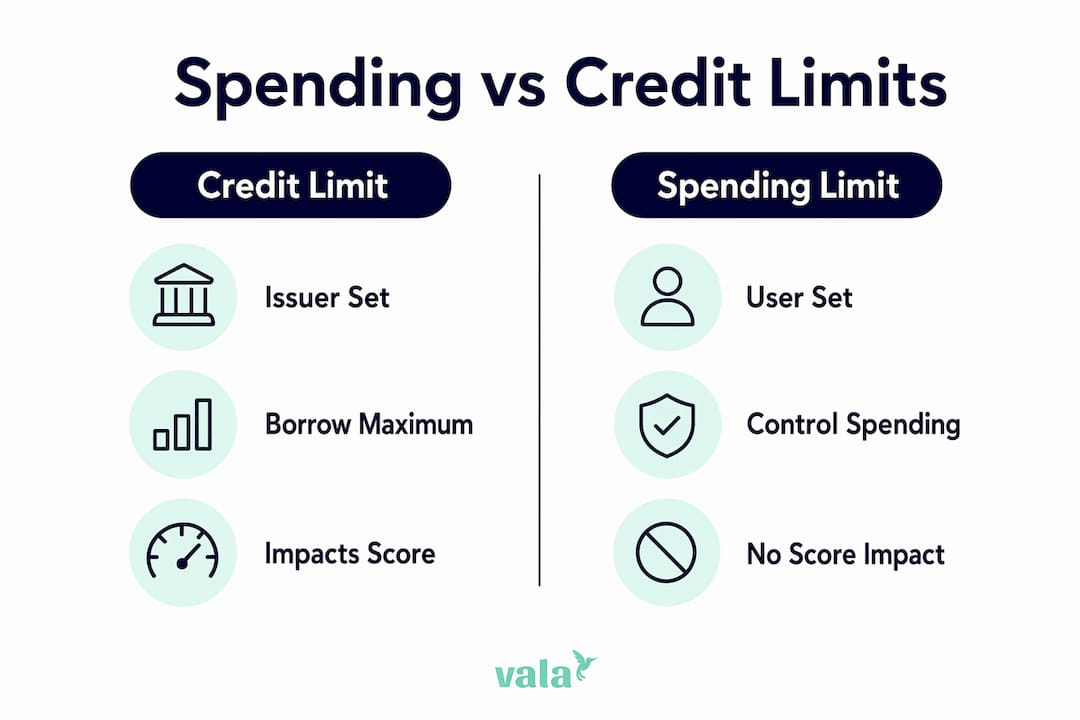
A credit limit is the maximum amount a card issuer allows you to borrow. A spending limit is the maximum you allow yourself to spend, and it sits below that issuer-assigned ceiling. The spending limit definition, in practical terms, is a self-imposed or app-enforced guardrail that keeps your actual charges well under your credit ceiling.

Credit limits vary widely, from $300 for first-time cardholders to $20,000 or more for premium cards. Spending limits, by contrast, are set by you based on your budget, not your borrowing capacity. That distinction matters because your credit utilization ratio, the percentage of your credit line you actually use, directly affects your credit score.

Hands pointing at credit vs spending limit chart on desk

Requesting a lower credit limit from your issuer can actually hurt your credit utilization ratio. A better approach is to keep your issuer-assigned limit intact and set a personal spending cap well below it. Discover’s financial experts recommend this strategy specifically to protect credit health.

Here is a clear comparison of the two concepts:

Feature Credit Limit Spending Limit
Set by Card issuer You or your app
Purpose Defines max borrowing Controls actual spending
Effect on credit score Directly tied to utilization Indirect, protects utilization
Flexibility Requires issuer approval Adjustable anytime
Example $10,000 Discover card limit $500 monthly grocery cap

Infographic comparing credit limits and spending limits

Keeping your spending limit at or below 30% of your credit line is the standard recommendation for maintaining a healthy credit score. That means on a $10,000 credit line, your personal spending cap should stay at or under $3,000 per billing cycle.

What are the common types of spending limits?

Spending limits come in several forms, and each serves a different budgeting need. Knowing which type fits your situation helps you apply them correctly.

  • Per-transaction limits cap a single purchase at a set dollar amount. For example, you might block any single charge above $200 without a secondary approval step.
  • Daily limits restrict total spending within a 24-hour window. Many digital banking apps let you set a $150 daily cap on debit card purchases.
  • Weekly limits divide your monthly budget by approximately 4.3 weeks. This approach gives you more frequent checkpoints than a monthly budget.
  • Monthly limits are the most common personal budget limits. They align with billing cycles and income schedules.
  • Merchant category limits restrict spending by type, such as capping restaurant charges at $200 per month while leaving grocery spending unrestricted.
  • Authorized user limits let account holders assign a lower spending cap to a partner, family member, or employee on the same account.

Offline chip transactions create a specific challenge called “limit drift.” When a card reader processes a transaction offline, the charge does not hit your account in real time. Small offline transactions can temporarily push you past your set limit before the system reconciles. This is a known gap in spending limit enforcement that most budgeters do not anticipate.

Pro Tip: Set your per-transaction alert threshold lower than your actual limit. If your daily cap is $100, set an alert at $75. That buffer gives you time to pause before you hit the ceiling.

How to set a spending limit that actually works

Setting a spending limit takes more than picking a number. A limit that is too tight breaks down under real-life pressure. A limit that is too loose does nothing. Here is a practical process for getting it right.

  1. Calculate your baseline. Review the last 60–90 days of spending in each category. Use an automated expense tracker to pull this data without manual work.
  2. Set limits at 30–40% of your periodic income or credit line. This range protects your credit utilization and leaves room for irregular expenses. Experts recommend building sinking funds alongside your limits to cover costs like car repairs or annual subscriptions.
  3. Choose weekly over monthly limits when possible. Weekly limits give you roughly four recalibration points per month instead of one. If you overspend on Tuesday, you correct by Friday rather than scrambling at month-end.
  4. Enable alerts before you hit the limit. Most mobile banking apps and personal finance tools let you set a notification at 70–80% of your cap. That warning gives you a decision window, not a crisis moment.
  5. Use structural enforcement for high-risk categories. Dedicated prepaid accounts or separate checking accounts stop spending mechanically when funds run out. This method removes the need for willpower entirely.
  6. Adjust limits after major life changes. A new job, a move, or a growing family changes your spending baseline. Review your limits every 90 days and after any significant financial event.

Digital spending limits can be adjusted instantly through your bank’s mobile app or security settings, often with secondary authentication for protection. Most major banks and apps also allow temporary limit increases for planned large purchases, so you are not locked in permanently.

Pro Tip: Couples should set shared category limits in addition to individual ones. A joint grocery cap of $600 per month, tracked in a shared app, prevents the common problem of both partners spending independently without awareness of the combined total.

What are the benefits and limitations of spending limits?

Spending limits serve two distinct functions: budget control and fraud protection. Understanding both helps you use them more effectively.

Benefits:

  • Fraud prevention. Visa’s real-time authorization systems prevent over $40 billion in fraudulent transactions annually. Spending limits add a personal layer on top of that network-level protection by blocking transactions that exceed your set threshold.
  • Automatic budget enforcement. Limits remove the need to manually check your balance before every purchase. The system stops you before you overspend.
  • Credit score protection. Personal spending caps keep your utilization ratio low without requiring you to reduce your credit line.
  • Improved spending awareness. Setting a limit forces you to assign a dollar value to each category, which surfaces hidden spending patterns most people never notice.

Limitations:

  • Limit drift from offline transactions. As noted above, offline chip transactions can temporarily push spending past your cap before reconciliation catches up.
  • Irregular expenses break fixed limits. Annual fees, medical bills, and seasonal costs do not fit neatly into monthly caps. Without sinking funds, these expenses feel like limit failures even when your system is working correctly.
  • Overreliance without budgeting discipline. A spending limit is a tool, not a complete financial plan. Limits work best when paired with regular reviews and a broader budget strategy.

“Spending limits serve as both budget controls and fraud prevention tools, authorized in real time to block suspicious transactions.” — Plasma Card Controls

One often-overlooked benefit: issuers maintain minimum service standards even when limits are active. For example, mandatory minimums like $200 daily ATM access remain available regardless of other spending controls you set. Your limits cannot accidentally lock you out of essential funds.

Key takeaways

A spending limit is the most direct tool you have for controlling personal finances, and it works best when paired with weekly checkpoints, sinking funds, and automated tracking.

Point Details
Spending limit vs. credit limit A spending limit is self-imposed; a credit limit is issuer-assigned and affects your borrowing ceiling.
Protect your credit score Set personal spending caps below 30% of your credit line instead of requesting issuer limit reductions.
Weekly limits outperform monthly Dividing your budget into weekly caps gives you four correction points per month instead of one.
Structural enforcement works best Dedicated prepaid accounts stop spending mechanically, removing reliance on willpower or app alerts alone.
Limit drift is a real risk Offline transactions can temporarily exceed your cap; build a buffer and reconcile regularly to stay accurate.

The honest truth about spending limits most guides skip

I have watched a lot of people set spending limits with genuine intention and then abandon them within six weeks. The limits were not the problem. The structure around them was.

The most common failure pattern is what I call feast-and-famine budgeting. You set a $1,200 monthly grocery and dining limit, spend $900 in the first three weeks, and then either blow past the cap or eat poorly for the last ten days. Weekly limits solve this directly. A $280 weekly food budget resets every Monday. You get four chances to course-correct instead of one.

The second failure I see consistently is treating limits as the entire financial system. A spending limit tells you when to stop. It does not tell you where your money went, whether your savings goals are on track, or whether a recurring subscription quietly doubled in price. Limits need to be paired with automated expense tracking to give you the full picture.

The third issue is irregular expenses. Most people budget for groceries and gas but forget about the $800 car registration, the $400 dental visit, or the holiday spending spike. Build sinking funds for these categories and treat them as separate line items. Your monthly limits will stop feeling arbitrary once they account for the full reality of your spending year.

The bottom line: spending limits are powerful, but only as one layer of a real financial system. Combine them with weekly reviews, automated alerts, and a tool that shows you patterns over time.

— SaverStride

Take control of your spending with Valapoint

Setting a spending limit is the first step. Knowing whether it is actually working is the next one.

https://valapoint.com

Valapoint’s personal finance app lets you set budget limits by category, track spending in real time, and get AI-powered alerts before you hit your cap. You can see exactly where your money goes each week, spot patterns that lead to overspending, and adjust your limits without logging into a bank portal. For couples, Valapoint also tracks shared expenses so both partners stay on the same page. If you want a clearer, calmer relationship with your money, Valapoint gives you the tools to build it. Start with your financial DNA test to understand your spending style before you set your first limit.

FAQ

What is a spending limit in simple terms?

A spending limit is a preset maximum amount you are allowed to spend within a specific time period or per transaction. It is a personal budget control, not a bank-assigned borrowing cap.

How do i set a spending limit on my credit card?

Log into your card issuer’s mobile app or online portal, navigate to card controls or security settings, and set a per-transaction or daily limit. Most issuers, including Discover, allow instant adjustments with secondary authentication.

Does a spending limit affect my credit score?

A self-imposed spending limit does not directly affect your credit score. It helps indirectly by keeping your credit utilization below 30%, which is the threshold most scoring models reward.

What is a spending limit example for a monthly budget?

A practical spending limit example: if your take-home pay is $4,000 per month, you might set a $600 grocery limit, a $300 dining limit, and a $200 entertainment limit. Each category cap keeps total discretionary spending under 28% of income.

Why do spending limits sometimes fail?

Limit drift from offline transactions and unplanned irregular expenses are the two most common causes. Building a small buffer below your actual cap and maintaining sinking funds for irregular costs prevents most limit failures.

How AI Detects Spending Patterns: A Clear Guide

AI spending pattern detection is defined as the process of using machine learning models and large language models to parse, categorize, and analyze bank transactions so you can see exactly where your money goes. This is the technical foundation behind every personal finance app that tells you “you spent 30% more on dining this month.” Understanding how it works gives you real control over your money. Tools like Plaid and frameworks like Red Hat’s agentic AI pipeline have pushed this technology far beyond simple spreadsheet math. The industry term for this field is transaction intelligence, and knowing how it operates helps you choose smarter tools and trust the insights they deliver.

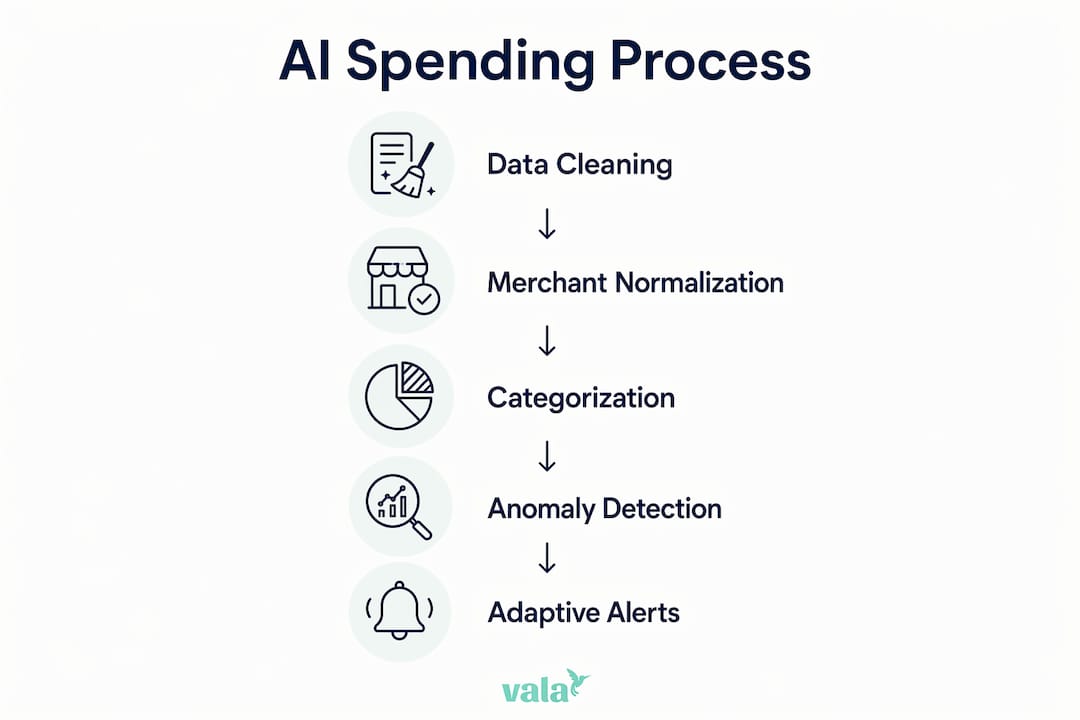
How AI detects spending patterns in raw transaction data

The first challenge AI faces is that your bank data is messy. A charge might appear as “SQ *BLUEBOTTLE SF 94103” instead of “Blue Bottle Coffee.” Before any pattern can be detected, AI must clean and structure that raw text.

Plaid’s UXC v2 pipeline solves this with a two-stage large language model process. Stage one extracts key descriptors from the transaction string, pulling out the merchant name, location signals, and purchase context. Stage two assigns a spending label from a structured taxonomy that includes categories like Food, Transportation, Utilities, and Entertainment. This two-stage LLM pipeline achieves up to 13% higher accuracy on primary categories and 23% higher accuracy on subcategories compared to earlier systems. That improvement means fewer transactions land in the wrong bucket, which directly affects how accurate your budget summary looks.

Merchant normalization is where most of the real work happens. Inconsistent merchant strings create false pattern changes that make it look like your habits shifted when they did not. Plaid addresses this by running web searches and using contrastive learning to resolve cryptic names into consistent labels. Without this step, the same coffee shop could appear under three different category labels across a single month.

Hands typing amid transaction documents at office

Pro Tip: When reviewing your spending categories in any finance app, check whether recurring merchants are labeled consistently month over month. Inconsistent labels are a sign the app’s normalization is weak, and your trend data may not be reliable.

Other systems use a staged approach with a rules engine before machine learning takes over. The transaction-classifier project on GitHub demonstrates this well: a direction detection layer first identifies income versus expense with 0.99 confidence, a rules engine handles structural patterns at 0.98 confidence, and then an ML ensemble assigns the final category from 10 budget buckets. That layered design reduces errors at each step before the harder classification work begins.

Why taxonomy design matters for your budget

The categories AI assigns are only as useful as the taxonomy behind them. A taxonomy that lumps “fast food” and “grocery stores” into one “Food” bucket tells you very little. Better systems separate dining out, groceries, alcohol, and coffee into distinct subcategories. That granularity is what lets you see that your grocery spend is stable while your restaurant spend has climbed 40% over three months. The structured taxonomy approach is the foundation that makes all downstream analysis meaningful.

How does AI spot unusual spending behavior?

Categorizing transactions is only the first step. The more powerful capability is detecting when your spending behavior changes in ways that matter, even when the dollar amounts look normal.

Infographic illustrating AI spending detection steps

Traditional anomaly detection flags transactions that are unusually large. That catches obvious problems but misses a lot. Semantic-Transactional Anomaly Detection (STAD) takes a different approach. It uses Transformer-based models to build a “persona vector” from your historical spending behavior. Think of it as a fingerprint of your financial habits. When a new transaction is semantically incongruent with that fingerprint, the system flags it even if the amount is perfectly ordinary.

The STAD framework combines semantic anomaly scores with an XGBoost classifier to catch fraud and behavioral shifts that fall within normal numeric limits. A $12 charge at a hardware store might be unremarkable in dollar terms, but if your persona vector shows you never shop at hardware stores, the system treats it as worth reviewing. This is a fundamentally different way of thinking about financial monitoring.

Here is what semantic anomaly detection tracks that numeric systems miss:

  • Category drift: You normally spend on groceries, but suddenly charges appear in categories outside your baseline
  • Merchant type shifts: New merchant types appear that have no history in your spending profile
  • Sequence breaks: Your usual weekly spending rhythm changes in a way that suggests a new habit or a problem
  • Time-of-day anomalies: Transactions occur at times that are inconsistent with your historical patterns

Numeric anomaly detection alone fails to catch contextually wrong transactions without adding semantic and sequential modeling layers. Many small financial leaks go unnoticed precisely because they fall within normal dollar ranges. Semantic scoring catches them by comparing behavior, not just amounts.

Pro Tip: If your finance app only alerts you when a transaction is “unusually large,” you are missing the smarter layer of AI analysis. Look for apps that explain why a transaction was flagged, not just that it was flagged.

How does AI turn spending data into alerts you can act on?

Detecting a pattern is useful. Explaining it in plain English is what makes it actionable. This is where agentic AI and natural language processing come in.

Red Hat’s agentic AI pipeline for financial monitoring works in five steps:

  1. Intent classification: The system reads your spending query or alert condition and classifies what you are asking for, such as “notify me when dining spend exceeds last month.”
  2. Query generation: The classified intent is translated into an executable database query that pulls the right transaction data.
  3. Execution and validation: The query runs on your live transaction data, and the result is validated for accuracy before any alert is triggered.
  4. Human-readable messaging: The system generates a plain-English explanation of what triggered the alert, including the specific comparison window and the amounts involved.
  5. Adaptive learning: The system learns from historical data to refine future alerts, so they stay relevant as your habits evolve.

This pipeline directly addresses the “black box” problem in AI finance tools. When an app just says “you overspent,” you have no idea what to do next. When it says “your dining spend this month is $340, which is $95 above your three-month average of $245,” you have a specific number to work with. Turning user intent into plain-English alerts increases trust and makes the insight usable.

The adaptive component matters more than most people realize. Your spending habits in January look nothing like your habits in July. A system that compares your current spending to a fixed annual average will generate alerts that feel irrelevant. Incremental learning and rule adaptation keep AI spending insights accurate as your personal habits shift over time.

What are the privacy risks of AI spending analysis?

AI spending analysis requires access to your transaction data, and that data does not always stay where you expect it to.

Third-party aggregators like Plaid see transactions from one in four U.S. adults. That scale is what makes their AI models accurate, but it also means your financial behavior is part of a very large dataset. Most personal finance apps connect to your bank through aggregators like Plaid, so your data flows through at least one intermediary before it reaches the app you actually use.

Key privacy considerations to review before connecting any finance app:

  • Data retention policies: How long does the app and its aggregators keep your transaction history?
  • De-identification practices: Is your data anonymized before being used for AI model training?
  • Third-party sharing: Does the app share data with marketing partners or AI sub-processors beyond the core service?
  • Opt-out options: Can you request deletion of your data, and does that deletion extend to aggregators?
  • Re-identification risk: Spending patterns are highly personal. Even de-identified data can sometimes be linked back to individuals through behavioral fingerprints.

Privacy policies vary widely across finance apps, and some share data with marketing partners or AI sub-processors in ways that raise real concerns about inferred personal attributes. Reading the privacy policy before connecting your bank account is not optional. You can also learn more about how AI personalizes budgets while keeping your data handling in check.

The right balance is choosing tools that are transparent about data use, offer clear opt-outs, and explain how your information contributes to model training. Privacy should be a feature you evaluate, not an afterthought.

Key takeaways

AI detects spending patterns by combining merchant normalization, taxonomy labeling, semantic anomaly scoring, and adaptive alert generation to turn raw transaction data into clear, personal financial insights.

Point Details
Two-stage LLM categorization AI extracts merchant descriptors first, then assigns spending labels for up to 23% better subcategory accuracy.
Semantic anomaly detection STAD builds a behavioral persona vector to flag unusual spending even when dollar amounts look normal.
Adaptive alert generation Agentic AI translates your spending intent into plain-English alerts that update as your habits change.
Privacy due diligence Review data retention, sharing, and opt-out policies before connecting any finance app to your bank.
Taxonomy granularity Detailed spending categories like dining versus groceries produce more useful budget insights than broad labels.

Why merchant normalization is the unsung hero of spending AI

Most coverage of AI in personal finance focuses on the flashy parts: anomaly detection, predictive budgets, smart alerts. After spending time with how these systems actually work, the part that impresses me most is merchant normalization. It is unglamorous, but it is where the accuracy of everything else is decided.

If “AMZN MKTP US*AB12CD” and “Amazon.com” are not recognized as the same merchant, your shopping category is split across two labels. Your trend data looks wrong. Your alerts fire at the wrong thresholds. The whole downstream analysis is built on a cracked foundation. Plaid’s investment in web searches and contrastive learning to resolve these strings is the kind of infrastructure work that never makes a product demo but determines whether you can actually trust your spending summary.

The other thing I think gets underestimated is the value of explainability. An alert that says “you spent more on food” is nearly useless. An alert that says “your dining spend is $95 above your three-month average” gives you something to act on. The Red Hat agentic pipeline approach, where the system generates a human-readable explanation of exactly what triggered the alert, is the standard every finance app should be held to. If your current app cannot tell you why it flagged something, that is a real limitation worth considering.

My honest advice: treat AI spending insights as a starting point, not a verdict. The AI sees your transactions. You know your life. A charge flagged as unusual might be a one-time gift purchase. The best use of these tools is to let them surface patterns you would not notice on your own, then apply your own judgment to decide what matters. You can explore how AI saves money automatically without requiring you to micromanage every transaction.

— SaverStride

See your spending clearly with Valapoint

Valapoint’s AI-powered finance app does exactly what this article describes, without requiring you to understand the technology behind it. Vala automatically categorizes your transactions, tracks spending trends across custom categories, and surfaces the patterns that lead to financial leaks.

https://valapoint.com

You get clear, plain-English insights into where your money goes each month, plus customizable alerts that compare your current spending to your personal baseline. Vala’s AI learns your habits over time, so the insights stay relevant as your life changes. Connect your accounts and let Vala’s AI financial intelligence show you what your bank statement alone never could. Start tracking smarter with the Vala personal finance app today.

FAQ

How does AI detect spending patterns from bank data?

AI parses raw transaction strings, normalizes merchant names, and assigns spending labels using large language models and machine learning classifiers. Systems like Plaid’s UXC v2 use a two-stage pipeline that achieves up to 23% higher subcategory accuracy than earlier methods.

What is semantic anomaly detection in personal finance?

Semantic anomaly detection uses Transformer-based models to build a behavioral profile from your spending history and flag transactions that do not fit that profile, even when the dollar amount is normal. The STAD framework combines this with XGBoost classification to catch behavioral shifts that numeric-only systems miss.

Can AI predict my future expenses?

AI predicts expenses by analyzing your historical spending sequences and identifying recurring patterns across time windows. Adaptive systems like Red Hat’s agentic AI pipeline refine these predictions as your habits evolve, making forecasts more accurate over time.

Is my transaction data safe with AI finance apps?

Safety depends on the specific app and its aggregators. Third-party services like Plaid process transactions from one in four U.S. adults, and privacy policies vary on data retention, sharing with marketing partners, and opt-out rights. Always review the privacy policy before connecting your bank account.

Why do spending categories sometimes look wrong in finance apps?

Incorrect categories usually result from weak merchant normalization, where the app fails to resolve cryptic transaction strings into consistent merchant names. This creates false pattern changes in your spending history and reduces the accuracy of budget summaries and trend alerts.

Expense Tracking Best Practices for Ages 18–45

Expense tracking best practices are the combination of habit formation, automation, and decision-focused categories that give you real control over your money. The industry term for this discipline is personal expense management, and it covers everything from how you log a coffee purchase to how you review your budget each month. Done right, it takes less than 15 minutes a week and tells you exactly where your money goes. Done wrong, it creates data overload and zero behavior change. This guide covers what actually works.

1. expense tracking best practices start with a spending baseline

The most effective first step is to track 30 days of spending without changing a single habit. This gives you an honest picture of where your money actually goes, not where you think it goes. Most people are surprised by the gap between the two.

During this baseline period, do not cut subscriptions, skip dinners out, or adjust your grocery runs. Any change you make distorts the data. Your goal is observation, not optimization. Once you have 30 days of clean data, patterns become obvious and decisions become easy.

  • Record every transaction, including small ones like coffee or parking
  • Use one account or card if possible to simplify capture
  • Note the category for each purchase as you go, not at the end of the month
  • Do not judge the spending yet. Just record it.

Pro Tip: Set a recurring phone reminder for the same time each day to log any cash purchases. Digital transactions capture themselves, but cash disappears from memory fast.

2. build a weekly 15-minute review habit

A weekly 15-minute review is the single habit that separates people who track expenses from people who actually manage them. Fifteen minutes is short enough to stay consistent and long enough to catch budget leaks before they compound.

Hands calculating weekly expenses on table

Pick a fixed day and time, like Sunday evening or Monday morning, and treat it like a standing appointment. During the review, check your category totals against your budget, flag any unusual charges, and note one thing you want to adjust in the coming week. That’s it. The review does not need to be a deep analysis every time.

Consistency in routine reviews reduces friction and builds the habit faster than any app feature will. The tool matters less than the schedule.

3. use automation to track expenses in real time

Automation shifts expense management from reactive to proactive. Instead of scrambling at month-end to reconcile transactions, you get real-time visibility as each purchase happens. That shift alone reduces errors and removes the stress of catching up.

The core automation features worth prioritizing are:

  • Automatic categorization: Transactions are sorted by merchant type the moment they post
  • Bank account integration: Your app pulls transactions directly, so nothing gets missed
  • Spending alerts: You get notified when a category approaches its limit
  • Receipt capture: Mobile tools that photograph and attach receipts to transactions eliminate lost-receipt problems entirely

Automation does not replace your judgment. It removes the manual work so your judgment can focus on decisions, not data entry.

Pro Tip: When choosing a tracking app, test whether it connects directly to your bank before committing. An app that requires manual imports will get abandoned within 60 days.

You can learn more about how this works in practice with Valapoint’s guide to automated expense tracking.

4. choose budgeting frameworks that match your life

The 50/30/20 rule is the most widely used personal budgeting framework: 50% of take-home pay goes to needs, 30% to wants, and 20% to savings or debt repayment. If your needs category consistently exceeds 50%, that is a direct signal your budget needs adjustment, not just your spending.

Other frameworks serve different goals. Zero-based budgeting assigns every dollar a job before the month begins, which works well for people who want maximum control. The pay-yourself-first method moves savings out automatically before you spend anything, which works well for people who struggle to save at the end of the month.

Framework Best For Main Advantage Main Limitation
50/30/20 Rule Most individuals and couples Simple, flexible, easy to start Less precise for irregular income
Zero-Based Budgeting Detail-oriented planners Every dollar has a purpose Time-intensive to maintain monthly
Pay-Yourself-First Savers who overspend Savings happen automatically Does not address spending categories
Envelope Method Cash spenders Hard spending limits per category Difficult to use with digital payments

Choose the framework that you will actually use. A simple system you follow beats a complex one you abandon.

5. build expense categories that drive decisions

Tracking without decision-oriented categories creates data overload and ineffective reviews. Every category in your system should answer a specific question, like “Am I spending too much on food?” or “How much are my subscriptions costing me each month?”

Start with five to seven core categories: housing, food, transportation, subscriptions, health, entertainment, and savings. Add subcategories only when the data from a parent category is too broad to act on. For example, splitting “food” into “groceries” and “dining out” makes sense if you are trying to reduce restaurant spending. Splitting it further into “breakfast,” “lunch,” and “dinner” rarely helps.

Simplifying categories increases consistent use. Overly complex systems lead to errors and, eventually, abandonment. Use Valapoint’s subscription cost calculator to get a clear view of how recurring charges stack up across your categories.

6. separate needs from wants before you spend

The 50/30/20 rule only works if you correctly classify your expenses. Rent is a need. A streaming service is a want. A gym membership could be either, depending on your health goals and income. The classification matters because it determines which category absorbs the cost and whether you flag it for review.

A practical rule: if you would cut it first in a financial emergency, it is a want. If cutting it would directly harm your health, housing, or employment, it is a need. Apply this test to every recurring charge during your 30-day baseline. You will likely reclassify several items.

AI-powered budget personalization can help you identify which categories are misclassified and where your spending patterns suggest a need for rebalancing.

7. run monthly reviews to adjust and improve

A 30-minute monthly review builds the cadence that keeps your tracking system accurate over time. Weekly reviews catch small leaks. Monthly reviews tell you whether your budget targets still reflect your actual life.

During the monthly review, compare your category totals to your targets, identify any category that exceeded its limit two or more times, and decide whether to adjust the target or the behavior. Both are valid responses. Sometimes your grocery budget is too low. Sometimes you genuinely overspent.

Review Type Frequency Time Required Primary Focus
Weekly Check-In Every week 15 minutes Catch overspending early, flag unusual charges
Monthly Deep Review Once a month 30 minutes Adjust targets, assess category trends, plan ahead

Pro Tip: Schedule your monthly review on the first weekend of each month. Pair it with something you enjoy, like a good coffee or a favorite playlist, to reduce resistance and build the habit faster.

8. keep records the right way

The IRS recommends keeping expense documentation for 3 years for standard audits and 7 years for major purchases. Digital scanned receipts are legally accepted if they are complete and legible. This matters even for personal finances if you claim deductions or run a side business.

The easiest approach is to photograph receipts immediately after purchase and attach them to the transaction in your tracking app. Apps that support this feature make the process take under 10 seconds. Waiting until the end of the month to sort receipts is where documentation habits break down.

For a deeper look at how digital records work within a broader financial system, the guide on digital document transformation covers IRS-compliant digital recordkeeping in practical terms.

Key takeaways

Consistent expense tracking requires a 30-day baseline, weekly reviews, automation, and categories built around decisions you actually need to make.

Point Details
Start with a baseline Track 30 days without changing habits to get accurate spending data.
Review weekly A 15-minute weekly check catches budget leaks before they grow.
Use automation Real-time categorization and bank integration remove manual data entry.
Match your framework Choose 50/30/20, zero-based, or pay-yourself-first based on your actual behavior.
Keep categories simple Five to seven core categories drive better decisions than twenty narrow ones.

What i’ve learned from tracking expenses for years

Most people fail at expense tracking not because they lack discipline but because they start with too much complexity. They download three apps, create 25 categories, and try to log every transaction manually. By week two, the system collapses under its own weight.

The approach that actually works is almost embarrassingly simple. One app. Five categories. Fifteen minutes on Sunday. That’s it. You build from there only when the data tells you to, not because a budgeting article told you to add more structure.

The other thing I’ve noticed is that the review habit matters more than the tool. I’ve seen people manage their finances well with a plain spreadsheet and others fail with the most sophisticated app on the market. The difference is always the weekly review. Without it, tracking becomes a passive record of the past instead of an active guide for the future.

Start simple. Stay consistent. Add complexity only when a specific question demands it. Your system should answer questions, not create them.

— SaverStride

Take control of your spending with Valapoint

If you want a system that handles the hard parts automatically, Valapoint’s personal finance app is built for exactly this. Vala connects to your bank accounts, categorizes transactions in real time, and sends weekly spending summaries so your 15-minute review takes even less effort.

https://valapoint.com

You can set custom budget targets, track progress toward savings goals, and spot recurring charges that are quietly draining your budget. Vala also supports group expense splitting, which makes it useful for couples and roommates managing shared costs. Whether you are just starting your first budget or refining a system you have used for years, Valapoint gives you the clarity to make confident money decisions. Start tracking for free and see where your money actually goes.

FAQ

What are expense tracking best practices?

Expense tracking best practices are the habits and systems that make your financial data accurate and useful. They include establishing a spending baseline, running weekly reviews, using automation, and organizing expenses into decision-focused categories.

How do i start tracking expenses effectively?

Start by recording every transaction for 30 days without changing your spending. Then set a weekly 15-minute review to check category totals and catch any budget leaks early.

Which budgeting framework works best for personal finance?

The 50/30/20 rule works best for most individuals: 50% to needs, 30% to wants, and 20% to savings or debt. If your needs consistently exceed 50% of your income, that signals a need for budget adjustment.

How many expense categories should i use?

Five to seven core categories is the right range for most people. More categories create complexity without improving decisions, and overly complex systems get abandoned faster than simple ones.

Do i need an app to track expenses?

An app is not required, but it removes the manual work that causes most people to quit. Apps with bank integration and automatic categorization reduce the time commitment to under 15 minutes a week.

Top 3 Mint.intuit.com Alternatives 2026

Finding a budgeting app that makes daily and shared expense management easy without complex setup or manual spreadsheets is a real challenge. Many popular apps either require detailed manual categorization, lack real-time alerts, or limit shared budgeting to higher-priced plans. This comparison covers features, automation, and shared budgeting support across three leading options so you can pick the best fit for your needs.

Table of contents

Vala: money leak detector

https://valapoint.com

At a glance

Vala turns raw transactions into spending insights, budgeting actions, and savings progress tracking. The app emphasizes an AI Coach that gives context aware budgeting suggestions tied to your actual purchases. It targets U.S. households and shared budgets with a mobile first interface and security focused architecture.

Core features

  • AI Coach App for context aware budgeting suggestions that learn from your transactions.
  • Automatic expense categorization to reduce manual sorting and show where money flows each month.
  • Bill splitting tools for roommates, partners, or family members to share and settle expenses.
  • Budget savings tracker with recurring contributions that shows progress toward goals like emergency funds.
  • Secure bank account linking for a consolidated view of balances, transactions, and fast tracking of expenses.
  • Financial goal tracker for debt payoff and milestone based targets.
  • Real time alerts for bills, subscriptions, and spending spikes to prevent surprises.
  • Subscription tracking to surface recurring charges you can cancel or reduce.

Key differentiator

AI driven, context aware financial insights power Vala’s recommendations while the design focuses on mobile first use and shared household budgets. That combination lets the app suggest actions based on how you actually spend and who you share expenses with. The emphasis on shared workflows makes budgeting a group task rather than something you do alone. This focus suits people splitting rent, recurring bills, or family expenses.

Pros

  • Intuitive mobile first design makes budgeting quick on your phone and reduces friction for daily tracking.

  • Secure bank linking gives a broader financial picture so you do not toggle between multiple apps.

  • Personalized insights and real time alerts help you spot subscription leaks and unexpected spending fast.

  • Shared budgeting features work for couples, families, and roommates so everyone sees the same balances and plans.

  • Flexible plan options include free features for basic tracking and premium tools for savings goals and advanced alerts.

Cons

  • Pricing details are shown inside the app only, so you may not see exact costs until you sign up.

Who it’s for

Vala fits U.S. individuals and households that want a mobile first, AI assisted budgeting tool. Choose Vala if you split bills with roommates or a partner and need clear shared ledgers. The app also suits young professionals who want automated savings nudges without manual spreadsheets.

Unique value proposition

The AI Coach that converts transaction context into suggested actions reduces time you spend categorizing and planning. That means you get concrete steps such as trimming a subscription or setting a recurring transfer to savings. For shared budgets, Vala moves cost splitting and alerts into the same workflow so money management becomes a coordinated task.

Real world use case

A young professional links bank accounts to Vala, which categorizes purchases and highlights recurring charges. They split utilities with roommates inside the app and automate a weekly transfer to a savings goal. Real time alerts stop overspending during a busy month and keep the budget on track.

Pricing

Current plans and pricing are shown in the app. Vala offers a free tier with basic tracking and premium capabilities behind a paid plan. Exact features and costs are disclosed inside the app during signup.

Website: https://valapoint.com

YNAB (you need a budget)

https://ynab.com

At a glance

YNAB reports a 4.8 star app store rating with more than 75,000 reviews. The app uses a strict budgeting method that asks users to assign every dollar a job and track progress by category. That focus pairs with active community support and a strong library of educational resources.

Core features

  • Give every dollar a job: Assign funds to categories so you plan spending before it happens.
  • Set and track savings goals: Create target amounts and watch category balances move toward them.
  • Integrated loan calculator: Model paydown scenarios and see how payments affect your budget.
  • Real-time sync across devices: Web, iOS, and Android stay updated.
  • Subscription sharing for up to six people: Share one plan for household or partner budgeting.

Key differentiator

YNAB centers its workflow on a single budgeting principle: assign every dollar a purpose. The app teaches that principle with guided lessons, forums, and live workshops. That education-first approach makes YNAB more of a financial course plus app than a passive tracker. Users who want habit change will notice the difference quickly.

Pros

  • Effective for debt reduction and saving. Users report clearer payoff plans and visible progress when they follow the method.
  • Promotes disciplined money habits. The budgeting framework forces decisions about priority spending rather than reactive tracking.
  • Well regarded in the press and app stores. The vendor cites coverage from outlets like Forbes and the New York Times, which reinforces credibility.
  • Ad-free and privacy focused. The product emphasizes a cleaner interface without in-app ads and a privacy forward stance.
  • Strong community and learning materials. Weekly workshops, guides, and an active forum help new users adopt the method.

Cons

  • Steep learning curve for beginners. New users often need time and coaching to apply the method to irregular income.
  • Bank sync can be unreliable for some institutions. The vendor notes occasional connection and balance discrepancies.
  • Higher subscription cost than some alternatives. The annual plan sits above many free or lower cost budgeting apps.
  • Limited multi currency support inside a single plan. That restriction affects frequent travelers and international households.

When it may not fit

If you prefer automatic categorization with minimal setup, YNAB will feel hands on and time consuming. Small households that need multi currency support will find the plan limiting. Teams that rely on flawless bank sync for real time reconciliation may need a backup process.

Notable integrations

  • Bank account linking for transaction import. This covers most mainstream U.S. and international banks though reliability varies.
  • Apple Card import is supported with region dependent behavior. Availability depends on how card providers expose data.

Who it’s for

YNAB fits individuals and couples who want a guided, educational approach to budgeting. It works well for people focused on paying off debt and building savings. Tech savvy adults who like learning and using a rules based workflow will get the most value.

Real world use case

A couple shares one subscription and maps monthly paychecks to budget categories. They track savings toward a home down payment and use the loan calculator to plan debt paydown. The shared plan forces weekly money conversations and prevents surprise shortfalls.

Pricing

YNAB charges $109 USD per year or $14.99 USD per month. The vendor offers a free 34 day trial with no credit card required so you can test the method before subscribing.

Website: https://ynab.com

Roo

https://roo.money

At a glance

Roo centers your budget on a single daily number you check each morning. That number reflects what you can safely spend after accounting for Bills and Living money. The app uses a three-step swipe workflow to sort transactions and keep the daily figure accurate.

Core features

Roo simplifies daily money decisions with a compact set of tools.

  • One daily number that shows how much you can spend today.
  • Swipe system to sort transactions into Bills or Living quickly.
  • Auto-corrects when your income or bills change so the daily number updates.
  • Account sync works with most bank accounts for automatic transaction import.
  • Custom pouches for savings goals and tucked-away expenses.

These features remove spreadsheets and long category trees. You get immediate feedback each morning.

Key differentiator

Roo is built around behavioral psychology and a swipe interface that makes budgeting a daily habit. The app focuses on a simple routine instead of detailed categories. That design aims to reduce decision fatigue and keep people on track with small daily actions.

Pros

  • Simple interface reduces friction. The swipe workflow makes sorting transactions fast and repeatable.
  • Proactive controls help prevent overspending. The daily number nudges you before mistakes happen.
  • Psychology-first design lowers frustration. Users avoid long setup and complex rule building.
  • Real-time insights and automatic corrections help you adapt when bills or income shift.
  • No spreadsheets or many categories. The minimal setup suits people who want an easy habit.

Cons

  • Limited long-term budgeting tools. Roo does not provide deep multi-month budget breakdowns.
  • Sparse public reviews. External user feedback is currently limited and mostly anecdotal.
  • May struggle with multiple complex goals. Managing many simultaneous savings targets feels constrained.
  • Possible account compatibility gaps with some banks. You may need manual imports in rare cases.

When it may not fit

Roo is not a good match if you need granular category reports or multiaccount forecasting. People who track dozens of subcategories or run multi-month budget scenarios will find the interface too simplified. If you require complete compatibility with every financial institution you may face occasional sync gaps.

Who it’s for

Choose Roo if you want a low-effort way to control daily spending without spreadsheets. It suits people who prefer a habit driven approach and quick morning check ins. It also fits users who find traditional category budgets too time consuming.

Real world use case

A user links checking and credit accounts and opens Roo each morning. They swipe new transactions into Bills or Living and glance at the Living pouch number. That single figure guides spending decisions for the day and reduces impulse purchases.

Pricing

Roo offers an Early Access price that the company advertises as lockable forever. The plan runs at $12/month or $96/year after a first free month. The model is a single subscription for full app access.

Website: https://roo.money

Comparison of alternatives

For individuals exploring alternatives to Mint by Intuit, comparing features and focus areas of various budgeting applications is vital to make an informed decision. Applications like Vala, YNAB, and Roo each provide unique strengths tailored to different financial management needs.

Analytical subsection 1: customization and integration

Vala introduces an AI Coach to transform transactional data into insights. It combines this with shared budgeting tools, enhancing transparency in managing joint expenses. By contrast, YNAB’s focus on assigning every dollar to a category requires active user engagement but nurtures disciplined spending habits via learning resources. Roo adopts a simplified approach, emphasizing minimal interaction by generating a daily spending figure for quick decision-making. Therefore, Vala caters to nuanced spending habits, YNAB fosters financial understanding, and Roo simplifies expense tracking.

Analytical subsection 2: usability and learning curve

Vala prioritizes ease of use with a mobile-first design and automation in tracking and recommendations. YNAB’s structure, while requiring a higher time investment upfront, rewards users with insights into expense categorization. Meanwhile, Roo’s immediate and straightforward daily spending updates serve those desiring simplicity. Thus, Vala suits collaborative users, YNAB benefits analytical planners, and Roo aids those new to structured budgeting.

Best fit

  • For individuals and households looking for tailored financial insights combined with shared budget functionality, Vala is. Its AI-driven predictions offer effective management for shared expenses and savings goals.
  • Users who are deeply interested in understanding financial management methods and dedicated to structuring budgets benefit from YNAB, which excels due to its educational resources and habit-building framework.
  • For those seeking an uncomplicated approach to daily budgeting without delving into extensive setups, Roo provides an ideal interface focused on concise expense guidance.

Our pick

Valapoint.com excels in delivering AI-driven contextual financial insights, complemented by its support for shared workflows, making it an excellent choice for users with collaborative financial goals or those appreciating automated suggestions. However, if one’s priorities lie in extensive budget planning education, competitors like YNAB might prove to be the preferable choice. Ultimately, the ideal selection depends on evaluating one’s budgeting priorities and routine.

To navigate the selection of a budgeting app that aligns with users’ goals, preferences, and interface requirements, the following table compares key characteristics among leading options.

Product Core Feature/Use Case Key Differentiator Best For Pricing Notable Limitation
Valapoint AI-driven budgeting and shared household features Mobile-first design with AI-powered financial insights U.S. households with shared budgeting needs Not disclosed Pricing disclosed inside app only
YNAB Category-based proactive budgeting with educational tools Method-focused approach and extensive learning resources Individuals/families seeking disciplined financial habits $109/year or $14.99/month Steep learning curve for beginners
Roo Daily spending tracker with behavioral focus Psychology-based, swipe interface for simple daily habits Users desiring minimal effort daily budgeting Early access: $96/year or $12/month Limited multi-month breakdown tools

Discover a smarter alternative to Mint.intuit.com with Valapoint

Finding the right money management tool can feel overwhelming. Many users of mint.intuit.com alternatives seek clear budgeting, automatic expense tracking, and an easy way to manage shared finances. Valapoint addresses these key challenges by offering an AI-powered app that not only tracks your spending but also suggests actionable steps to help you save more and split costs effortlessly.

https://valapoint.com

Take control of your finances with Valapoint’s intuitive features that simplify budgeting for individuals, couples, and groups. Start by linking your accounts for a consolidated view, then let the AI Coach highlight spending leaks and help you automate savings. Visit Valapoint to experience budgeting designed just for you and start gaining financial clarity today.

FAQ

What are the primary budgeting features offered by Valapoint?

Valapoint provides an AI Coach that offers context-aware budgeting suggestions, automatic expense categorization, and a budget savings tracker. These features help users gain insights into their spending and track progress toward their financial goals.

How does valapoint’s shared budgeting feature compare to ynab’s approach?

YNAB excels in promoting a disciplined budgeting method by encouraging users to assign every dollar a job, making it suitable for those who prefer a strict framework. Valapoint, on the other hand, offers shared budgeting tools that focus on simplicity, allowing couples and roommates to track shared expenses together easily.

What benefits does Valapoint provide in real-time spending alerts?

Valapoint allows users to receive real-time alerts for bills, subscriptions, and spending spikes. This feature helps prevent unexpected overspending, ensuring users can manage their finances more effectively.

Is Valapoint compatible with multiple bank accounts?

Yes, Valapoint supports secure bank account linking, providing a consolidated view of balances and transactions. This allows users to manage their finances in one place, making it easier to track spending across different accounts.

How does valapoint’s pricing structure compare to other budgeting apps?

Valapoint offers flexible plan options, including a free tier for basic tracking and premium tools for advanced features. This allows users to choose a plan that fits their needs without a substantial initial commitment, similar to other budgeting apps.

Can Valapoint help users automate savings?

Yes, Valapoint features a budget savings tracker that encourages recurring contributions to savings goals, making it easier for users to automate saving over time. This can help build an emergency fund or achieve other financial milestones.

Types of Financial Planning Tools for Ages 18–45

Financial planning tools are defined as the apps, software, calculators, and worksheets that help you budget, track expenses, plan investments, and simulate financial outcomes. Most people aged 18 to 45 already use at least one of these tools without realizing it. The types of financial planning tools available today range from simple budgeting apps like Goodbudget to Monte Carlo simulators used by retirement planners. Knowing which category fits your current goals is the fastest way to close the gap between where your money is and where you want it to go.

1. Budgeting apps: the starting point for most people

Budgeting apps are the most widely used type of financial planning tool because they solve the most immediate problem: knowing where your money actually goes. Cash-flow planning tracks detailed income and expenses at a granular level, making it the foundation of any solid financial plan. Without this baseline, every other tool you use is working with incomplete information.

The core features that separate a useful budgeting app from a forgettable one include:

  • Bank account syncing that pulls transactions automatically, so you spend less time entering data
  • Envelope budgeting (used by Goodbudget) that assigns every dollar to a spending category before the month begins
  • Predictive budgeting (used by MoLo) that forecasts upcoming expenses based on your spending history
  • Spending alerts that notify you when you approach a category limit
  • Multi-device syncing so your budget is always current whether you check on mobile or desktop

Budgeting apps vary widely in their feature sets. Goodbudget focuses on envelope budgeting without requiring bank connections, which appeals to privacy-conscious users. Empower (formerly Personal Capital) syncs accounts and adds net worth tracking. MoLo uses predictive modeling to flag cash-flow shortfalls before they happen.

The tradeoff is real: automation saves time but requires linking sensitive financial accounts to third-party servers. If that concerns you, a manual envelope system or a spreadsheet template gives you full control with zero data exposure.

Man using budgeting app on smartphone in library

Pro Tip: Combine a manual budgeting method for your most sensitive accounts with an automated app for everyday spending. You get the convenience of automation without putting all your financial data in one place.

2. Financial calculators and simulation tools

Financial calculators are purpose-built tools that answer one specific question: what happens to your money over time under different conditions? They range from simple savings growth calculators to retirement-focused Monte Carlo simulators used by financial advisors and self-directed planners alike.

Monte Carlo simulation tools model financial outcomes probabilistically, running thousands of randomized sequences over multi-decade timelines to estimate a range of possible success rates rather than a single fixed prediction. This matters because a single projected number gives you false confidence. A probability range tells you how likely you are to succeed under realistic uncertainty.

Key tools in this category include Fire Planner, Portfolio Visualizer, and SmartAsset’s suite of retirement and savings calculators. Each serves a slightly different use case:

  • Fire Planner is built for FIRE (Financial Independence, Retire Early) planning and runs Monte Carlo and historical backtesting simultaneously
  • Portfolio Visualizer focuses on portfolio analysis and asset allocation modeling
  • SmartAsset calculators cover retirement savings, debt payoff, and home affordability in a simple, accessible format

Monte Carlo retirement planners simulate each month over multi-decade timelines incorporating diverse asset growth rates, income streams, and expense categories. The accuracy depends less on the interface and more on the quality of your input assumptions, including inflation rates and withdrawal ordering.

The biggest limitation of these tools is also their biggest strength. Input assumptions heavily influence results, which means a simulation is only as reliable as the data you feed it. Use conservative estimates for returns and generous estimates for expenses to stress-test your plan against realistic worst-case scenarios.

3. Investment planning software

Investment planning software operates at a different level than budgeting apps. Where budgeting tools focus on today’s cash flow, investment platforms focus on long-term goals: retirement, education funding, wealth accumulation, and tax efficiency. The distinction matters when you are choosing which tool to prioritize.

Advisor-used platforms like eMoney Pro and MoneyGuidePro provide cash flow analysis, retirement projections, and tax optimization alongside client-friendly visualizations. RightCapital is another platform gaining traction for its clean interface and tax planning depth. These tools are built for complexity and scenario modeling that goes well beyond what a budgeting app can handle.

Features that define this category:

  • Goal visualization that maps your current savings trajectory against specific targets
  • Tax-aware projections that factor in Roth conversions, capital gains timing, and required minimum distributions
  • Risk profiling that adjusts recommended asset allocations based on your timeline and tolerance
  • Scenario modeling that lets you test “what if” situations like early retirement, job loss, or a market downturn

Modern financial planning platforms blend cash-flow and goals-based planning, allowing users to create detailed projections without losing sight of overall objectives. This is the category to explore once your budgeting is stable and you are ready to optimize for the long term. For most people aged 18 to 45, this means using a budgeting app first and graduating to investment planning software as your financial complexity grows.

4. Debt management tools

Debt management tools are a distinct category of financial planning resources focused entirely on one goal: getting out of debt faster and paying less interest in the process. They are not the same as budgeting apps, even though some budgeting apps include basic debt tracking features.

Dedicated tools like Debt Payoff Planner let you choose between two proven repayment strategies:

  • Avalanche method: Pay off the highest-interest debt first to minimize total interest paid over time
  • Snowball method: Pay off the smallest balance first to build momentum and psychological wins early

The practical difference between these methods is significant. The avalanche method saves more money mathematically. The snowball method keeps more people on track behaviorally. The best debt management tool is the one that shows you both options side by side so you can make an informed choice based on your personality, not just the math.

Debt Payoff Planner and similar apps visualize your payoff timeline as a clear graph, showing exactly when each debt disappears and how much interest you save by adding even a small extra payment each month. That visual feedback is what separates a structured payoff plan from a vague intention to “pay more when possible.”

5. Spreadsheets and financial worksheets

Spreadsheets remain one of the most flexible and underrated types of financial planning tools available. Google Sheets and Microsoft Excel give you complete control over your financial model without requiring you to share account data with any third party. For users who are uncomfortable linking bank accounts to apps, a well-structured spreadsheet is a fully capable alternative.

The most effective spreadsheet templates for personal finance cover zero-based budgeting, net worth tracking, debt payoff scheduling, and savings rate calculation. The Vertex42 template library and the r/personalfinance community on Reddit both maintain free, well-designed spreadsheet templates that cover these use cases in depth.

The tradeoff is manual data entry. Spreadsheets require discipline to maintain consistently, and they do not send you alerts when you overspend. They work best for people who prefer to review their finances weekly in a deliberate, focused session rather than relying on automated notifications throughout the day.

6. Retirement planning tools

Retirement planning tools are a specialized subset of financial calculators and investment software, focused specifically on projecting whether your current savings rate will support your desired retirement lifestyle. They deserve their own category because the math involved, including Social Security estimates, required minimum distributions, and sequence-of-returns risk, is more complex than general savings calculators handle.

The Social Security Administration’s my Social Security portal gives you a personalized benefit estimate based on your actual earnings record. This is the most accurate starting point for any retirement projection because it uses real data rather than generic assumptions. Pair that with a tool like Fire Planner or Fidelity’s retirement score calculator to model how your savings and expected Social Security income combine over time.

The key insight most retirement planning tools surface is that your savings rate matters far more than your investment returns in the early years of your career. A 25-year-old saving 20% of income at a 6% return will retire with significantly more than a 35-year-old saving 10% at an 8% return, even though the second person has better investment performance. Starting early and saving consistently is the variable these tools consistently confirm.

7. How to choose the right financial planning tool for your needs

Selecting between cash-flow and goals-based planning tools is the most important decision you will make when building your financial toolkit, because it defines the structure of your entire planning workflow. The right answer depends on where you are financially right now.

Use this comparison to match your situation to the right tool type:

Tool type Best for Complexity Cost
Budgeting apps (Goodbudget, Empower) Daily expense tracking and cash flow Low to medium Free to $15/month
Financial calculators (Fire Planner, SmartAsset) Retirement projections and scenario testing Medium Free
Investment planning software (MoneyGuidePro, RightCapital) Long-term goals and tax optimization High Subscription or advisor fee
Debt management apps (Debt Payoff Planner) Structured debt repayment Low Free to $5/month
Spreadsheets (Google Sheets, Excel) Full customization with no data sharing Variable Free to $10/month

Most people benefit from using two tools together: a budgeting app for day-to-day tracking and a calculator or investment platform for long-term planning. Many users overlook simple budgeting apps as legitimate planning tools, treating them as less serious than full wealth management platforms. That is a mistake. A budgeting app you actually use beats a sophisticated platform you log into twice a year.

Pro Tip: Start with the free version of any tool before committing to a paid plan. Most budgeting apps and calculators offer enough functionality in their free tiers to determine whether the tool fits your workflow. Upgrade only when you hit a specific limitation.

You can also explore a comparison of budget planning apps to see how different tools stack up on features, pricing, and ease of use before you decide.

Key takeaways

The most effective financial planning approach combines a budgeting app for daily cash flow with a calculator or investment tool for long-term goal tracking.

Point Details
Start with budgeting apps Tools like Goodbudget and Empower build the cash-flow foundation every other tool depends on.
Use calculators for projections Monte Carlo simulators like Fire Planner show probability ranges, not false single-point predictions.
Match tool complexity to your stage Investment software like MoneyGuidePro suits users with stable budgets ready for long-term optimization.
Debt tools need their own space Dedicated apps like Debt Payoff Planner outperform basic debt tracking inside general budgeting apps.
Test free versions first Most tools offer free tiers sufficient to evaluate fit before any financial commitment.

What I have learned about financial tools after years of watching people use them

People consistently overcomplicate their financial toolkit. They download five apps, connect all their accounts, and then feel overwhelmed by the noise. Within a month, they have stopped checking any of them.

The pattern I have seen work is simple: one tool for tracking what you spend, one tool for planning what you want. That is it. A budgeting app paired with a retirement calculator covers 80% of what most people aged 18 to 45 actually need to manage their finances well.

The rise of AI in personal finance apps is genuinely changing what is possible. Automated categorization, spending pattern detection, and predictive alerts are no longer premium features. They are becoming standard. But AI tools are only useful if the underlying data is accurate, which means the discipline of consistent tracking still matters.

My honest caution: be selective about which apps you grant access to your bank accounts. Read the privacy policy before you link anything. The convenience of automatic syncing is real, but so is the risk of your transaction data being sold to third parties or exposed in a breach.

The best financial tool is the one you open regularly and trust completely. Start simple, build the habit, and add complexity only when your financial situation genuinely demands it.

— SaverStride

Take control of your finances with Valapoint

If you are ready to move from tracking expenses manually to having a clear, automated picture of your financial health, Valapoint’s Vala app is built for exactly that.

https://valapoint.com

Vala tracks your expenses in real time, identifies hidden spending patterns, and helps you set and hit savings goals without requiring a finance degree to operate. It is designed for individuals aged 18 to 45 who want clarity and confidence in their money without adding complexity to their day. Whether you are managing solo finances, splitting costs with a partner, or planning for a major goal, Vala gives you the tools to do it clearly. Try the Vala personal finance app and see what your money is actually doing. You can also explore Valapoint’s financial calculators and tools to run your own projections.

FAQ

What are the main types of financial planning tools?

The main types are budgeting apps, financial calculators, investment planning software, debt management tools, and spreadsheets. Each addresses a different aspect of personal finance, from daily expense tracking to long-term retirement projections.

Are budgeting apps considered financial planning tools?

Yes. Budgeting apps are a core type of financial planning tool focused on cash-flow management. Tools like Goodbudget and Empower help you track income, categorize expenses, and build savings habits that support broader financial goals.

How does a Monte Carlo simulator help with retirement planning?

A Monte Carlo simulator runs thousands of randomized scenarios to show a probability range of retirement success rather than a single fixed estimate. This helps you understand how likely your plan is to hold up under realistic market uncertainty.

Do I need multiple financial planning tools?

Most people benefit from at least two: one for daily budgeting and one for long-term planning or projections. Using a personal finance app alongside a retirement calculator gives you both immediate visibility and forward-looking clarity.

What should I look for when choosing a financial planning tool?

Prioritize ease of use, privacy controls, and whether the tool matches your current financial complexity. Start with free versions of top budgeting apps before committing to paid plans, and choose tools that you will realistically open and use every week.

How to Create Your Annual Financial Plan for 2026

An annual financial plan is a structured roadmap that maps your income, expenses, debt, savings, and investments across a full calendar year. To create an annual financial plan for 2026, you need four core components: a realistic budget, a debt repayment strategy, a savings target, and an investment timeline. The most widely recommended starting framework is the 50/30/20 rule, which allocates 50% of after-tax income to needs, 30% to wants, and 20% to savings and debt repayment. Tools like Valapoint, the debt avalanche method, and SMART goal frameworks give you the structure to move from intention to measurable progress by December 2026.

What do you need before creating your 2026 financial plan?

Before you write a single budget line, you need a clear picture of where your money actually stands. Skipping this step is the most common reason financial plans fall apart before February. Gather everything in one place before you start allocating.

Here is what to collect:

  • Net monthly income: Add up all after-tax income sources, including your salary, freelance work, rental income, and any side hustle revenue.
  • Fixed monthly expenses: Rent or mortgage, car payments, insurance premiums, and loan minimums. These do not change month to month.
  • Variable monthly expenses: Groceries, dining, entertainment, clothing, and subscriptions. Pull three months of bank statements to find your real average, not your estimated one.
  • Debt inventory: List every debt with its current balance, interest rate, and minimum payment. This becomes the foundation of your repayment strategy.
  • Savings and investment accounts: Note current balances in your emergency fund, 401(k), IRA, and any brokerage accounts.

Once you have this data, organize it in a spreadsheet or a budgeting app that supports real-time tracking. Spreadsheets work well for people who want full manual control. Apps work better for people who want automation and pattern recognition. Either way, the data must be current and complete before you move forward.

Pro Tip: Starting your planning 4 to 6 months early reduces rushed estimates and produces a more accurate plan. If you are reading this mid-year, start now rather than waiting for January.

Hands typing on laptop with budget spreadsheet

How to build a realistic budget for 2026 using proven frameworks

A budget is not a restriction. It is a spending plan that tells your money where to go before the month begins. Two frameworks dominate personal budgeting: the 50/30/20 rule and zero-based budgeting. Each has a distinct use case.

The 50/30/20 rule is the most accessible starting point for most adults aged 25 to 50. You split your after-tax income into three buckets: 50% for needs like housing and utilities, 30% for wants like dining and travel, and 20% for savings and debt repayment. It requires minimal setup and is easy to adjust as income changes.

Zero-based budgeting assigns every dollar a specific job until your income minus your expenses equals zero. This method works best for people with irregular income or those who want granular control over every category. It takes more time to set up but leaves no money unaccounted for.

Infographic illustrating steps of financial planning 2026

Budgeting method Best for Setup effort Flexibility
50/30/20 rule Beginners, stable income Low High
Zero-based budgeting Detail-oriented planners, variable income High Medium
Envelope method Cash spenders, overspenders Medium Low

Common budgeting mistakes to avoid in 2026:

  • Underestimating variable expenses. Most people budget what they wish they spent, not what they actually spend. Use real data from the last 90 days.
  • Forgetting annual expenses. Car registration, holiday gifts, and annual subscriptions hit once a year but should be divided into monthly reserves.
  • Setting a budget and never reviewing it. A budget that is not reviewed monthly becomes fiction within 60 days.

Pro Tip: Track your spending weekly for the first two months of your plan. Weekly check-ins catch overspending before it compounds into a monthly shortfall.

What debt repayment methods optimize your 2026 financial health?

Debt is the single largest drag on most people’s ability to save and invest. Choosing the right repayment method in 2026 can mean the difference between paying off debt in three years versus five.

The two primary methods are the debt avalanche and the debt snowball. The debt avalanche targets your highest-interest debt first while paying minimums on everything else. The debt avalanche saves borrowers over $1,000 annually in interest compared to other payoff methods. That is real money redirected toward savings or investments once the debt is cleared.

The debt snowball targets your smallest balance first, regardless of interest rate. It costs more in total interest but delivers faster psychological wins. Research consistently shows that early wins improve follow-through for people who struggle with motivation.

Method Interest cost Payoff speed Motivation boost
Debt avalanche Lowest Fastest mathematically Lower early wins
Debt snowball Higher Slower mathematically Strong early wins

To integrate debt repayment into your annual plan, set a fixed monthly payoff amount above the minimum on your target debt. Use Valapoint’s debt payoff calculator to model exactly when each debt clears and how much interest you save. Treat this fixed amount as a non-negotiable line in your budget, the same way you treat rent.

One critical balance to maintain: do not pay down low-interest debt aggressively while ignoring your employer’s retirement match. Employer matching contributions are effectively free money with an immediate 50% to 100% return. Capture the full match before directing extra cash toward debt.

How to prioritize saving and investing in your 2026 annual plan

Saving and investing are not the same thing, and your 2026 plan needs both. Saving protects you from short-term disruption. Investing builds long-term wealth. The sequence matters.

Follow this order when allocating your 20% savings and investment bucket:

  1. Build a starter emergency fund. Target $500 to $1,000 first. This emergency fund baseline prevents you from going deeper into debt when an unexpected expense hits.
  2. Capture your full employer retirement match. If your employer matches 4% of your salary, contribute at least 4%. This is the highest guaranteed return available to most workers.
  3. Expand your emergency fund. Once you have the starter amount, build toward three to six months of living expenses. Keep this in a high-yield savings account, not a checking account.
  4. Pay down high-interest debt. Any debt above 7% to 8% interest deserves aggressive repayment before broader investing.
  5. Invest for medium and long-term goals. Use SMART goal frameworks to define goals with specific dollar amounts and deadlines. A short-term goal might be a $10,000 vacation fund by December 2027. A long-term goal might be $500,000 in retirement savings by age 60.

Insurance is a financial planning component most people overlook until it is too late. Health, disability, and term life insurance protect your income and assets from catastrophic loss. Review your coverage annually as part of your financial goal timeline to confirm it still matches your current life situation.

Pro Tip: Automate your savings transfers on payday. When money moves to savings before you see it in your checking account, you spend what remains rather than saving what is left over.

How do you maintain your financial plan throughout 2026?

A financial plan written in January and reviewed in December is not a plan. It is a wish list. Many personal financial plans fail because they are treated as a one-time effort rather than a living document with regular updates.

A rolling forecast updated monthly or quarterly keeps your plan relevant and responsive to real life. Rolling forecasts replace the static annual budget with a continuous 12-month view that shifts forward each month. This approach is standard practice in corporate finance and works equally well for personal finances.

Set these review checkpoints into your calendar now:

  • Monthly: Review actual spending versus budget. Adjust next month’s allocations based on what changed.
  • Quarterly: Reassess your debt payoff progress, savings balances, and investment contributions. Update your projections.
  • Annually: Conduct a full plan reset. Recalculate net income, update goals, and revise your budget framework if your life circumstances changed.

Common pitfalls that derail plans mid-year include lifestyle creep after a raise, unplanned large expenses like car repairs or medical bills, and loss of motivation after a slow month. The fix for all three is the same: a scheduled review that catches drift early. Adaptive budgeting software and apps support version control and continuous updates far better than a static spreadsheet.

Pro Tip: Assign clear ownership of your plan. If you share finances with a partner, decide who reviews which categories and when. Clear plan ownership and a defined review cadence are the two factors most strongly linked to plan adherence.

Key takeaways

A complete 2026 financial plan requires a realistic budget, a structured debt strategy, a sequenced savings approach, and monthly reviews to stay on track.

Point Details
Start with a full financial audit Collect income, expenses, debts, and savings data before writing a single budget line.
Use the 50/30/20 rule as your baseline Allocate 50% to needs, 30% to wants, and 20% to savings and debt repayment.
Choose debt repayment strategically The debt avalanche saves over $1,000 annually in interest versus other methods.
Sequence your savings correctly Build a starter emergency fund first, then capture employer match, then invest.
Review your plan monthly Rolling forecasts and monthly check-ins prevent plans from becoming irrelevant by Q2.

Why flexibility beats perfection in your 2026 financial plan

The most common reason I see financial plans fail is not lack of discipline. It is rigidity. People build a detailed January budget, hit one unexpected expense in February, and abandon the entire plan because it no longer matches reality.

The plans that actually work are the ones built with revision in mind. I have found that separating aspirational targets from realistic forecasts is one of the most underrated planning moves you can make. Mixing both in a single document undermines the plan’s effectiveness because you can never tell whether you are on track or just optimistic.

Monthly recalibration is not a sign that your plan is broken. It is proof that your plan is working. A financial plan’s real value comes from the structured conversations about priorities it forces you to have with yourself, not from a static document you filed away in January.

Set ambitious goals. Write them down with specific dollar amounts and deadlines. Then build a realistic monthly budget that gets you there incrementally. The psychological benefit of hitting a $200 savings milestone in March beats the frustration of missing a $2,000 target every single time. Progress compounds. So does confidence.

— SaverStride

Track your 2026 plan with Valapoint

Building your plan is step one. Sticking to it is where most people need support.

https://valapoint.com

Valapoint’s personal finance app gives you real-time expense tracking, budget management, and goal progress in one place. You can set up your 50/30/20 budget, track debt payoff milestones, and get automatic alerts when spending drifts off course. The AI-powered insights surface hidden spending patterns you would not catch manually, so you spend less time reviewing spreadsheets and more time making progress. Valapoint also supports couples and groups, making it easy to manage shared finances without the back-and-forth. Start your 2026 plan with the tools that keep it alive all year.

FAQ

What is an annual financial plan?

An annual financial plan is a structured document that outlines your income, budget, debt repayment strategy, savings targets, and investment goals for a full calendar year. It serves as a decision-making guide for every major financial choice you make throughout the year.

How do I start creating a financial plan for 2026?

Start by calculating your net monthly income, listing all fixed and variable expenses, and inventorying your debts and savings accounts. Once you have that data, apply a budgeting framework like the 50/30/20 rule to allocate your income across needs, wants, and savings.

What is the best budgeting method for 2026?

The 50/30/20 rule is the most accessible method for most individuals, allocating 50% to needs, 30% to wants, and 20% to savings and debt repayment. Zero-based budgeting is a stronger choice for people with variable income or those who want full control over every spending category.

How often should I review my annual financial plan?

Review your plan monthly to compare actual spending against your budget, and conduct a full quarterly review to assess debt payoff progress and savings growth. Plans reviewed monthly are significantly more likely to stay on track than those reviewed only once or twice a year.

Should I pay off debt or invest first in 2026?

Capture your full employer retirement match before aggressively paying down debt, since employer matching delivers an immediate guaranteed return. After securing the match, prioritize paying off any debt with an interest rate above 7% to 8% before directing additional funds toward investing.